Google AI Unveils TimesFM-3: A Zero-Shot Foundation Model for Multivariate Time Series Forecasting
Google AI has unveiled TimesFM-3, a 330 million parameter zero-shot foundation model specifically engineered for multivariate time series forecasting, marking a significant leap by natively pretraining for this complex task, unlike its predecessors.
✨ This content was summarized and interpreted by AI; it may contain errors — please verify accuracy with the original sources. Learn more
Listen to this story
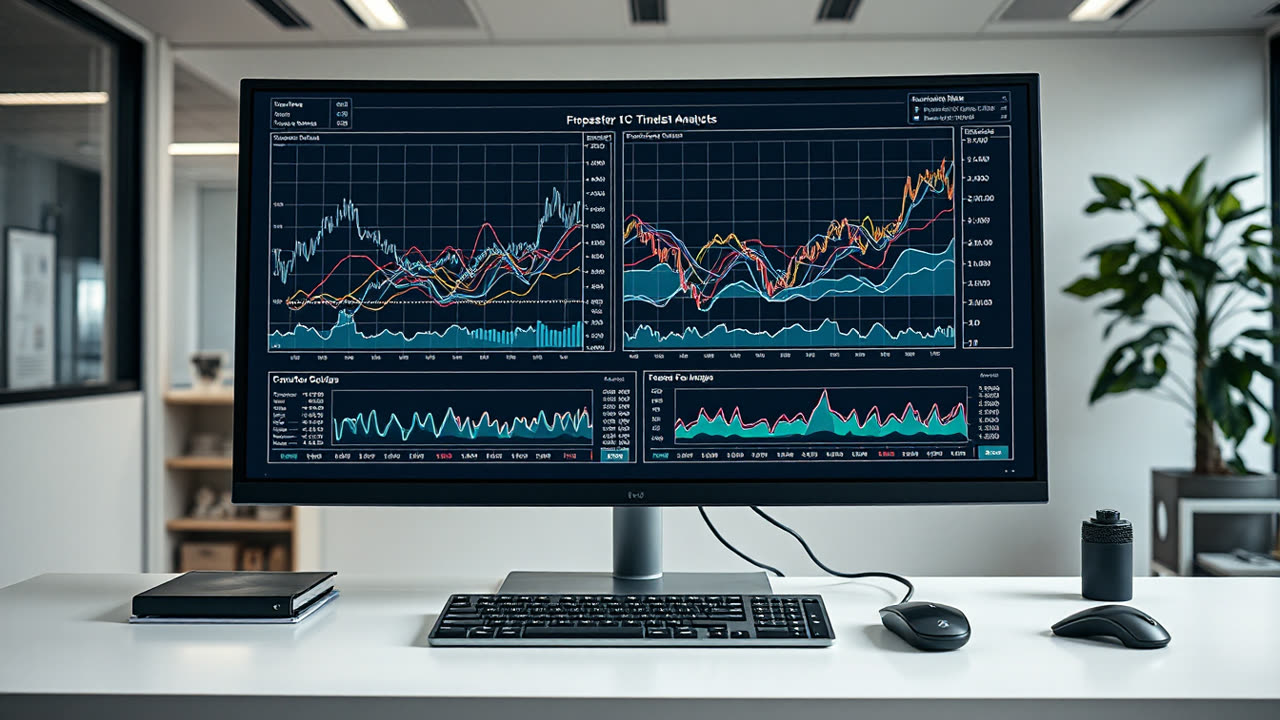
Google AI has unveiled TimesFM-3, a 330 million parameter zero-shot foundation model specifically engineered for multivariate time series forecasting, marking a significant leap by natively pretraining for this complex task, unlike its predecessors. This substantial model can forecast multiple related series in a single forward pass, streamlining an often computationally intensive and data-hungry process. The release signifies a maturation in the application of large language model (LLM) architectures to structured data challenges, pushing the boundaries of what's achievable in predictive analytics without extensive task-specific fine-tuning.
The immediate impact of TimesFM-3 lies in its "zero-shot" capability, eliminating the traditional barrier of requiring vast historical data and extensive model training for each new forecasting scenario. For industries reliant on accurate, real-time predictions—such as supply chain management, financial market analysis, energy grid optimization, and retail demand forecasting—this translates into unprecedented agility. Businesses can deploy sophisticated forecasting models almost instantly for new product lines, emerging market trends, or unforeseen operational shifts, drastically reducing time-to-insight and operational costs. For instance, a logistics company can now predict demand fluctuations across hundreds of interconnected routes and warehouses simultaneously without retraining, simply by feeding new data into the pretrained TimesFM-3. This democratizes high-fidelity forecasting, making it accessible to organizations lacking specialized AI teams or extensive historical datasets. Furthermore, the model's ability to handle multivariate series inherently captures the complex interdependencies often present in real-world systems, offering more holistic and accurate predictions than models that treat each series in isolation.
TimesFM-3 represents a crucial evolution from earlier iterations, particularly TimesFM-2.5 and prior checkpoints, which were not natively pretrained for multivariate analysis. While earlier versions demonstrated strong performance in univariate settings and offered some transfer learning capabilities, TimesFM-3's ground-up multivariate pretraining fundamentally alters its understanding of temporal relationships across multiple data streams. This design choice allows it to inherently learn and leverage the correlations between different variables from the outset, leading to superior performance in scenarios where factors like sales, promotions, weather, and economic indicators all influence each other. In comparison to traditional statistical models like ARIMA or even more recent deep learning architectures that require extensive feature engineering and domain-specific training, TimesFM-3’s foundation model approach offers a paradigm shift. Its scale and pretraining allow it to learn intricate patterns and long-range dependencies that smaller, specialized models often miss, positioning it as a powerful rival to existing state-of-the-art methods. The move towards foundation models in time series mirrors the success seen in natural language processing and computer vision, suggesting a broader trend towards highly capable, generalized models that can be adapted to a multitude of tasks with minimal effort.
Looking ahead, TimesFM-3's release is likely to accelerate the adoption of AI-driven forecasting across industries, lowering the barrier to entry for advanced predictive capabilities. We can anticipate a proliferation of specialized applications built atop this foundation model, where developers focus on data integration and user experience rather than core model architecture. Future iterations might explore even larger parameter counts, multimodal inputs (integrating text descriptions or image data alongside time series), and enhanced explainability features to build trust and facilitate human oversight. The competition in this space is also set to intensify, with other major tech players and research institutions undoubtedly working on their own time series foundation models. Google's early lead with TimesFM-3, particularly its native multivariate and zero-shot capabilities, positions it strongly in the burgeoning market for generalized AI predictive tools, setting a new benchmark for efficiency and accuracy in the critical domain of forecasting. This development not only streamlines current analytical workflows but also opens doors to entirely new predictive applications that were previously impractical due to data or computational constraints.