Google DeepMind's Gemini Achieves Agentic Video Understanding
Google DeepMind has integrated "agentic video understanding" into its Gemini model, enabling the AI to reason, plan, and execute multi-step tasks based on complex video content, moving beyond passive observation to active problem-solving.
✨ This content was summarized and interpreted by AI; it may contain errors — please verify accuracy with the original sources. Learn more
Listen to this story
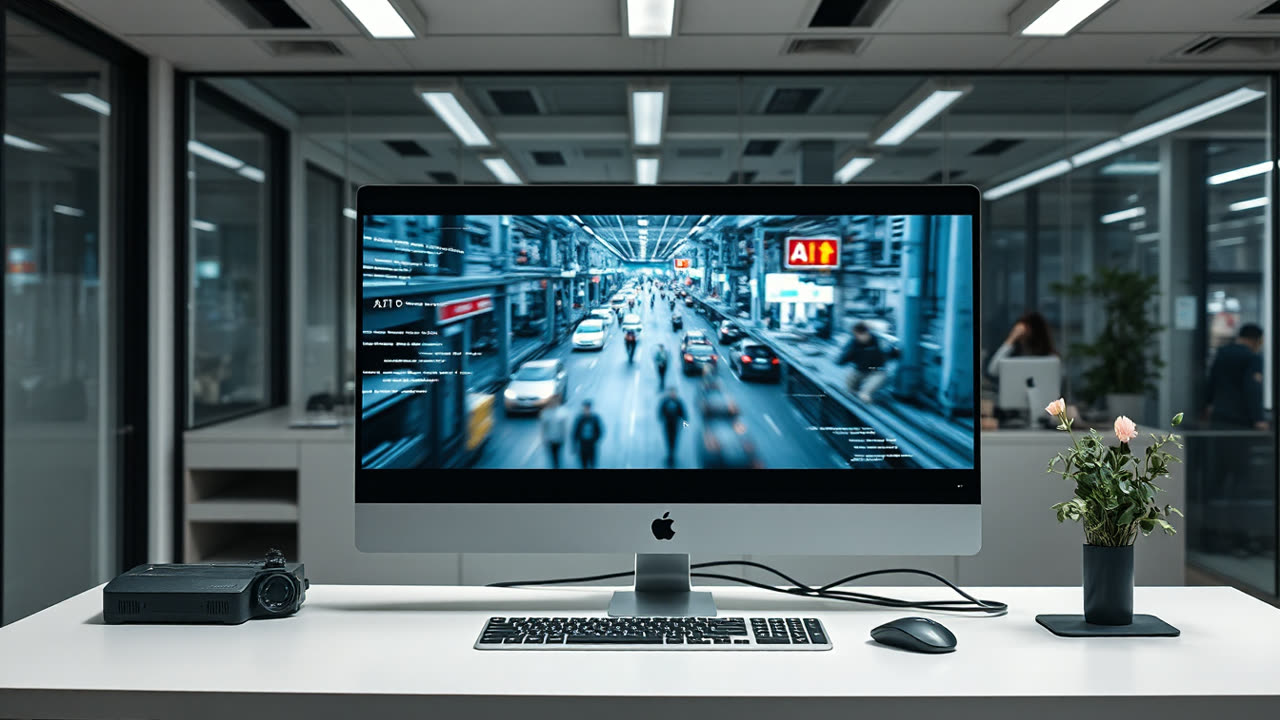
Google DeepMind's integration of "agentic video understanding" into its Gemini model marks a significant leap beyond passive video analysis, transforming how AI interprets and interacts with dynamic visual information. This advancement empowers Gemini to not only observe but also reason, plan, and execute multi-step tasks based on complex video content, moving from mere recognition to genuine comprehension and active problem-solving within video environments. Unlike prior generations of video AI that primarily focused on identifying objects or actions in isolation, agentic video understanding allows Gemini to build a coherent, temporal understanding of events, infer intent, and predict outcomes, akin to human-level situational awareness. This capability is rooted in Gemini's multimodal architecture, which fuses visual data with linguistic context, enabling a richer, more nuanced interpretation of video narratives. The core innovation lies in the "agentic" aspect, where the AI is not just a viewer but an intelligent agent capable of formulating goals and devising strategies to achieve them by processing and reacting to visual stimuli.
This paradigm shift fundamentally alters the utility of AI in video-rich domains, offering profound implications for both users and industry. For individual users, agentic video understanding could revolutionize personal productivity and accessibility. Imagine an AI assistant capable of sifting through hours of home video footage to compile a highlight reel based on a complex request like "find all clips where my child is interacting happily with the new puppy and summarize the key moments," rather than just "find clips with a dog." In educational settings, it could enable personalized learning experiences by analyzing student engagement with video lectures, identifying points of confusion based on facial expressions or gaze patterns, and automatically generating targeted explanations or practice questions. Furthermore, for content creators, this technology could automate tedious editing tasks, suggest optimal cuts, or even generate new content by understanding the narrative flow and emotional arc of existing footage, dramatically reducing production times and costs.
Industrially, the impact is even more transformative. In security and surveillance, agentic systems could move beyond simple anomaly detection to predict potential threats by understanding sequences of suspicious behaviors and identifying deviations from normal patterns across multiple camera feeds in real-time. This proactive capability could significantly enhance public safety and operational efficiency in large-scale environments. For robotics and automation, particularly in complex manufacturing or logistics, agentic video understanding allows robots to learn intricate tasks by observing human demonstrations, adapting to new scenarios, and even anticipating potential errors before they occur. This capability bridges the gap between observation and intelligent action, accelerating the deployment of autonomous systems in dynamic, unstructured environments. In healthcare, surgical training could be augmented by AI agents that analyze live surgical footage, providing real-time feedback on technique, identifying critical steps, and even warning of potential complications based on observed patterns. The entertainment sector could leverage this for advanced content moderation, ensuring compliance with evolving standards by understanding context and intent within video, not just explicit imagery.
Compared to previous generations, which relied heavily on supervised learning for specific tasks like object detection (e.g., identifying a car) or action recognition (e.g., a person walking), Gemini's agentic approach represents a qualitative leap. Older models often struggled with generalization and lacked the ability to reason across multiple frames or infer unstated intentions. Competitors' multimodal models, while powerful, often still operate more as advanced classifiers or summarizers rather than active agents capable of planning and executing tasks based on a deep understanding of video. Gemini's strength lies in its ability to combine diverse data types – visual, auditory, and textual – to form a holistic understanding, a core advantage of its large multimodal model architecture. This allows it to move beyond merely describing what is seen to understanding *why* something is happening and *what might happen next*, a crucial step towards truly intelligent video processing.
Looking ahead, the trajectory of agentic video understanding points towards increasingly sophisticated AI agents that can operate with greater autonomy and solve more abstract problems. The immediate next steps will likely involve refining these models to handle longer, more complex video sequences with higher fidelity, reducing computational overhead, and improving real-time inference capabilities. Ethical considerations, particularly around privacy, bias in data interpretation, and the potential for misuse in surveillance, will become paramount and necessitate robust regulatory frameworks and transparent model development. Further research will focus on integrating more common-sense reasoning and world knowledge into these models, allowing them to make more human-like judgments and handle ambiguous situations with greater accuracy. Ultimately, agentic video understanding with Gemini is not merely an incremental improvement; it lays the foundation for a future where AI can truly see, understand, and interact with the visual world in ways that were once confined to science fiction, promising a new era of intelligent automation and human-computer interaction.