Google DeepMind's WeatherNext 3 Delivers Unprecedented 5 km Global Weather Forecasts
Google DeepMind’s WeatherNext 3 now delivers unprecedented 5 km global weather forecasts, refreshing hourly by ingesting live geostationary satellite mosaics and training extensively on a vast dataset of weather station observations, fundamentally redefining accessibility and precision for both individual users and critical industries.
✨ This content was summarized and interpreted by AI; it may contain errors — please verify accuracy with the original sources. Learn more
Listen to this story
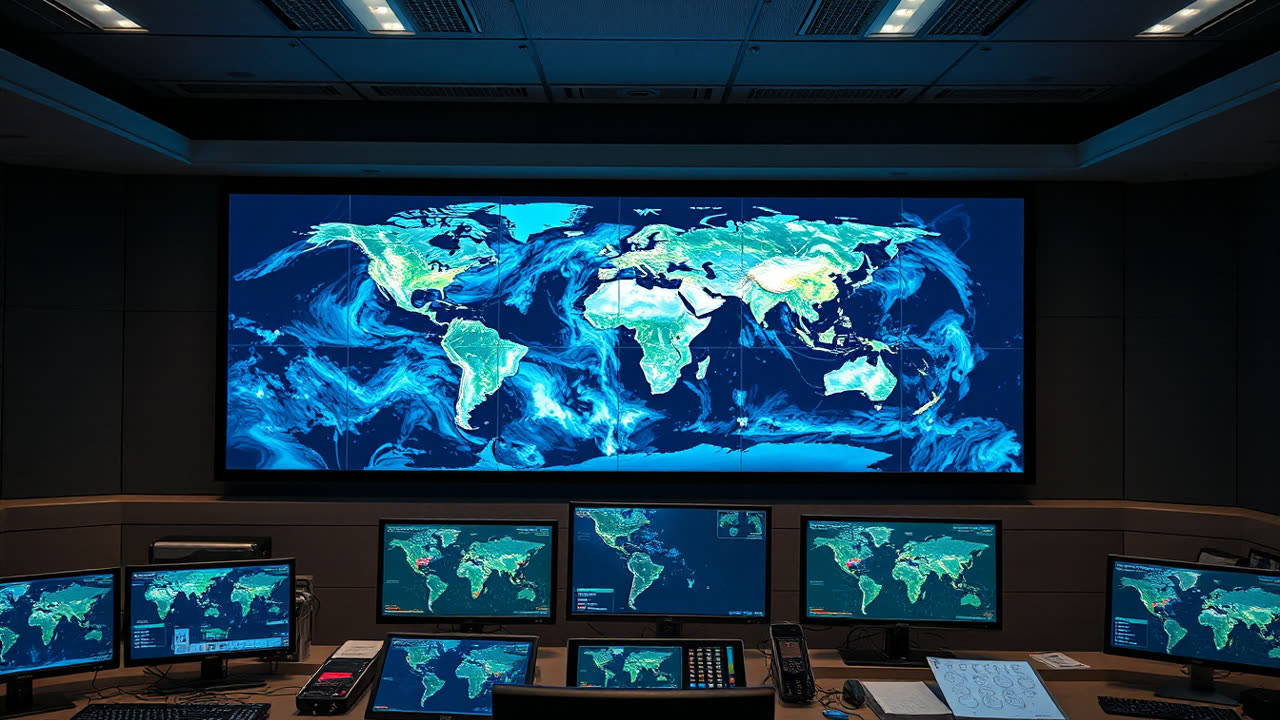
Google DeepMind’s WeatherNext 3 now delivers unprecedented 5 km global weather forecasts, refreshing hourly by ingesting live geostationary satellite mosaics and training extensively on a vast dataset of weather station observations, a significant leap forward in predictive atmospheric modeling. This granular, real-time forecasting capability, integrated across Google Search, Gemini, and Maps, fundamentally redefines accessibility and precision for both individual users and critical industries. The model's ability to provide such high-resolution data globally and update it every 60 minutes represents a substantial improvement over previous generations of AI-driven weather prediction and traditional numerical weather prediction (NWP) models, which often operate on coarser grids and longer refresh cycles for global coverage.
This advancement matters profoundly because it directly translates into more accurate and timely warnings for severe weather events, vastly improving public safety and disaster preparedness. For instance, a 5 km resolution can pinpoint localized phenomena like thunderstorms, heavy rainfall, or even microbursts with far greater accuracy than 25 km or 50 km models, allowing for targeted alerts and evacuation orders. Beyond personal safety, the economic implications are immense. Industries heavily reliant on precise weather data, such as agriculture, can optimize planting and harvesting schedules, minimize crop loss due to unexpected weather, and manage irrigation more efficiently. The aviation sector stands to benefit from more precise wind shear and turbulence predictions, enhancing flight safety and fuel efficiency. Logistics and transportation companies can optimize routes to avoid adverse conditions, reducing delays and operational costs. The energy sector, particularly renewable energy providers, can better forecast solar irradiance and wind speeds, improving grid management and energy distribution.
Prior to WeatherNext 3, Google DeepMind had already made strides with models like GraphCast, which demonstrated superior accuracy in medium-range forecasting compared to traditional methods like the European Centre for Medium-Range Weather Forecasts (ECMWF) HRES model for certain variables, albeit at a coarser resolution of 0.25 degrees (approximately 28 km) and a less frequent refresh. WeatherNext 3’s 5 km resolution and hourly refresh rate significantly surpass these benchmarks, bringing it into a class of its own for global, real-time granularity. Traditional NWP models, while highly sophisticated, are computationally intensive, often requiring supercomputers to run simulations that can take hours to produce forecasts. The ECMWF's flagship model, for example, operates at around a 9 km resolution globally and typically updates every 6 or 12 hours. Similarly, the U.S. Global Forecast System (GFS) from NOAA offers a global resolution of roughly 13 km with 6-hourly updates. WeatherNext 3, by leveraging deep learning and training on vast observational data, bypasses some of these computational bottlenecks, enabling its rapid update cycle and fine resolution. Its ingestion of live geostationary satellite mosaics provides a continuous stream of current atmospheric conditions, crucial for initializing and correcting the model in near real-time, an edge over models that rely on less frequent data assimilation cycles.
The architecture of WeatherNext 3, building upon machine learning techniques, allows it to learn complex atmospheric dynamics and relationships from historical and live data without explicitly programming every physical equation. This data-driven approach is particularly adept at identifying patterns and making predictions even in data-sparse regions or for rapidly evolving phenomena. The integration into Google's ecosystem — Search, Gemini, and Maps — is pivotal, transforming a powerful scientific tool into an omnipresent utility. Users will no longer need to seek out specialized weather apps for high-fidelity forecasts; this information will be contextually available within their daily digital interactions, from planning a trip on Maps to asking Gemini about local conditions.
Looking ahead, the trajectory of AI in weather forecasting suggests even more refined predictions. We can anticipate WeatherNext 3 to further integrate with ground-based radar networks, IoT sensors, and potentially even drone data to achieve hyper-local forecasting down to street-level resolution in urban areas. The continued advancement in AI model efficiency and computational power will likely lead to even faster refresh rates, approaching near-instantaneous updates. Furthermore, the model could evolve to provide not just deterministic forecasts but also probabilistic predictions with quantified uncertainties, offering a more complete picture of potential weather outcomes. This level of predictive capability will be invaluable for climate change adaptation strategies, enabling better long-term planning for resource management and infrastructure development. The success of WeatherNext 3 also sets a precedent for AI's role in other complex scientific domains, demonstrating the potential for machine learning to accelerate discovery and application in fields like climate modeling, material science, and personalized medicine, signaling a broader shift towards AI-powered scientific exploration and operationalization.