Google Launches 'Googlebooks' to Challenge Apple with Unified Android-ChromeOS Laptops
Google's new 'Googlebooks' introduce five premium laptops blending Android and ChromeOS with deep Gemini AI, aiming to create a Mac-like ecosystem and directly challenge Apple's dominance.
✨ This content was summarized and interpreted by AI; it may contain errors — please verify accuracy with the original sources. Learn more
Listen to this story
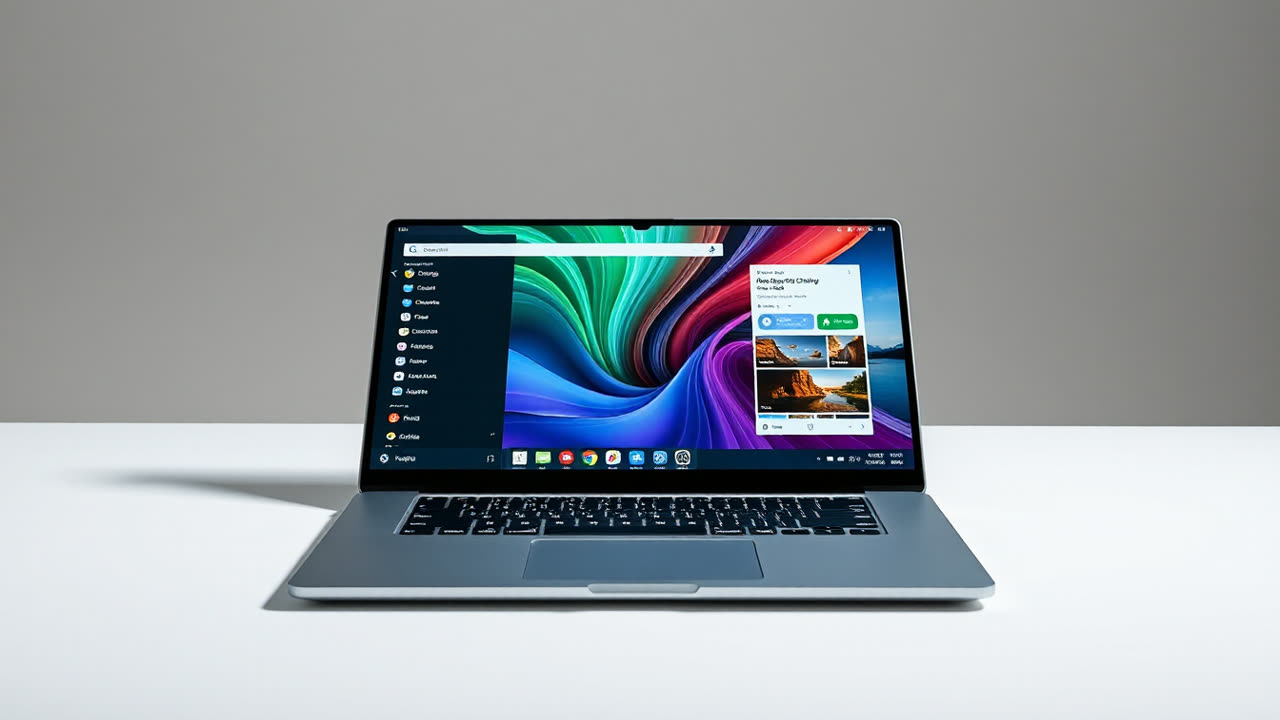
Google's ambitious foray into the premium laptop space, dubbed 'Googlebooks,' introduces five distinct models, each integrating a novel Googlebook OS that seamlessly blends Android and ChromeOS to deliver a Mac-like ecosystem experience for its vast Android user base, all at a decidedly premium price point. These new machines, ranging from ultraportable 13-inch clamshells to versatile 16-inch 2-in-1 convertibles, are positioned to directly challenge Apple's long-standing dominance in the integrated hardware-software experience, emphasizing deep Gemini AI integration across all functionalities. The Googlebook OS aims to unify the familiarity of Android applications with the robust desktop environment of ChromeOS, promising unparalleled continuity and productivity for users deeply embedded in Google's mobile ecosystem.
This strategic pivot by Google holds significant implications for both the consumer laptop market and the broader tech industry. For Android users, the Googlebook represents a potential liberation from platform fragmentation, offering a cohesive computing experience that mirrors the tightly integrated Apple ecosystem. Currently, Android users often navigate a disparate landscape of Windows PCs, traditional Chromebooks, or even Macs, none of which offer the seamless app handoff, unified notifications, or deep service integration that Apple users enjoy between their iPhones and Macs. The Googlebook OS, with its promise of running full Android applications natively alongside ChromeOS desktop apps, could unlock new levels of productivity and creative potential, allowing users to move fluidly between mobile and desktop workflows without friction. This could significantly enhance user loyalty within the Android sphere, providing a compelling reason for power users to remain within Google's hardware and software orbit.
For the industry, Googlebooks could ignite a new wave of competition in the premium laptop segment, a space largely dominated by Apple and high-end Windows manufacturers. The global high-end laptop market was valued at $112.4 billion in 2025 and is projected to expand to $201.8 billion by 2034, registering a compound annual growth rate (CAGR) of 6.7% during the forecast period from 2026 to 2034, driven by accelerating demand for premium computing hardware across various segments. By targeting the "Mac-like experience," Google is not just selling hardware; it's selling an ecosystem, much like Apple, which has led the competitive landscape with strong premium brand positioning. This move could push traditional PC makers to reconsider their own strategies, potentially inspiring further convergence efforts between Windows and Android or even a renewed focus on unique software experiences. The emphasis on Gemini AI integration is particularly noteworthy, positioning the Googlebook as an intelligent companion capable of proactive assistance, enhanced search, and sophisticated content creation—features that could become a new battleground for differentiation beyond raw specifications. Recent market trends indicate a growing consumer appetite for premium devices offering advanced AI capabilities and seamless cross-device functionality. In 2025, AI PC shipments represented approximately 42% of all premium laptop units shipped, up from 11% in 2023, with AI-enabled processors appearing in 56% of premium models in 2023.
Historically, Google's presence in the laptop market has been characterized by ChromeOS, a lightweight, cloud-centric operating system that has found considerable success in education and budget-friendly segments. However, ChromeOS has struggled to gain significant traction in the premium or professional markets, often perceived as less capable than Windows or macOS for demanding tasks. The "Googlebook OS" represents a significant evolution, attempting to bridge this gap by bringing the vast Android app library and its developer ecosystem into a more powerful desktop environment. Google officially announced its plans to merge ChromeOS and Android into a unified platform by 2026, internally known as "Aluminium OS." This strategic move aims to accelerate AI advancements and foster seamless integration between laptops and the Android ecosystem, leveraging the full Android AI stack, including Gemini AI. This contrasts sharply with prior attempts, which often relied on web-based Android apps or less optimized solutions. Apple, on the other hand, has perfected the art of ecosystem lock-in, where the synergy between macOS and iOS devices creates a sticky user experience that is difficult to replicate. Features like Handoff and Continuity enable users to transition activities smoothly from one Apple device to another. Google's challenge with Googlebooks is to build a similarly compelling narrative and experience for its own diverse user base, leveraging the sheer scale of Android's global adoption.
Looking ahead, the success of Googlebooks will hinge on several critical factors. Developer adoption of the new unified platform will be paramount; while Android apps will run natively, optimization for larger screens and desktop interaction will be crucial for a truly "Mac-like" experience. Google will need to ensure that professional-grade applications are readily available and performant, moving beyond the traditional perception of Android as a mobile-first platform. Furthermore, the "premium pricing" strategy necessitates impeccable build quality, robust performance, and exceptional customer support to justify the cost in a highly competitive market. The integration of Gemini across a wide set of devices and form factors is key to delivering a consistent AI-powered experience. Court documents suggest that ChromeOS will be phased out by 2034, with a full release of "Aluminium OS" (the Android desktop UI) expected by 2028, indicating a long-term commitment to this unified platform. Should Google successfully execute on these fronts, Googlebooks could establish a formidable third pillar in the premium laptop space, offering a genuine alternative to Apple and high-end Windows machines. Failure, however, could see it relegated to another niche, underscoring the immense difficulty of building a cohesive, premium ecosystem from the ground up, even for a tech giant like Google. The integration of Gemini, however, suggests a long-term vision where AI becomes the central unifying force, potentially allowing Googlebooks to evolve into an even more intelligent and adaptive computing platform in subsequent generations.