Google Launches 'Teensy-Tiny' AI Data Center to Orbit for Space Resilience Test
Google is sending a miniature AI data center, powered by its Tensor Processing Units, into orbit to test its resilience against cosmic radiation and extreme space conditions, aiming to revolutionize on-board satellite data processing.
✨ This content was summarized and interpreted by AI; it may contain errors — please verify accuracy with the original sources. Learn more
Listen to this story
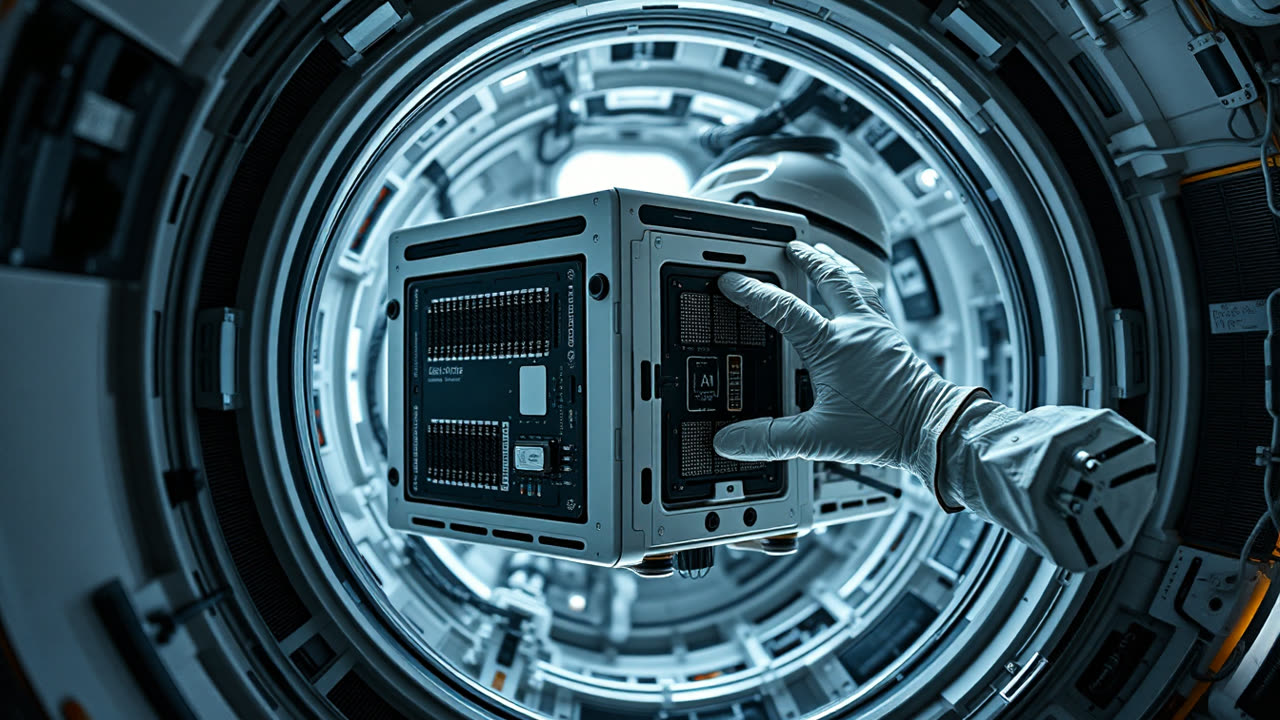
Google is launching a miniature AI data center, specifically a "teensy-tiny" package of its Tensor Processing Units (TPUs), into orbit, marking a pivotal step towards autonomous, on-board data processing in the harsh environment of space. This experimental deployment, which Google is undertaking in partnership with space logistics firm Nanoracks, aims to rigorously test the resilience and performance of commercial off-the-shelf (COTS) AI acceleration hardware, particularly its TPU chips, against the formidable challenges of cosmic radiation, extreme temperature fluctuations, and vacuum conditions. The primary objective is to evaluate how these chips, designed for terrestrial data centers, withstand the constant bombardment of charged particles and the absence of atmospheric protection, which can induce bit flips, data corruption, and catastrophic hardware failures.
This audacious experiment carries profound implications for both space exploration and Earth-bound applications, fundamentally altering the paradigm of data management and decision-making in orbit. Currently, most raw data collected by satellites, from high-resolution imagery to scientific measurements, must be downlinked to ground stations for processing, a bandwidth-intensive and time-consuming process. By enabling sophisticated AI processing directly on board, Google's initiative promises to revolutionize this workflow. Imagine satellites that can autonomously identify critical events, such as wildfires, illegal fishing, or disaster zones, and transmit only actionable intelligence rather than terabytes of unprocessed imagery. This edge computing capability dramatically reduces latency, conserves precious bandwidth, and enables near real-time responses to dynamic situations on Earth, impacting everything from environmental monitoring and agricultural optimization to defense and humanitarian aid. For users, this translates into faster, more relevant insights from space-based assets, potentially unlocking new services and applications previously constrained by data bottlenecks.
The industry impact is equally transformative. This move by Google signals a shift from traditional, purpose-built, radiation-hardened processors—which are typically expensive, less powerful, and several generations behind commercial silicon—towards leveraging mass-produced, high-performance AI accelerators in space. If successful, it could democratize access to advanced space computing, lowering the cost and increasing the capabilities of satellite constellations. Companies like Amazon Web Services (AWS) with its AWS Ground Station and Microsoft Azure Space are already investing heavily in cloud-to-space integration, focusing on ground-based processing of satellite data and developing cloud services tailored for space workloads. However, Google's direct hardware deployment pushes the frontier further by bringing the processing power *to* the data source, directly challenging the traditional architecture where data always flows to the ground. This on-board processing capability is critical for future deep-space missions where communication delays make real-time interaction impossible, demanding autonomous decision-making from spacecraft.
Historically, space-grade electronics have prioritized reliability over raw computational power, relying on older, larger lithography processes and redundant systems to guard against radiation damage. Google's approach, by sending advanced COTS TPUs, represents a calculated risk and a potential leap forward. These chips are optimized for parallel processing tasks essential for machine learning algorithms, offering orders of magnitude more computational throughput than conventional radiation-hardened processors. The challenge lies in mitigating the effects of single-event upsets (bit flips) and total ionizing dose (cumulative radiation damage) on these sensitive components, likely through a combination of software-level error correction, redundant processing units, and potentially novel shielding techniques within the miniature data center. The success of this experiment could pave the way for a new generation of "smart satellites" that are not just data collectors but intelligent, autonomous agents capable of complex analysis and adaptive behavior.
Looking ahead, a successful demonstration of Google's orbiting AI data center could trigger a rapid acceleration in the development of space-based edge computing infrastructure. We could foresee constellations of satellites equipped with powerful AI processors forming a distributed neural network in orbit, capable of collaborative data analysis and real-time inference on a global scale. This would not only enhance Earth observation and communication but also lay the groundwork for more ambitious lunar and Martian missions, where local AI processing will be indispensable for autonomous rovers, habitats, and scientific instruments. The next steps will undoubtedly involve scaling up these capabilities, developing more robust radiation mitigation strategies for COTS hardware, and integrating these space-hardened AI platforms into operational satellite systems. The implications extend to global internet connectivity, advanced weather forecasting, and even new forms of space-based manufacturing or resource utilization, all powered by intelligent systems that can process and react to data at the speed of light, directly from the cosmic frontier.