Google Maps Entire Fruit Fly Brain, Engineers Run Doom Simulations
Google has achieved a monumental breakthrough by mapping the entire adult male fruit fly's brain and central nervous system, a 166,000-neuron connectome that engineers are already using to run simulations of classic video games like Doom, bridging biological neural networks with advanced AI.
✨ This content was summarized and interpreted by AI; it may contain errors — please verify accuracy with the original sources. Learn more
Listen to this story
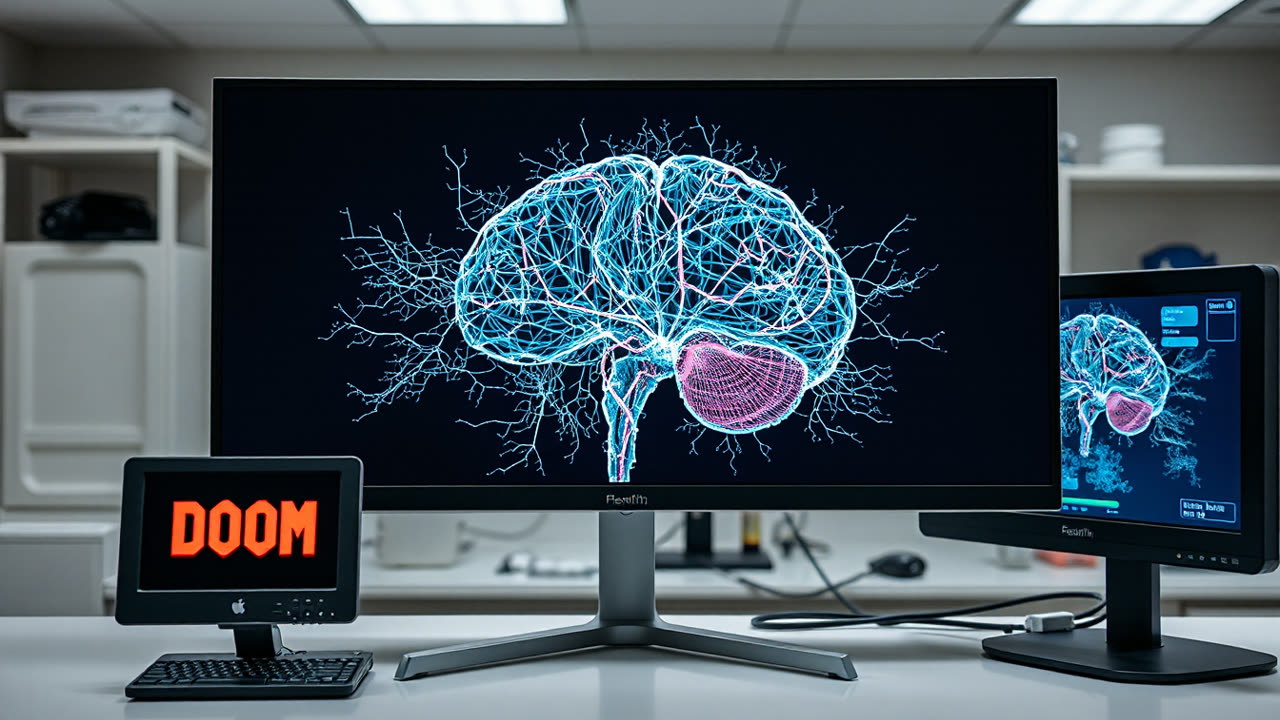
Google's audacious mapping of the entire adult male fruit fly's brain and central nervous system, encompassing over 166,000 neurons and hundreds of millions of synaptic connections, represents a monumental leap in connectomics, immediately evidenced by software engineers leveraging the resulting MaleCNS v1.0 connectome to run simulations of classic video games like Doom and Super Mario 64. This unprecedented level of detail, released publicly, provides a complete "wiring diagram" of a complex biological nervous system, offering a foundational blueprint for understanding how neural circuits generate behavior. The feat, achieved by a collaborative effort including Google, Janelia Research Campus, and the University of Cambridge, involved meticulously reconstructing the fly's brain from thousands of electron microscope images, a process that took years and immense computational resources.
The immediate application of this connectome to run game simulations, while seemingly whimsical, underscores a profound paradigm shift: the tangible bridge between biological neural networks and artificial intelligence. By feeding the detailed synaptic connections and neuronal pathways into AI models, researchers are not merely mimicking brain function but directly experimenting with a fully realized biological architecture. This move from abstract neural network designs to a biologically accurate, albeit simplified, model could accelerate the development of more efficient and robust AI systems. The fruit fly's brain, despite its relatively small size compared to mammals, exhibits sophisticated behaviors, including navigation, learning, and decision-making, making its connectome a rich source of inspiration for AI algorithms. Understanding how these 166,000 neurons coordinate to perform complex tasks could unlock principles for designing AI that requires less training data, operates with greater energy efficiency, and exhibits more generalized intelligence.
This achievement significantly advances the field beyond previous milestones, most notably the complete connectome of the nematode *Caenorhabditis elegans*, mapped in 1986, which comprises only 302 neurons. While the *C. elegans* connectome provided initial insights into neural circuitry, the fruit fly's nervous system is orders of magnitude more complex, featuring distinct brain regions, sophisticated sensory processing units, and a far richer behavioral repertoire. This leap in complexity means researchers can now investigate hierarchical processing, memory formation, and motor control in a biologically grounded model with unprecedented resolution. For the industry, this opens new avenues for neuromorphic computing, where hardware is designed to emulate brain structures directly. Companies like Intel (with Loihi) and IBM (with TrueNorth) have been exploring such architectures for years, but the MaleCNS v1.0 connectome provides a concrete, biologically validated blueprint to inform the next generation of these chips, potentially leading to AI that is both more powerful and significantly more energy-efficient than current GPU-centric approaches. Furthermore, the detailed map could aid in drug discovery by offering a precise model to study the effects of various compounds on neural circuits, or provide insights into neurological disorders by simulating damage or dysfunction within the fly's brain.
Looking ahead, the implications are vast and multi-faceted. The success with the fruit fly will inevitably spur efforts to map even larger and more complex brains, with the mouse brain connectome being a long-term, ambitious goal. Each new connectome will serve as a richer dataset for AI researchers, offering increasingly sophisticated blueprints for brain-inspired computing. We can anticipate the emergence of AI models that are not just *inspired* by the brain but are, in essence, functional emulations of specific biological brains, beginning with simpler organisms. This could lead to AI systems with emergent properties currently difficult to achieve with purely artificial designs, such as intrinsic curiosity, adaptive learning, and robust error correction. Beyond AI, the complete understanding of how a brain generates behavior at the synaptic level could revolutionize our understanding of consciousness, learning, and memory. The public release of such detailed connectomes will foster collaborative research globally, accelerating discoveries in both neuroscience and artificial intelligence. However, it also raises ethical considerations regarding the simulation of sentient-like behaviors and the potential for creating artificial intelligences that mimic biological life with increasing fidelity, prompting a deeper societal dialogue about the nature of intelligence itself.