Google Maps Transforms into AI-Powered Personal Assistant with Direct Ordering and Booking
Google Maps has significantly expanded its generative AI capabilities, allowing users to directly order food, book hotels, and receive highly personalized recommendations through the 'Ask Maps' tool, fundamentally redefining its utility.
✨ This content was summarized and interpreted by AI; it may contain errors — please verify accuracy with the original sources. Learn more
Listen to this story
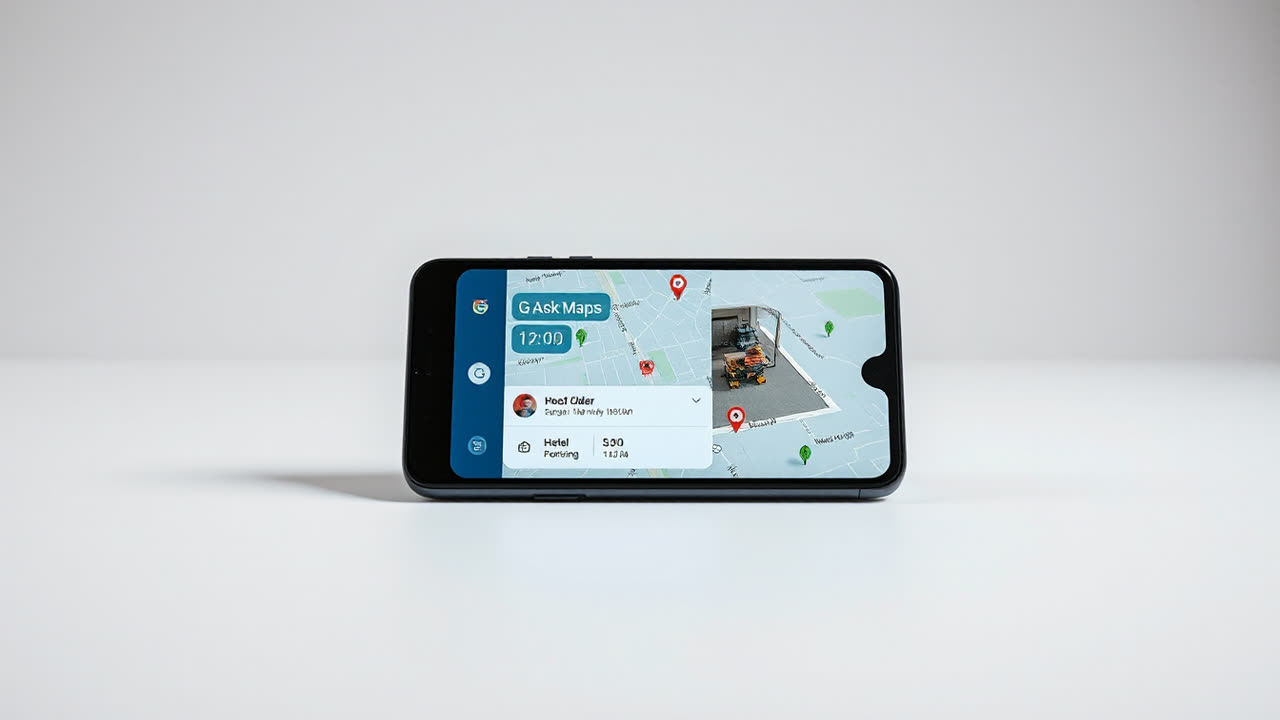
Google Maps has significantly expanded its generative AI capabilities, allowing users to directly order food, book hotels, and receive highly personalized recommendations that integrate with their existing itineraries through the "Ask Maps" tool. This evolution transforms the ubiquitous navigation platform from a directional guide into a proactive personal assistant, capable of handling complex, multi-step requests previously requiring users to juggle multiple applications. The update marks a pivotal shift, moving beyond simple search queries to a truly conversational interface that understands context and user intent, powered by Google's latest large language models.
This enhancement is not merely an incremental update; it fundamentally redefines the utility of a mapping application, pushing it deeper into the transactional layer of local commerce. For users, the immediate benefit is unparalleled convenience. Imagine landing in a new city, opening Google Maps, and asking, "Find me a highly-rated Italian restaurant near my hotel that delivers, and book me a table for 7 PM, also considering I have a flight at 9 AM tomorrow." The "Ask Maps" AI can now process such a nuanced request, cross-referencing restaurant availability, delivery options, user reviews, hotel location, and even factor in a user's flight schedule to suggest dining options that minimize travel time or offer quick service. This reduces decision fatigue and streamlines the planning process for activities, dining, and travel logistics, offering a cohesive experience previously fragmented across dedicated food delivery apps, hotel booking sites, and calendar tools. The integration extends to finding specific items within stores or suggesting activities based on weather forecasts and personal preferences, creating a truly bespoke user journey.
The implications for the industry are profound, particularly for local businesses and the broader ecosystem of third-party service providers. For restaurants and hotels, direct integration with Google Maps' AI offers a powerful new channel for customer acquisition and engagement. Businesses that optimize their Google Business Profile with accurate menus, real-time availability, and service details will likely see increased visibility and direct bookings or orders facilitated by the AI. This could potentially reduce reliance on commission-heavy third-party aggregators, allowing businesses to retain a larger share of revenue from direct transactions. However, it also raises questions about data privacy and the potential for Google to become an even more dominant gatekeeper for local commerce, influencing consumer choices based on its algorithms and partnerships. The update also presents a significant challenge to dedicated food delivery and hotel booking applications, which now face direct competition from a platform used by billions for navigation alone. Their value proposition will need to evolve beyond mere aggregation to offer unique features, loyalty programs, or niche services that Google Maps might not encompass.
Historically, Google Maps has steadily integrated more features beyond basic navigation, from transit information and street view to business listings and user reviews. Early iterations allowed users to search for nearby restaurants or hotels, but the actual transaction – ordering food or booking a room – required navigating to a separate app or website. The "Ask Maps" tool, powered by generative AI, represents the culmination of years of development in natural language processing and contextual understanding. While previous AI integrations in Maps might have offered personalized recommendations based on past behavior or popular trends, they lacked the conversational depth and transactional capability now available. Rivals like Apple Maps have also been enhancing their features with more detailed guides and look around functionality, but none have yet offered the same level of integrated, conversational, and transactional AI for local services. Similarly, dedicated travel apps often provide robust booking options but lack the real-time, on-the-go contextual awareness of a mapping application.
Looking ahead, this move positions Google Maps as a central hub for personal logistics and local commerce. We can anticipate further integrations with other Google services, such as Google Wallet for seamless payments and Google Calendar for even more sophisticated itinerary planning. The AI's ability to learn user preferences over time will only grow, leading to even more predictive and proactive suggestions. Imagine Maps not only ordering your coffee but also pre-ordering it based on your typical morning routine, or automatically rescheduling dinner reservations if it detects a traffic delay on your route. The potential for hyper-personalization is immense, blurring the lines between a digital assistant, a travel agent, and a local guide. Challenges will include refining the AI's accuracy and robustness, particularly in understanding complex, multi-layered requests across diverse languages and cultural contexts. Ensuring transparency in how recommendations are generated and offering users control over their data and privacy settings will also be critical for widespread adoption and trust. The future of navigation is clearly conversational and transactional, with Google Maps leading the charge in creating an all-encompassing digital concierge for the physical world.