Google Open-Sources WeatherNext: A 15-Day AI Hurricane Forecast Model
Google's new open-source AI model, WeatherNext, offers an unprecedented 15-day forecast for hurricane track and intensity, promising to revolutionize global disaster preparedness.
✨ This content was summarized and interpreted by AI; it may contain errors — please verify accuracy with the original sources. Learn more
Listen to this story
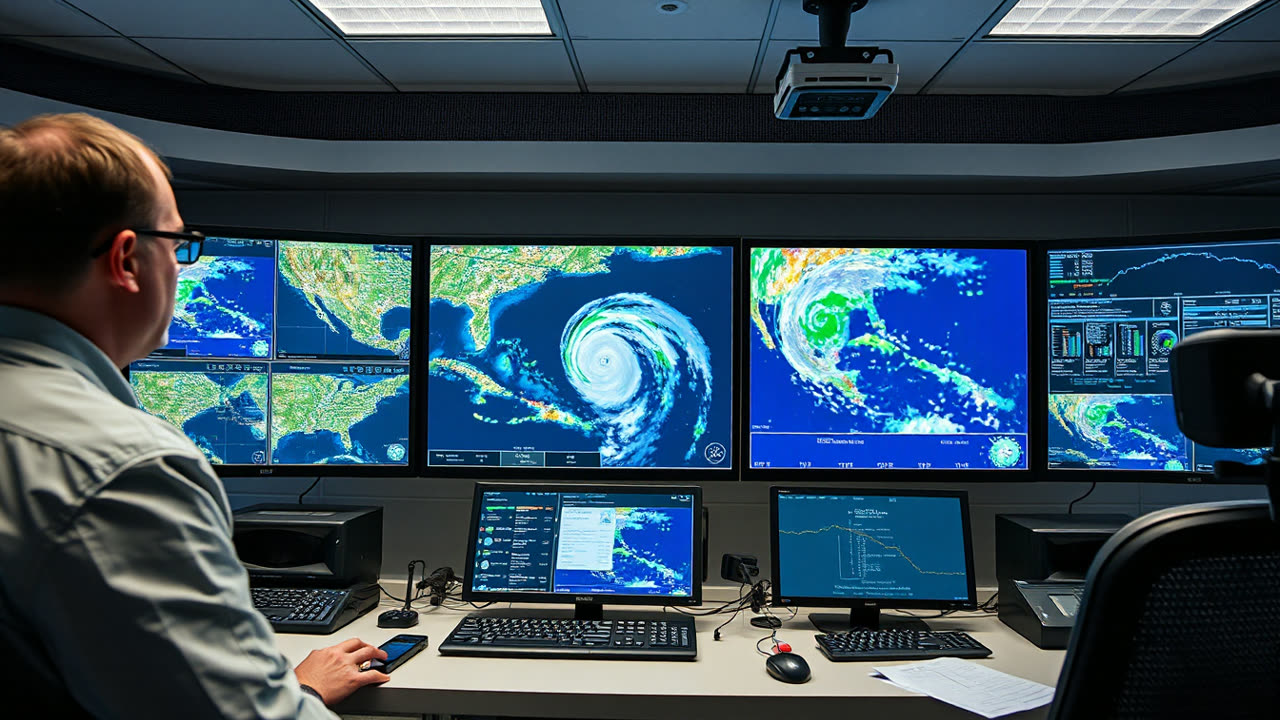
Google has open-sourced WeatherNext, an AI model poised to revolutionize hurricane warning systems by offering a remarkable 15-day forecast for storm track and intensity, a significant leap beyond conventional capabilities. This development, initially unveiled in early 2024, democratizes access to advanced predictive analytics, potentially enhancing global preparedness and mitigating the catastrophic impacts of tropical cyclones. The model's ability to project storm behavior with such an extended lead time directly addresses a critical challenge in meteorology: providing sufficient notice for large-scale evacuations, resource mobilization, and infrastructure protection, which often require days, not hours, of planning.
The significance of WeatherNext lies not just in its extended forecast horizon but also in its operational mechanics and the strategic decision to open-source it. Unlike traditional numerical weather prediction (NWP) models that rely on complex physics-based simulations requiring immense computational power, WeatherNext leverages deep learning, trained on decades of historical weather data. This approach allows it to quickly identify patterns and extrapolate future conditions, dramatically reducing the computational overhead and processing time associated with generating forecasts. For instance, while traditional models like the European Centre for Medium-Range Weather Forecasts (ECMWF) or the Global Forecast System (GFS) are highly accurate in the short to medium term, their computational demands often limit the frequency and resolution of their long-range outputs, particularly concerning high-impact events like hurricanes. WeatherNext, by contrast, can produce a 15-day forecast in mere seconds on standard hardware, making it accessible to a broader array of meteorological agencies and research institutions globally, including those in developing nations frequently hit by severe storms.
The decision to open-source WeatherNext injects a powerful collaborative dynamic into the notoriously complex field of weather forecasting. By making the model's code, architecture, and training methodologies publicly available, Google invites a global community of scientists, developers, and weather enthusiasts to scrutinize, improve, and adapt the technology. This open innovation model has historically accelerated progress in other scientific domains, fostering rapid iteration, bug fixing, and the development of specialized applications that would be impossible within a proprietary framework. For users, this means not only earlier warnings but potentially more refined and localized predictions as the model is fine-tuned with regional data and expertise. The industry stands to benefit from a faster pace of innovation, potentially leading to hybrid models that integrate the strengths of AI with traditional physics-based approaches, creating a new generation of even more robust forecasting tools. This move also positions Google as a key enabler in climate resilience efforts, extending its influence beyond core technology products into critical public safety infrastructure.
Comparing WeatherNext to existing AI-driven weather models, such as Huawei's Pangu-Weather or NVIDIA's FourCastNet, reveals a growing trend toward AI augmentation in meteorology, but with distinct advantages in terms of accessibility and specific application. Pangu-Weather, for example, has demonstrated impressive accuracy in medium-range forecasts, often outperforming traditional models in certain metrics, but it is not open-source, limiting its broader adoption and independent verification. FourCastNet, while also powerful and leveraging AI for rapid predictions, is primarily a research tool and not necessarily focused on the specific, high-stakes application of hurricane track and intensity over a 15-day window with the same public-facing, open-source commitment as WeatherNext. Google's explicit focus on hurricanes and the generous open-source licensing carve out a unique and impactful niche, emphasizing practical application and community-driven improvement for a critical natural disaster.
Looking ahead, the open-sourcing of WeatherNext marks a pivotal moment, signaling a future where AI-powered weather forecasting becomes a standard, rather than an experimental, component of global meteorological operations. The immediate next steps will likely involve a flurry of activity from academic institutions, national weather services, and private companies eager to integrate WeatherNext into their existing workflows or develop novel applications atop its framework. Challenges will undoubtedly emerge, including the need for robust validation against real-world storm events across diverse geographical regions, addressing potential biases in the training data, and ensuring interpretability of AI predictions for human forecasters. Furthermore, the ethical implications of such powerful predictive technology, particularly regarding warning dissemination and the prevention of alarm fatigue, will require careful consideration. Ultimately, the success of WeatherNext will be measured not just by its technical prowess, but by its ability to empower communities to better prepare for, and ultimately minimize the devastation wrought by, the planet's most formidable storms.