Google to Launch First Experimental AI Satellite, MVP, on October 1st
Google is poised to launch its first experimental AI satellite, MVP, into orbit on October 1st, marking a pivotal step in the company's ambitious Project Suncatcher initiative to establish solar-powered AI data centers in space.
✨ This content was summarized and interpreted by AI; it may contain errors — please verify accuracy with the original sources. Learn more
Listen to this story
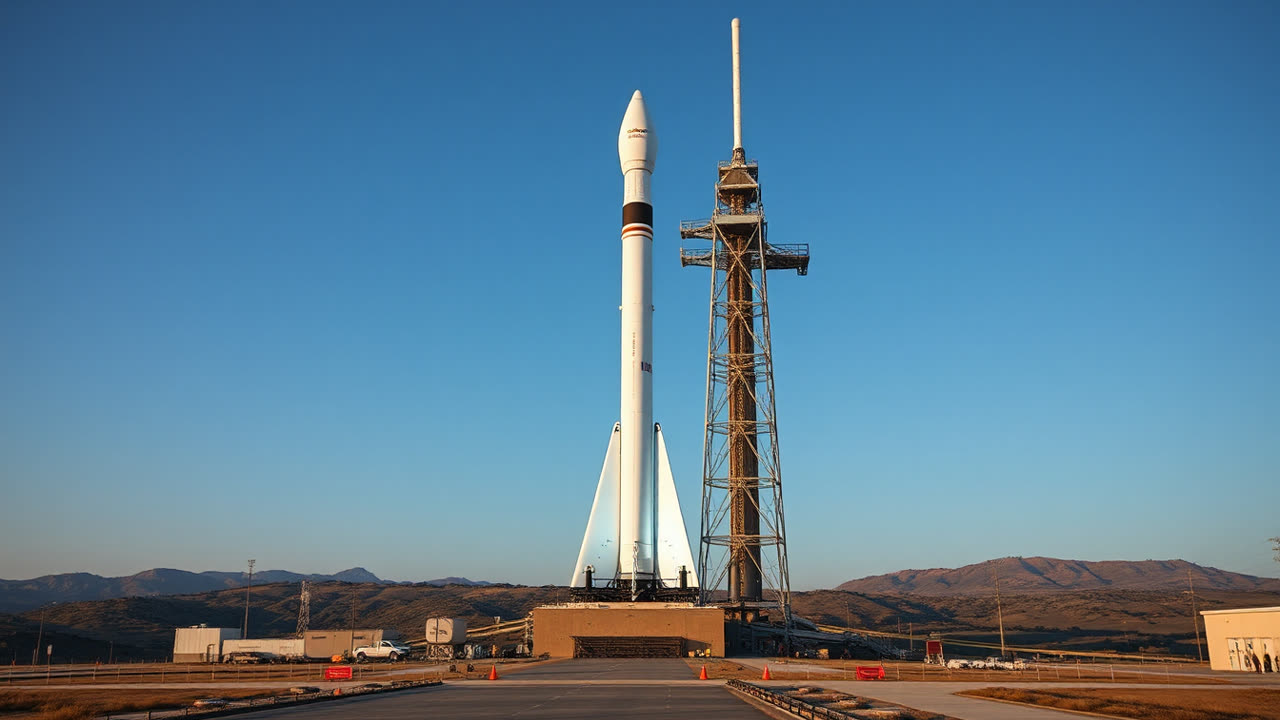
Google is poised to launch its first experimental AI satellite, named MVP, into orbit on October 1st, marking a pivotal step in the company's ambitious Project Suncatcher initiative to establish solar-powered AI data centers in space. This refrigerator-sized satellite, developed in collaboration with Planet Labs, will carry four of Google's Tensor Processing Units (TPUs) aboard a SpaceX Falcon 9 rocket from Vandenberg Space Force Base, aiming to test how these advanced AI processors perform in the harsh environment of low Earth orbit (LEO). While the MVP's immediate task is to answer simple AI queries using Google's Gemini and gather crucial engineering data on hardware resilience, its true significance lies in its potential to revolutionize data processing, energy consumption, and the very architecture of artificial intelligence infrastructure.
The implications of moving AI processing capabilities into space are profound, extending far beyond simply relocating servers. Primarily, it addresses the critical limitations of latency and bandwidth that plague current Earth-bound satellite data analysis. High-resolution Earth observation satellites generate terabytes of data daily, but ground stations often have limited contact windows—typically 5 to 15 minutes per orbital pass—and bandwidth constraints that prevent the full volume of raw data from being transmitted. By integrating AI directly onboard, satellites can process data at the source, transmitting only actionable insights rather than raw feeds, drastically reducing downlink requirements and enabling near real-time analysis for critical applications like disaster response, environmental monitoring, and defense. This shift from "data dumping" to "insight extraction" fundamentally changes how space-derived information is consumed and utilized, making it more immediate and valuable for a wider range of stakeholders, including those without deep technical expertise, through natural language querying capabilities.
Furthermore, Project Suncatcher confronts the escalating energy demands of large-scale AI operations. Space offers an unparalleled advantage: solar panels in LEO can collect up to eight times more solar power than their terrestrial counterparts, operating almost continuously without significant battery storage needs. The vacuum of space also presents a natural cooling environment, circumventing the massive water and energy consumption required for cooling terrestrial data centers. Google estimates that by the mid-2030s, the cost of establishing and operating orbital data centers could become comparable to ground-based alternatives, driven by projected reductions in launch costs to below $200 per kilogram. This long-term vision positions space as a sustainable frontier for AI infrastructure, mitigating the environmental footprint of an increasingly power-hungry technology.
Google's foray into space-based AI is not unprecedented, yet it marks a significant escalation in the race for orbital computing dominance. The company has a history of "moonshot thinking" and investments in space, including a 2015 investment in SpaceX. However, Project Suncatcher, initially announced in November 2025, represents a direct commitment to developing its own AI hardware for space. The technical hurdles are formidable: space is replete with radiation, extreme temperatures, and microgravity, all of which can degrade or disrupt electronic components. Traditional radiation-hardened processors often lag commercial counterparts by generations, but Google's laboratory tests indicate its Trillium TPUs possess surprising resilience to radiation, enduring doses exceeding a five-year mission. The MVP mission will specifically evaluate heat management designs, combining heat pipes with radiators to cool the power-intensive chips in a vacuum.
The competitive landscape for space-based AI is rapidly evolving. NVIDIA offers dedicated chip platforms like Jetson Orin and the Space-1 Vera Rubin module for orbital computing, already utilized by companies such as Planet Labs. Chinese enterprises are also making aggressive moves, with China having launched nine satellites, including an integrated AI computing project, on September 20, 2026, focused on onboard processing for Earth observation. Starcloud successfully trained the first AI model in space in December 2025 and aims for a gigawatt of space AI compute annually by 2027. Other players like Palantir and Satellogic launched an Edge AI-enabled satellite as early as April 2022, while Axiom Space deployed orbital data center nodes in Q1 2026. Even Elon Musk's SpaceX is pursuing its "Starmind" orbital AI constellation, with the FCC accepting an initial phase for 100,000 such satellites. This burgeoning ecosystem underscores a broad industry consensus on the strategic value of processing data at the edge—400 kilometers up.
Looking ahead, Google's current mission is merely the genesis of a much larger strategy. The company plans to launch two additional satellites in 2027, alongside a two-satellite test of laser-based inter-satellite communication, aiming for eventual fleets of over 80 spacecraft. These laser links are crucial for creating distributed machine learning clusters in orbit, enabling the high-bandwidth, low-latency connections necessary for data center-scale operations. The long-term vision entails constellations of interconnected, solar-powered satellites forming orbital data centers, capable of housing large-scale AI computing infrastructure. This will foster a shift towards increasingly autonomous satellite operations, where AI models can predict failures, optimize resources, and automate corrective actions without constant human intervention, transforming reactive operations into predictive ones. However, this future also brings complex challenges related to cybersecurity, data privacy, and governance, demanding robust international frameworks to ensure responsible development and prevent single entities from controlling vital space-based intelligence infrastructure. The launch of MVP is not just a technological demonstration; it is the first tangible step towards a future where the cloud truly extends beyond Earth's atmosphere, redefining the boundaries of AI computing.