Google Unveils WeatherNext 3: AI Model Delivers Hourly, High-Resolution Forecasts with Live Satellite Data
Google's WeatherNext 3, an AI-powered weather model, integrates live satellite data to deliver hourly, five-times sharper global forecasts, significantly improving precipitation predictions and impacting industries from energy to agriculture.
✨ This content was summarized and interpreted by AI; it may contain errors — please verify accuracy with the original sources. Learn more
Listen to this story
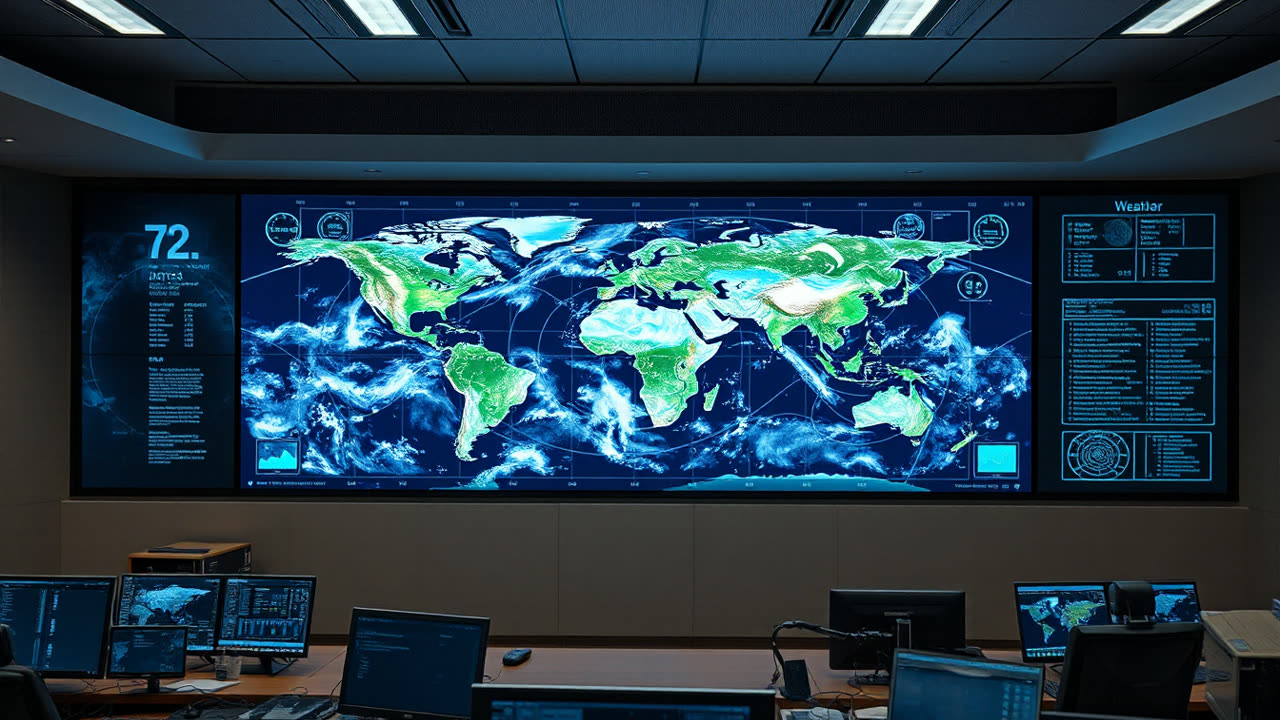
Google has unveiled WeatherNext 3, its latest AI-powered weather model, marking a significant leap forward in global weather forecasting by integrating live satellite data for higher-resolution, more accurate, and more frequent predictions. Released on September 3, 2026, by Google DeepMind and Google Research, WeatherNext 3 moves beyond traditional numerical weather prediction (NWP) models that rely solely on physics simulations, which often carry a six-hour data lag, by directly ingesting a continuous mosaic of global geostationary satellite data. This allows the model to generate a new forecast every hour, providing a continuously updating view of the atmosphere.
WeatherNext 3 delivers forecasts with unprecedented detail, offering a global weather picture roughly five times sharper than its predecessor, WeatherNext 2, which operated on a 25-kilometer grid with six-hour increments. The new model can visualize key surface variables like temperature and moisture at a 5-kilometer resolution, other surface variables at 10 kilometers, and atmospheric variables such as wind speed at 25 kilometers. This enhanced resolution is particularly crucial for regions with complex topography, like coastlines and mountain ranges, where weather conditions can fluctuate dramatically over short distances.
The model's ability to predict precipitation has seen a breakthrough, with evaluations showing a Continuous Ranked Probability Score (CRPS) improvement of up to 60% against NASA's IMERG satellite data and 10% against rain gauge measurements for early lead times in medium-range global forecasts. For longer-term forecasts (a day or more ahead), users can expect up to 50% more accurate precipitation predictions, especially in areas historically underserved by reliable forecasting. This improvement stems from WeatherNext 3's training on multiple high-quality precipitation data sources, including NASA's IMERG, Google's own satellite-radar reanalysis, and ECMWF reanalysis.
**Why It Matters: Impact on Users and Industry**
The implications of WeatherNext 3 are profound, extending far beyond simply improving daily forecasts for general users. Its integration into Google Search, Gemini, Maps, Google Maps Platform Weather API, and Google Earth Engine means billions of people will have access to significantly more precise and timely weather information directly through the tools they already use. This accessibility democratizes high-fidelity forecasting, particularly benefiting regions in Latin America, Africa, and Asia-Pacific, which have historically lacked high-resolution data due to the immense computational costs of traditional regional models.
For industries, WeatherNext 3 represents a significant analytical advantage. The model includes predictions specifically engineered for renewable energy production, offering 100-meter wind speeds (crucial for turbine-height forecasting), full cloud layer distributions, and complete solar irradiance components. This granular data empowers energy companies to optimize grid management, plan renewable energy installations, and balance load more effectively, addressing the inherent variability of solar and wind generation.
Beyond energy, the enhanced accuracy and resolution provide critical insights for agriculture, enabling farmers to make more informed planting and harvesting decisions based on precise precipitation and surface conditions. Logistics and supply chain operations can reroute deliveries to avoid disruptions, improving business continuity and driver safety. The model's probabilistic ensembles, offering 64 members to characterize predictive uncertainty, are invaluable for insurance companies in assessing exposure and communicating with customers.
**Background and Comparison to Rivals**
The evolution of AI weather forecasting has been rapid. Google's WeatherNext lineage includes WeatherNext 1 Graph (GraphCast, November 2023), WeatherNext 1 Gen (GenCast, December 2024), and WeatherNext 2 (June 2025). While earlier AI models like GraphCast and Huawei's Pangu-Weather demonstrated superior speed and, in many metrics, accuracy compared to traditional numerical weather prediction (NWP) models, they often relied on data generated by these physics-based systems and sometimes struggled with fine-scale local predictions or extreme events. GraphCast, for instance, outperformed the European Centre for Medium-Range Weather Forecasts (ECMWF) HRES model on 90% of 1,380 verification targets, generating a 10-day forecast in under 60 seconds on a single Google TPU.
WeatherNext 3 distinguishes itself by directly integrating live geostationary satellite observations as a primary input, moving away from solely relying on NWP data that can have a six-hour lag. This continuous, real-time data assimilation is a major differentiator, allowing for hourly refreshes and a more dynamic representation of rapidly developing weather phenomena. Traditional NWP models, while foundational, are computationally intensive, requiring supercomputers to run complex physics simulations over several hours for a single global forecast. Even leading AI models like ECMWF's AIFS, operational since 2024, or private sector offerings like Jua's EPT-2, while highly accurate and fast, operate on different update schedules and data assimilation approaches.
**Informed Outlook: What Comes Next**
The launch of WeatherNext 3 signals a pivot in AI weather forecasting, prioritizing real-time observational data directly over simulated outputs. This approach promises to further close the gap between rapid AI model inference and the accuracy traditionally associated with complex physics-based models, particularly for short-to-medium range, high-impact events. The next frontier will likely involve deeper hybridization, where AI models like WeatherNext 3, grounded in continuous real-world observations, are seamlessly integrated with the robust physical understanding embedded in NWP models. This could create a synergistic system that offers both unprecedented speed and the interpretability and reliability critical for forecasting rare, extreme weather events, where AI models have historically shown some limitations.
Furthermore, the availability of WeatherNext 3 data via Google Cloud, BigQuery, Earth Engine, and Google Maps Platform will foster an ecosystem of innovation. Developers and researchers will be able to build specialized applications leveraging this high-resolution, real-time data, driving advancements in fields from disaster preparedness and smart city planning to personalized health alerts based on environmental conditions. The focus on energy-specific variables also hints at a future where weather forecasting becomes an even more critical component of global decarbonization efforts, enabling more efficient and resilient renewable energy grids. As climate change continues to drive more frequent and intense weather events, the continuous evolution of models like WeatherNext 3 will be indispensable for societal resilience and adaptation.