Grand Theft Auto 2 Revitalized with Full Path Tracing and 60 FPS via NVIDIA RTX Remix
A 27-year-old classic, Grand Theft Auto 2, receives a stunning visual overhaul with full path tracing and 60 FPS frame generation, powered by a community mod leveraging NVIDIA's RTX Remix platform.
✨ This content was summarized and interpreted by AI; it may contain errors — please verify accuracy with the original sources. Learn more
Listen to this story
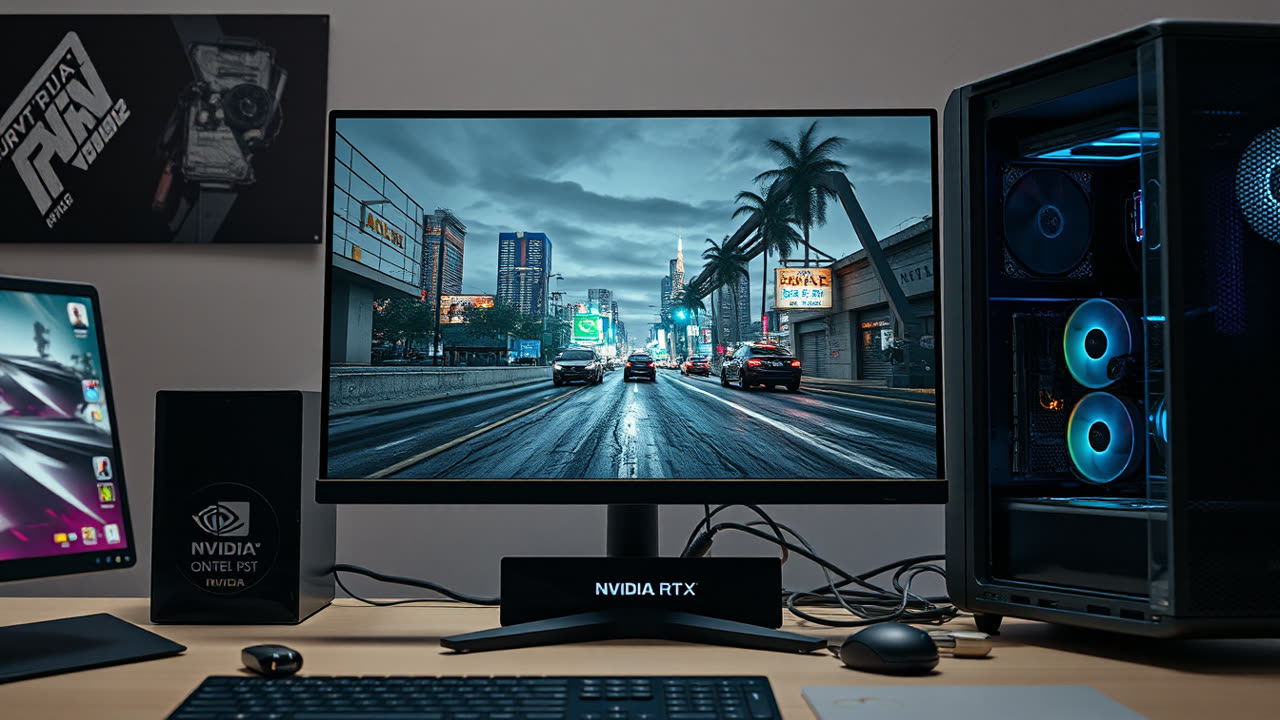
Grand Theft Auto 2, a title released 27 years ago, has been dramatically revitalized with full path tracing and 60 frames per second (FPS) frame generation, thanks to a new mod leveraging NVIDIA's RTX Remix platform. This community-driven effort, spearheaded by a modder, introduces a dynamic time-of-day system and a custom Direct3D 9 wrapper, fundamentally transforming the visual fidelity of the isometric 1999 classic. The implementation not only showcases the raw power of modern rendering techniques on vintage software but also underscores the burgeoning potential of AI-assisted modding tools to redefine game preservation and player experience.
This ambitious modification for GTA 2, originally celebrated for its gritty urban sandbox and top-down perspective, transcends mere texture upgrades or resolution bumps. Path tracing, a highly advanced form of ray tracing, simulates light more accurately by tracing individual light rays, resulting in hyper-realistic global illumination, reflections, and shadows previously unimaginable within the game's original engine. Coupled with NVIDIA's DLSS 3 frame generation, which intelligently inserts AI-generated frames between conventionally rendered ones, the mod achieves a silky-smooth 60 FPS, even under the heavy computational load of path tracing. This fusion of cutting-edge rendering and performance-enhancing AI breathes new life into a game whose graphical capabilities were once limited to a 256-color palette and low-resolution sprites, effectively bridging a quarter-century gap in graphical evolution.
The impact of such a mod extends far beyond a nostalgic trip for long-time fans; it represents a significant paradigm shift for both users and the wider gaming industry. For players, it offers an unprecedented opportunity to revisit beloved classics with a visual splendor that rivals contemporary titles, fostering a new appreciation for their foundational design and gameplay. The dynamic time-of-day system, for instance, adds an atmospheric depth that was entirely absent in the original, where lighting was largely static and pre-baked. This isn't just about improved graphics; it's about altering the very mood and immersion of the game world. For the industry, this mod serves as a powerful demonstration of RTX Remix's capabilities, proving its efficacy not just for niche enthusiast projects but as a viable tool for professional remastering or even official remakes. It highlights a pathway for developers to leverage AI-powered tools to modernize their back catalogs more efficiently and cost-effectively than traditional ground-up remakes, potentially unlocking new revenue streams from dormant intellectual properties.
Comparing this GTA 2 mod to prior generations of game modernization efforts reveals a stark contrast. Historically, enhancing old games involved painstaking manual asset replacement, custom engine modifications, or limited shader injections. While impressive in their own right, these methods rarely achieved the comprehensive, physically accurate lighting that path tracing delivers. RTX Remix, on the other hand, automates much of this process by intercepting DirectX 8/9 calls and inserting modern rendering pipelines, allowing modders to inject path tracing, DLSS, and custom assets with relative ease. This significantly lowers the barrier to entry for advanced modding, democratizing access to technologies once reserved for AAA studios. Other notable RTX Remix projects, such as those for *Portal* and *Half-Life 2 RTX*, further underscore this trend, demonstrating the platform's versatility across different game engines and eras. While *Portal with RTX* was an official NVIDIA release and *Half-Life 2 RTX* is a community remake, the GTA 2 mod showcases the independent modder's ability to achieve similar visual overhauls.
Looking ahead, the success of the GTA 2 RTX Remix mod is a harbinger of a future where AI-driven tools play an increasingly central role in game development and preservation. We can anticipate a surge in similar community projects targeting a vast library of classic titles, potentially creating a new "golden age" for retro gaming where visual fidelity is no longer a barrier to entry for modern audiences. NVIDIA's continued investment in RTX Remix, alongside advancements in AI model training and hardware capabilities, suggests that the tool will become even more sophisticated, perhaps even enabling automated upscaling of legacy assets or more intuitive integration of complex rendering techniques. The challenges remain, of course, including potential compatibility issues with various game engines and the significant computational demands of path tracing, which still require high-end GPUs. However, as hardware evolves and software becomes more optimized, the vision of effortlessly bringing photorealistic graphics to any classic game becomes increasingly attainable, ushering in an era where the past and future of gaming visually converge.