Hoymiles Launches HiFlow Pro: First UL 3700 Certified Microinverter Unlocks U.S. Balcony Solar Market
Hoymiles' HiFlow Pro, the first microinverter certified to North America's new UL 3700 safety standard, marks a pivotal moment for accessible plug-in solar, opening the U.S. residential market to millions previously excluded.
✨ This content was summarized and interpreted by AI; it may contain errors — please verify accuracy with the original sources. Learn more
Listen to this story
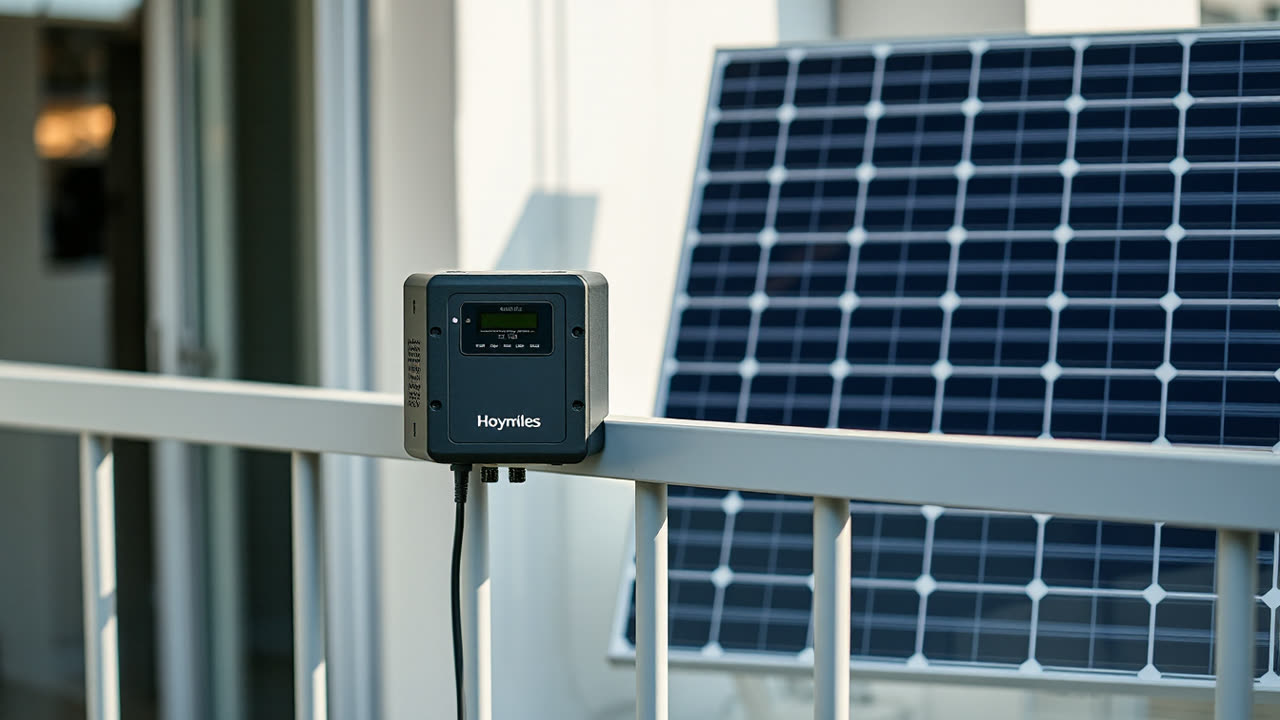
The United States' burgeoning plug-in solar market has reached a critical inflection point with the launch of Hoymiles' HiFlow Pro, the first microinverter certified to meet UL 3700, North America's new safety standard for balcony solar. This landmark certification, announced by Hoymiles in mid-July 2026, signals a transformative shift for accessible renewable energy, effectively unlocking a significant segment of the residential solar market previously constrained by regulatory ambiguities.
The HiFlow Pro microinverter series, available in configurations ranging from a 1-in-1 model delivering up to 500 VA to a 4-in-1 unit capable of 2000 VA output, is explicitly designed for mini solar systems in residential settings like balconies, terraces, and gardens. Its "plug-and-play" architecture, featuring built-in Wi-Fi and Bluetooth modules, allows for quick, hassle-free installation and commissioning, often taking less than a minute via the S-Miles Home App, eliminating the complex wiring and professional installation typically associated with traditional rooftop solar arrays. The microinverter boasts impressive efficiency, with a static Maximum Power Point Tracking (MPPT) efficiency of 99.8% and dynamic efficiency of 99.5%, ensuring maximum energy harvest even under varying weather conditions. Physically robust, the HiFlow Pro is housed in a NEMA Type 6/IP67-rated enclosure, enabling reliable operation across a wide temperature range from -40°C to +65°C, and has undergone over 250,000 hours of reliability testing.
The significance of UL 3700 certification cannot be overstated. Published in December 2025 by UL Solutions, this Outline of Investigation for Interactive Plug-In Photovoltaic (PIPV) Equipment and Systems is the first North American safety standard specifically tailored for consumer-accessible plug-in solar devices. It meticulously addresses three critical safety hazards unique to plug-in solar: preventing branch circuit conductor overloads caused by back-fed solar current, ensuring touch safety by de-energizing accessible plug blades and output circuits, and mitigating adverse interactions with existing ground-fault circuit interrupter (GFCI) protection. For systems exceeding 391 watts, UL 3700 compliance is mandatory. The HiFlow Pro integrates key safety features mandated by UL 3700, including rapid de-energization that drops voltage to safe levels (≤34V) within one second of being unplugged, and anti-islanding protection to prevent power export to the grid during outages, safeguarding utility workers. Hoymiles CEO Dr. Yang Bo highlighted that this launch not only introduces a new product but also establishes a new benchmark for residential solar combining simplicity, safety, and high performance.
This development is a game-changer for millions of American households. Historically, the roughly one-third of U.S. households who rent, or those living in apartments or homes with unsuitable roofs, have been largely excluded from solar adoption due to the prohibitive costs and logistical complexities of traditional installations. Balcony solar, by contrast, offers a practical, affordable entry point into clean energy, allowing users to offset their electricity consumption from always-on appliances and reduce monthly bills. The clarity provided by UL 3700 certification removes a major regulatory barrier, instilling consumer confidence and providing a clear pathway for manufacturers and authorities alike. This mirrors the success seen in Europe, particularly Germany, where over one million plug-in solar systems have been installed, contributing measurably to renewable energy goals and lowering consumer costs.
The regulatory landscape in the U.S. is rapidly evolving to accommodate this technology. As of July 2026, eight states—Utah, Maine, Virginia, Maryland, Colorado, Connecticut, Vermont, and New Hampshire—have already signed plug-in solar legislation into law, with New York's bill awaiting gubernatorial signature and nearly 30 states having introduced similar legislation. This legislative momentum, coupled with the new safety standard, is poised to unleash significant market growth. The global microinverter market, valued at USD 4.78 billion in 2025, is projected to surge to USD 16.82 billion by 2034, exhibiting a compound annual growth rate of 14.79%. While Enphase Energy currently dominates the U.S. microinverter market, Hoymiles is a prominent global player rapidly expanding its North American presence. The HiFlow Pro's first-mover advantage with UL 3700 certification will undoubtedly spur competitors like APsystems and Deye to accelerate their own certification efforts, fostering innovation and competitive pricing for consumers.
Looking ahead, the widespread adoption of plug-in solar systems, facilitated by products like the HiFlow Pro, will likely reshape residential energy consumption. Expect to see an influx of UL 3700-certified products from various manufacturers, driving down costs and enhancing features. The inherent "load-reducing" nature of these systems, offsetting base-load consumption, could also contribute to grid stability during peak demand, a crucial benefit as the American electrical grid faces increasing strain. Further policy evolution is anticipated, with more states enacting supportive legislation and potential federal incentives emerging. The integration of these systems into smart home ecosystems will also deepen, allowing for more sophisticated energy management and optimization. The era of accessible, safe, and truly "plug-and-play" solar has arrived in the U.S., setting the stage for a decentralized energy future where individual households play a more active role in their power generation.