Huawei Accelerates Ascend 960DT AI Chip Launch to Challenge Nvidia Amid US Controls
Huawei is fast-tracking its next-gen Ascend 960DT AI chip for a Q1 2027 launch, intensifying China's bid for AI sovereignty against Nvidia's global dominance and tightening U.S. export restrictions.
✨ This content was summarized and interpreted by AI; it may contain errors — please verify accuracy with the original sources. Learn more
Listen to this story
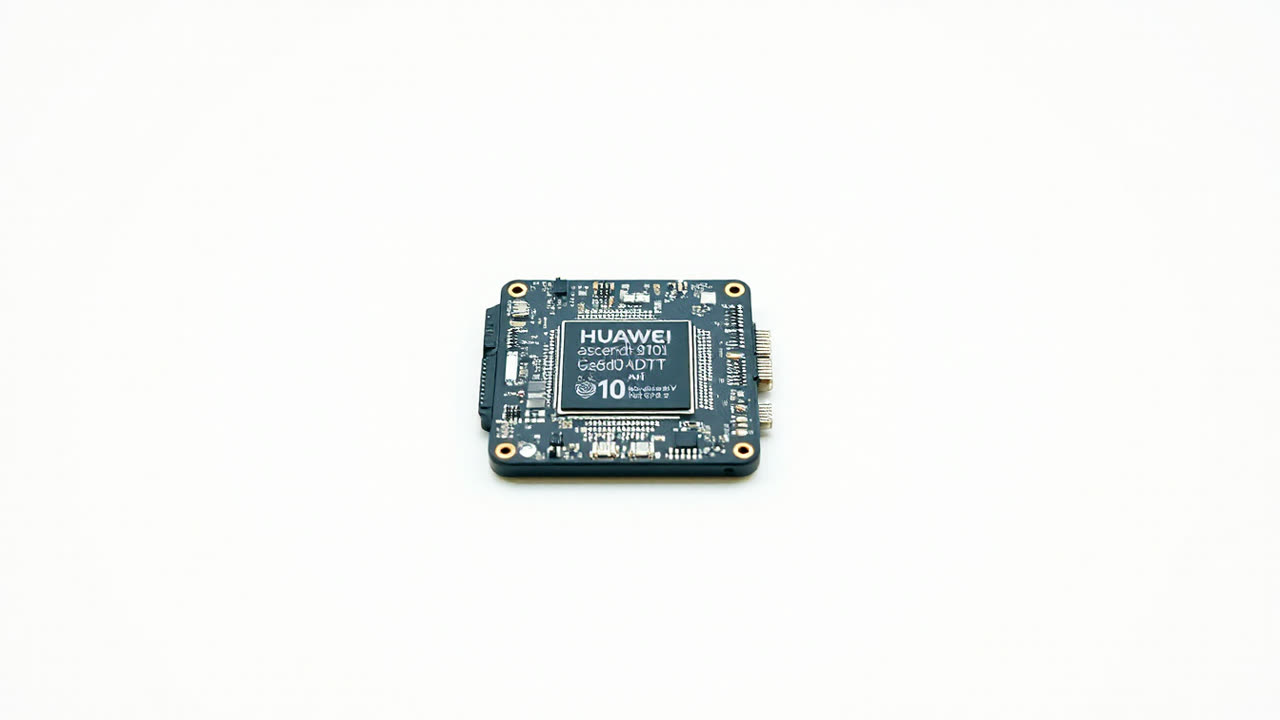
Huawei's accelerated plan to launch its next-generation Ascend 960DT AI chip in Q1 2027 marks a critical escalation in China's strategic push for AI sovereignty, directly challenging Nvidia's entrenched global dominance amidst tightening U.S. export controls. This move, fast-tracking the successor to the Ascend 910B, underscores Huawei’s determination to mitigate the severe impact of technology restrictions and solidify an indigenous AI infrastructure capable of powering China’s ambitious large language models and advanced computing initiatives. The 960DT is anticipated to significantly boost Huawei's computational prowess, aiming to close the substantial performance gap with Nvidia's current and forthcoming architectures, particularly the Blackwell series.
The significance of the Ascend 960DT lies not merely in its technical specifications, which are expected to build upon the 910B's 256 TFLOPS (FP16) performance but rather in its strategic implications for the global AI landscape and China's domestic technological resilience. Huawei's previous Ascend 910B, while a formidable chip, still lagged behind Nvidia's H100 in key benchmarks and overall ecosystem maturity, a gap that widened further with the introduction of Nvidia's H200 and the impending Blackwell B200. The B200, for instance, is projected to deliver up to 20 petaflops of FP4 performance and feature 192GB of HBM3e memory, setting an exceptionally high bar for any contender. The 960DT's accelerated timeline suggests Huawei aims to compete more directly with these cutting-edge offerings, potentially targeting performance metrics that place it in a similar league, or at least significantly reduce the performance deficit, particularly for models optimized within the MindSpore ecosystem.
For users within China, the 960DT represents a lifeline, offering a viable, domestically produced alternative to Nvidia's restricted GPUs. Chinese tech giants and research institutions, facing limitations on acquiring top-tier Nvidia chips like the H100 and H200 due to U.S. sanctions, have increasingly turned to Huawei's Ascend series. The 910B has already seen significant adoption, becoming a de facto standard for AI training and inference in many Chinese data centers. The 960DT will further empower these entities, enabling more complex AI workloads and potentially fostering a more robust, self-reliant AI development environment within the country. This reduces dependence on foreign technology and insulates China's AI progress from geopolitical headwinds.
From an industry perspective, the launch of the Ascend 960DT intensifies the competition in the highly lucrative AI chip market, albeit with distinct geopolitical boundaries. While Nvidia maintains an estimated 80% market share in the global AI accelerator market, particularly for high-end data center GPUs, Huawei's advancements within China are carving out a substantial domestic segment. The challenge for Huawei, however, extends beyond raw compute power to the entire software stack. Nvidia's CUDA platform remains a critical differentiator, boasting a vast developer ecosystem, extensive libraries, and optimized frameworks that are difficult to replicate. Huawei's MindSpore AI computing framework and Ascend AI software stack are making strides, but building a comparable ecosystem takes years of sustained effort and broad industry adoption. The success of the 960DT will partly hinge on how well its software environment integrates with existing AI models and how easily developers can migrate or develop new applications for it.
The background to this accelerated launch is rooted in the ongoing technological decoupling between the U.S. and China. U.S. export controls, initially targeting Huawei directly, have expanded to restrict the sale of high-performance AI chips to China, compelling domestic players like Huawei to innovate rapidly and independently. This geopolitical pressure has inadvertently spurred significant investment and development in China's semiconductor industry, from design to manufacturing. Huawei’s ability to bring the 960DT to market by Q1 2027, despite limitations on accessing advanced semiconductor manufacturing processes from TSMC, suggests continued progress with domestic foundries like SMIC, potentially leveraging advanced packaging techniques to compensate for lithography gaps. Reports from late 2023 indicated SMIC's ability to produce 7nm chips, a significant step, though still behind TSMC's 3nm and 2nm nodes used by Nvidia for its cutting-edge products. The 960DT's performance will be a testament to Huawei's design ingenuity and the capabilities of its domestic manufacturing partners under duress.
Looking ahead, the launch of the Ascend 960DT will likely solidify a bifurcated global AI chip market: one dominated by Nvidia and its Western allies, and another, increasingly self-sufficient, centered around Huawei and other Chinese developers. This dynamic will foster distinct innovation pathways, potentially leading to divergent hardware-software co-design philosophies and AI development paradigms. While the 960DT may not immediately match Nvidia's top-tier offerings in every metric, its very existence and accelerated rollout signal a powerful commitment to technological autonomy. The next phase will involve not just raw performance improvements but also the maturation of Huawei's entire AI ecosystem, including developer tools, cloud services, and specialized hardware for various AI applications. Success for the 960DT will be measured not just in TFLOPS, but in its ability to sustain China's AI ambitions, fuel its technological self-reliance, and ultimately, reshape the geopolitical landscape of artificial intelligence.