Hyundai Expands EV Offensive with IONIQ 4 and IONIQ 7 SUVs
Hyundai is poised to significantly expand its electric vehicle offensive with the impending introduction of the IONIQ 4 and IONIQ 7, two new battery-electric SUVs designed to plug critical gaps in its expanding lineup and challenge established players in high-volume segments.
✨ This content was summarized and interpreted by AI; it may contain errors — please verify accuracy with the original sources. Learn more
Listen to this story
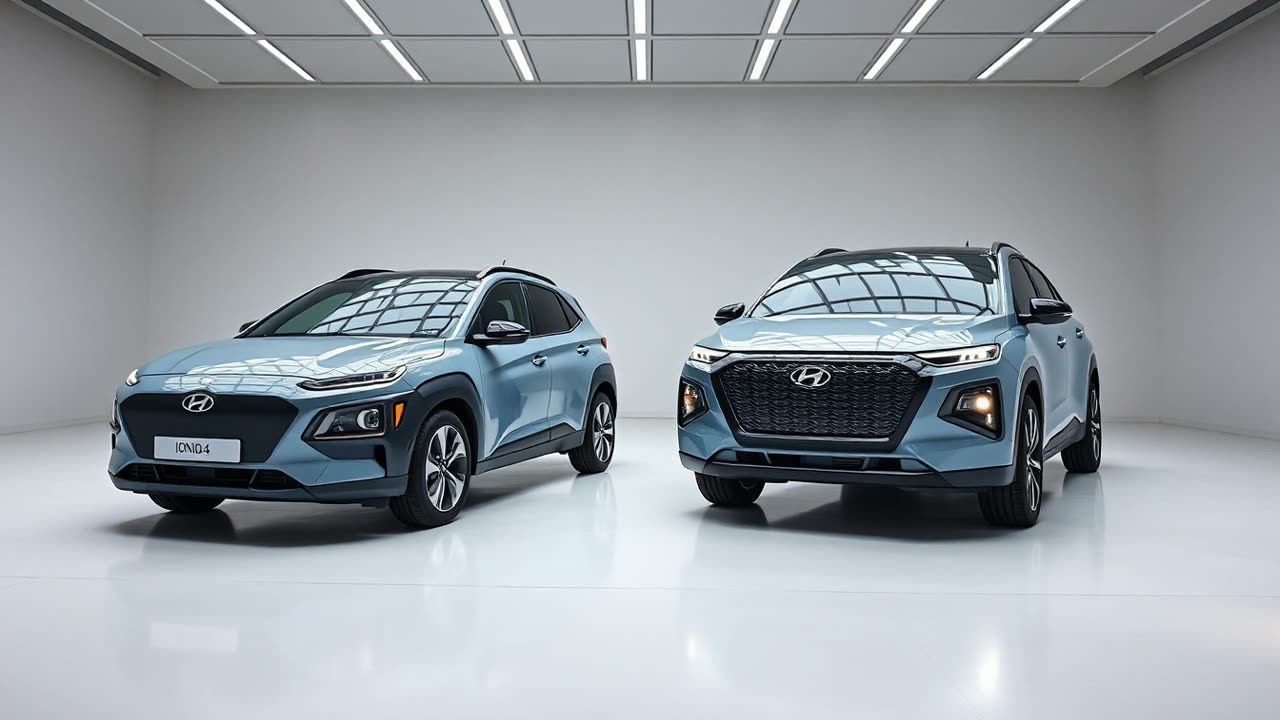
Hyundai is poised to significantly expand its electric vehicle offensive with the impending introduction of the IONIQ 4 and IONIQ 7, two new battery-electric SUVs designed to plug critical gaps in its expanding lineup and challenge established players in high-volume segments. This strategic move, reported on September 29, 2026, signals Hyundai's aggressive pursuit of EV market dominance, moving beyond its successful IONIQ 5 and IONIQ 6 models to capture broader consumer interest in compact and full-size electric utility vehicles. The IONIQ 4 is expected to target the burgeoning compact electric SUV market, while the IONIQ 7 will compete in the larger, three-row electric SUV space, directly confronting offerings from Tesla, Rivian, and legacy automakers like General Motors and Ford.
The introduction of the IONIQ 4 and IONIQ 7 is more than just an expansion; it's a calculated escalation of Hyundai's electrification strategy, aiming to democratize access to advanced EV technology across different price points and family needs. The IONIQ 4, likely positioned as a smaller, more accessible sibling to the IONIQ 5, is anticipated to leverage Hyundai's highly scalable E-GMP platform, offering competitive range, fast-charging capabilities, and a distinct design language. Its arrival is crucial for Hyundai to contend with a wave of compact electric SUVs, including the Chevrolet Equinox EV, Honda Prologue, and potentially new entries from Volkswagen and Toyota, all vying for urban and suburban buyers seeking practical, emission-free transport without the premium price tag of larger EVs. This segment is characterized by fierce competition over range-per-dollar, interior space, and integrated technology, making the IONIQ 4's value proposition critical for its success.
Conversely, the IONIQ 7 represents Hyundai's bold foray into the premium, family-oriented electric SUV segment, a space currently dominated by models like the Tesla Model X, Rivian R1S, Mercedes-Benz EQS SUV, and the upcoming Cadillac Escalade IQ. This larger vehicle is expected to offer substantial passenger and cargo capacity, advanced driver-assistance systems, and potentially a longer wheelbase version of the E-GMP platform to accommodate a larger battery pack for extended range. Its success will hinge on its ability to deliver not only impressive range and charging speeds but also a luxurious interior, robust towing capabilities, and a compelling blend of technology and comfort that justifies its likely higher price point. The IONIQ 7 could serve as a halo vehicle, showcasing Hyundai's engineering prowess and design ambition, while also catering to the growing demand for sustainable large-family transport.
Hyundai’s background in the EV space, particularly with the IONIQ 5 and IONIQ 6, provides a strong foundation for these new models. The IONIQ 5, launched in 2021, quickly garnered accolades for its retro-futuristic design, spacious interior, and 800V architecture enabling ultra-fast charging, often adding 60-70 miles of range in just five minutes. The IONIQ 6, following in 2022, built on this with a sleek, aerodynamic sedan profile, further improving efficiency and range. Both models have demonstrated Hyundai's ability to produce highly competitive EVs that offer compelling alternatives to established rivals. The IONIQ 4 and IONIQ 7 are expected to inherit and advance these core strengths, with potential improvements in battery density, motor efficiency, and software integration, leveraging subsequent generations of the E-GMP platform. Compared to early EVs that often compromised on range or charging speed, Hyundai's current and future offerings promise a more seamless transition for gasoline car owners.
Looking ahead, the launch of the IONIQ 4 and IONIQ 7 will solidify Hyundai's position as a full-line EV manufacturer, capable of addressing diverse consumer needs from compact crossovers to three-row family haulers. This expansion is crucial in a market where brand loyalty is increasingly tied to the breadth and quality of an automaker's electric offerings. For users, these new models mean more choice, potentially at more competitive prices, and with the benefit of Hyundai's proven reliability and warranty. For the industry, it intensifies the competitive landscape, pushing rivals to innovate faster and offer more compelling products. This sustained investment in a diversified EV portfolio suggests Hyundai is not merely participating in the EV transition but actively aiming to lead it, with a clear strategy to capture significant market share across key segments by the end of the decade. The next steps will likely involve further refinement of battery technology, enhanced autonomous driving features, and potentially the integration of vehicle-to-grid (V2G) capabilities as standard, further cementing Hyundai's forward-looking approach.