Hyundai's $17,700 Ioniq V Launches in China, Unavailable to Western Markets
Hyundai has launched its Ioniq V electric fastback sedan in China at an aggressive 119,900 yuan ($17,680 USD), featuring advanced tech and long range, but it remains exclusive to the Chinese market for now.
✨ This content was summarized and interpreted by AI; it may contain errors — please verify accuracy with the original sources. Learn more
Listen to this story
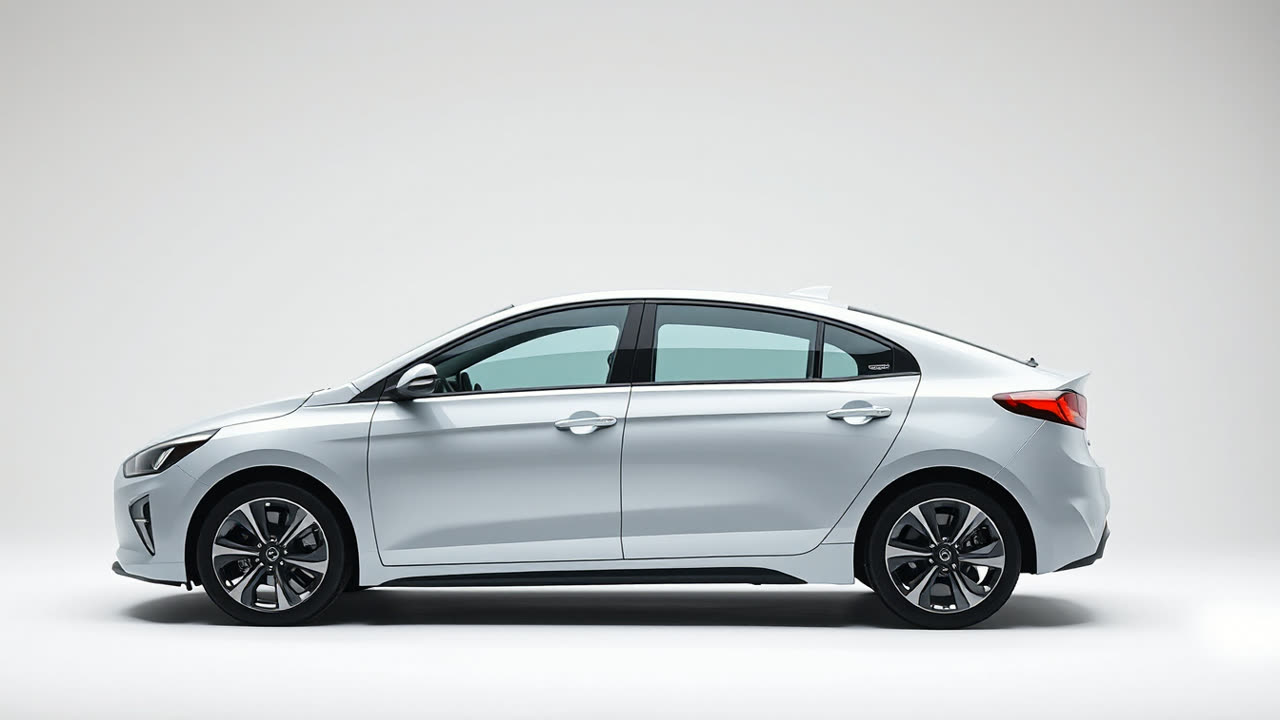
Hyundai has initiated pre-sale orders for its Ioniq V electric fastback sedan in China, commencing at an aggressive 119,900 yuan, which translates to roughly $17,680 USD, yet this compelling entry-level EV remains unavailable to English-speaking markets outside of China. This strategic launch, unfolding at the 2026 Chengdu Auto Show, marks a significant gambit in Hyundai's "In China, For China, To Global" strategy, aiming to revitalize its presence in the world's largest and most competitive EV market.
The Ioniq V is not a compact city car but a substantial mid-size fastback sedan, boasting dimensions comparable to a Hyundai Sonata or Toyota Camry, with a length of 4,900 mm and a wheelbase of 2,900 mm. It is built on Hyundai's advanced E-GMP (Electric Global Modular Platform), incorporating an 800-volt high-voltage fast-charging system, a premium feature often reserved for much more expensive EVs. Powering the Ioniq V are LFP (lithium iron phosphate) batteries supplied by CATL, available in two capacities: a 53.5 kWh pack paired with a 140 kW (188 hp) motor offering a CLTC range of 520-540 km (approximately 323-330 miles), and a larger 66.8 kWh pack with a 168 kW (225 hp) motor extending the CLTC range to an impressive 620-650 km (385-404 miles). It is important to note that CLTC range figures are typically more optimistic than EPA or WLTP ratings.
The vehicle's interior further defies its budget pricing, featuring a expansive 27-inch ultra-thin 4K panoramic display powered by a Qualcomm Snapdragon 8295 chip, complemented by a head-up display. Hyundai has deeply localized the Ioniq V's technology stack for the Chinese market, integrating local AI models like Baidu's Ernie Bot and ByteDance's Doubao into its infotainment system, alongside L2+ assisted-driving functions co-developed with Momenta. Its exterior design is strikingly angular and "cyberpunk," featuring frameless doors and a sleek, single-curve silhouette, departing from Hyundai's established global design language to cater specifically to Chinese aesthetic preferences.
This aggressive pricing and feature set for the Ioniq V fundamentally shifts the landscape of affordable electric vehicles. For consumers, it signals a long-awaited breakthrough in EV accessibility, demonstrating that a well-equipped, mid-size electric sedan with respectable range and advanced technology can be offered at a price point that undercuts even the cheapest new internal combustion engine (ICE) vehicles in some Western markets. The Ioniq V’s value proposition could reshape consumer expectations globally, highlighting a significant void in Western markets for genuinely affordable, yet capable, electric transport.
For the automotive industry, the Ioniq V represents a double-edged sword. Hyundai's "In China, For China, To Global" strategy is a direct acknowledgement of the intense competition from domestic Chinese EV manufacturers and an attempt to regain lost market share, with plans for 20 new models in China over the next five years. This localized development, including the reliance on CATL for LFP batteries and Chinese tech firms for software and ADAS, illustrates a pragmatic approach to compete effectively in a market that demands cutting-edge features at competitive prices. This strategic pivot could influence how global automakers approach product development and sourcing in other regions, potentially accelerating the adoption of similar localized strategies. The deployment of the E-GMP platform in such an affordable package also underscores its scalability and versatility, suggesting that its 800V architecture could become more widespread across Hyundai's future entry-level EV offerings.
Compared to its Ioniq siblings, the Ioniq V carves out a distinct niche. Unlike the Ioniq 5, Ioniq 6, or the larger Ioniq 9 (formerly 7), which cater to premium or larger segments with higher price tags and typically NCM (nickel-cobalt-manganese) battery chemistry, the Ioniq V is explicitly designed as a budget-conscious, China-centric model. Globally, its $17,700 starting price positions it well below established affordable EVs like the Dacia Spring or even the smaller BYD Seagull, while offering a significantly larger vehicle with more advanced features. While the Seagull and Spring are typically subcompacts or city cars, the Ioniq V provides mid-size sedan practicality at a comparable or even lower price point.
Looking ahead, the Ioniq V's trajectory outside China remains a critical point of speculation. While Hyundai has confirmed it is not intended to remain a regional exclusive and is conducting feasibility studies for export to regions like Asia-Pacific, Australia, Southeast Asia, the Middle East, and Central and South America, a direct launch in Western English-speaking markets (such as the US or Europe) at this price point appears unlikely in the short term. Factors such as import tariffs, differing regulatory standards, and local manufacturing costs would almost certainly drive up the price significantly. However, the sheer competitiveness of the Ioniq V in China sets a new global benchmark for affordable, feature-rich EVs. It strongly indicates that mass-market electric mobility is not just a distant dream but an imminent reality, forcing every major automaker to recalibrate their strategies for the burgeoning entry-level EV segment. The Ioniq V solidifies Hyundai's position as an aggressive innovator in the EV space, demonstrating its commitment to delivering compelling electric vehicles across a broad spectrum of price points and market demands.