IBM's Granite Speech 5.0 Turbo CTC: A Breakthrough in Real-Time ASR
IBM's Granite Speech 5.0 Turbo CTC achieves an unprecedented 2.9% Word Error Rate and 200x real-time processing speed, democratizing state-of-the-art speech recognition.
✨ This content was summarized and interpreted by AI; it may contain errors — please verify accuracy with the original sources. Learn more
Listen to this story
IBM's Granite Speech 5.0 Turbo CTC, a 470-million-parameter model, achieves a remarkable 2.9% Word Error Rate (WER) on the challenging Librispeech test-other dataset, coupled with an unprecedented real-time factor (RTF) of 0.005 on an NVIDIA A100 GPU, signifying a processing speed 200 times faster than real-time audio. This breakthrough, publicly available via Hugging Face, represents a significant leap in automatic speech recognition (ASR) technology, pushing the boundaries of both accuracy and processing efficiency previously seen as mutually exclusive. The "Turbo CTC" innovation streamlines the decoding process, allowing for substantially faster transcription without compromising the model's accuracy, a critical advancement for real-world applications demanding instantaneous and precise speech-to-text conversion.
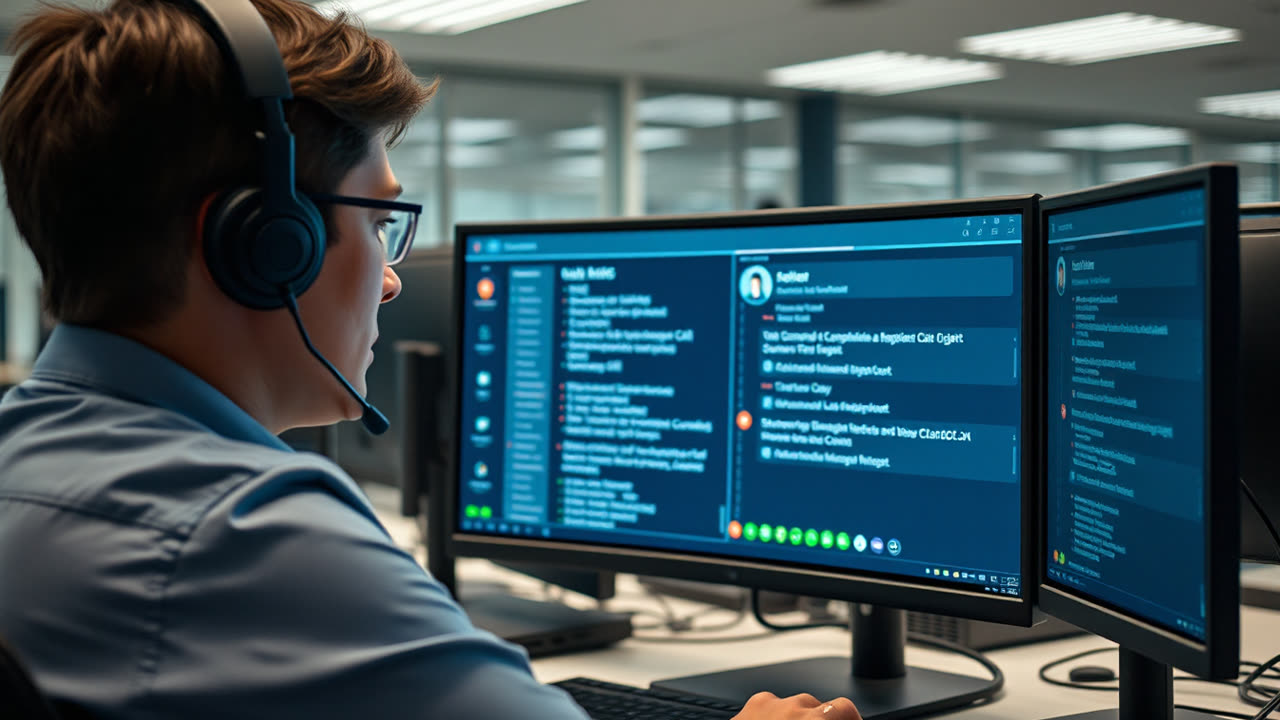
This level of performance fundamentally redefines the operational paradigms across numerous industries. For contact centers, the ability to transcribe calls with near-perfect accuracy and virtually no latency means immediate analysis of customer sentiment, real-time agent assistance with relevant knowledge base articles, and instant compliance monitoring. This translates directly into improved customer experience, reduced average handle times, and significant operational cost savings by automating tasks previously requiring human intervention or delayed post-call processing. In the healthcare sector, clinicians can benefit from highly accurate, real-time dictation, reducing documentation burdens and allowing more focus on patient care. Legal and journalistic fields gain access to instant, reliable transcripts of proceedings, interviews, and broadcasts, accelerating research, content creation, and compliance checks. Furthermore, live captioning for events, broadcasts, and online meetings can now achieve a level of fluidity and accuracy that mirrors human transcriptionists, enhancing accessibility for millions.
The Granite Speech 5.0 Turbo CTC stands out when compared to both its predecessors and contemporary rivals. IBM's previous generation models, while robust, did not achieve this dual peak of speed and accuracy. Compared to industry giants like OpenAI's Whisper, which set a high bar for generalized ASR accuracy, Granite Speech 5.0 Turbo CTC often demonstrates superior speed, particularly when optimized for specific tasks or domains, while maintaining competitive WERs. Whisper Large V3, for instance, achieves a 2.4% WER on LibriSpeech test-other but typically operates at a much higher RTF. Google's proprietary ASR systems, deeply integrated into its ecosystem, also offer high accuracy but often do not publicly disclose the same granular speed metrics, making direct, apples-to-apples comparisons challenging, especially for open-source accessibility. The "Turbo CTC" approach likely optimizes the inference path more aggressively than general-purpose transformer-based models, which might be why it excels in speed. The 470M parameter count is also notably efficient, suggesting a highly optimized architecture that balances model complexity with computational demands, unlike some larger models that trade size for marginal accuracy gains.
Looking ahead, the implications of Granite Speech 5.0 Turbo CTC are profound. Its availability on Hugging Face democratizes access to state-of-the-art ASR, enabling a wider range of developers and enterprises to integrate high-performance transcription into their applications without the need for extensive in-house AI expertise or massive computational resources for training. This could foster a new wave of innovation in voice-enabled applications, from more sophisticated personal assistants that understand nuanced commands instantly to real-time language translation services that minimize conversational lag. The industry will likely see a continued trend towards highly specialized, efficient models that can deliver top-tier performance for specific tasks, moving beyond the "one-size-fits-all" approach of some larger foundation models. Further research will undoubtedly focus on reducing WER even further in noisy environments or for highly accented speech, potentially through advanced noise suppression techniques or even larger, more diverse training datasets. The challenge will be to maintain this impressive RTF while pushing accuracy boundaries. We can also anticipate the deployment of such models on edge devices, bringing real-time, highly accurate transcription directly to smartphones, wearables, and embedded systems, ushering in an era of truly ubiquitous and seamless voice interaction.