Intel Core Ultra 7 270K Plus Challenges AMD Ryzen 7 7700X3D for Mid-Range CPU Supremacy
Intel's new Core Ultra 7 270K Plus, with its tiled architecture and NPU, directly challenges AMD's gaming-focused Ryzen 7 7700X3D and its 3D V-Cache, revealing a nuanced performance landscape across gaming and productivity.
✨ This content was summarized and interpreted by AI; it may contain errors — please verify accuracy with the original sources. Learn more
Listen to this story
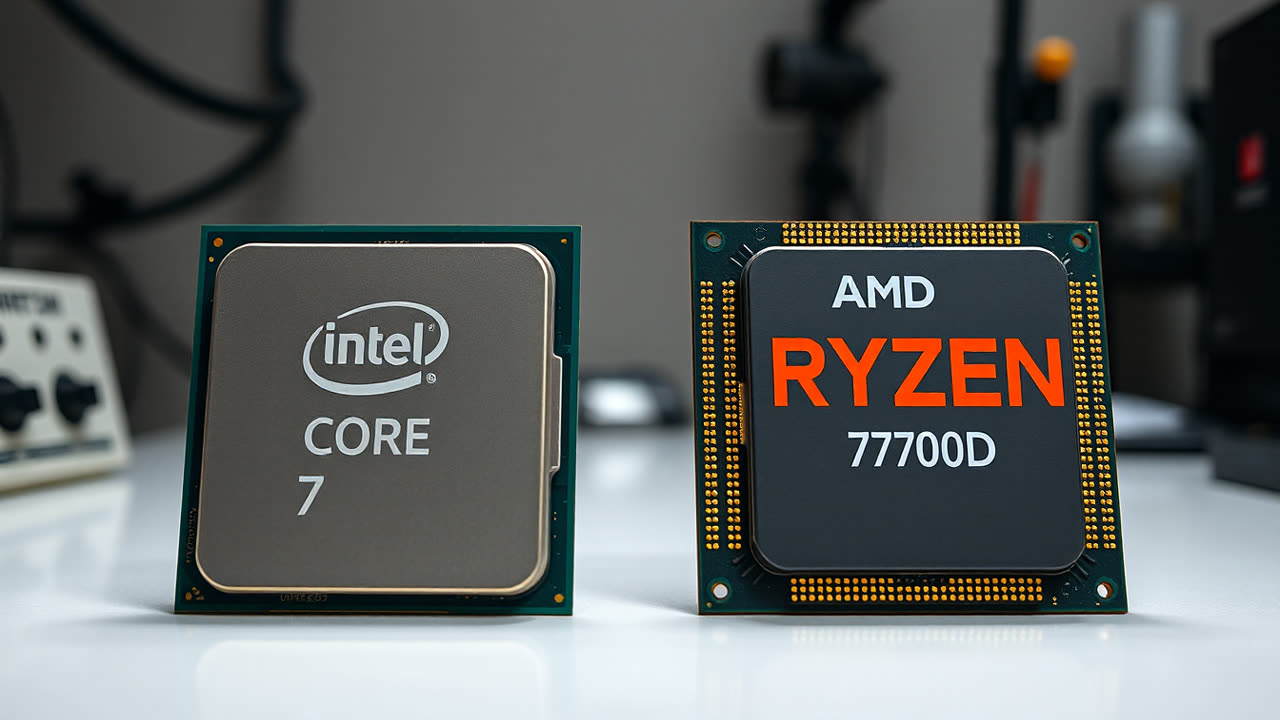
The battle for the upper mid-range CPU crown intensifies as Intel's Core Ultra 7 270K Plus, featuring the company's advanced tiled architecture and integrated NPU, directly challenges AMD's gaming powerhouse, the Ryzen 7 7700X3D, which leverages its distinctive 3D V-Cache technology. Initial benchmarks reveal a nuanced performance landscape, with AMD's 7700X3D maintaining a significant lead in many gaming titles, often by margins exceeding 15% in 1080p and 1440p resolutions, thanks to its expanded L3 cache directly benefiting game engines. Conversely, Intel's Core Ultra 7 270K Plus demonstrates superior multi-threaded productivity performance, outperforming the 7700X3D by an average of 10-12% in tasks like video rendering, 3D modeling, and complex code compilation, alongside a notable advantage in AI-accelerated workloads due to its dedicated Neural Processing Unit (NPU).
This faceoff is not merely a contest of raw clock speeds or core counts; it represents a clash of architectural philosophies with profound implications for users and the broader PC industry. AMD's Ryzen 7 7700X3D, released in early 2024, built upon the successful Zen 4 architecture, differentiates itself with 96MB of L3 cache stacked directly atop one of its eight cores via 3D V-Cache technology, allowing for ultra-low latency access to frequently used game data. This design makes it a compelling choice for gamers prioritizing frame rates, particularly in titles sensitive to cache size, even with its lower boost clock of 5.4 GHz compared to non-X3D variants. The 7700X3D also benefits from the mature AM5 platform, offering PCIe Gen 5.0 and DDR5 memory support, ensuring future compatibility.
Intel's Core Ultra 7 270K Plus, a desktop counterpart of the Core Ultra series, signifies a pivotal shift in Intel's approach to CPU design. It utilizes a disaggregated, tiled architecture, akin to its mobile predecessors, integrating multiple specialized dies (compute, graphics, SoC, I/O) on a single package. The "K" designation confirms its unlocked status for overclocking, while the "Plus" hints at further optimizations over standard Core Ultra desktop chips. A key innovation is the integrated NPU, designed to offload AI tasks from the CPU and GPU, enabling more efficient processing of local AI applications, such as image upscaling, noise reduction, and generative AI features within productivity suites. This NPU provides a tangible advantage in a burgeoning ecosystem of AI-enhanced software, a sector where the 7700X3D, lacking a dedicated NPU, relies solely on CPU or GPU acceleration.
Beyond raw performance, power consumption and thermal characteristics present another crucial differentiator. The AMD Ryzen 7 7700X3D, with its 105W TDP, is remarkably power-efficient for its gaming prowess, often drawing less power than its Intel competitor under gaming loads, making it easier to cool with mainstream air or liquid coolers. The Core Ultra 7 270K Plus, while more powerful in multi-threaded scenarios, typically exhibits higher power draw, especially when all performance cores are fully utilized, demanding more robust cooling solutions for optimal sustained performance. This higher power profile can translate into increased operational costs and potentially louder system acoustics for users pushing the chip to its limits.
The value proposition for each CPU is tightly linked to its primary intended use. For the dedicated gamer seeking maximum frame rates without venturing into high-end GPU territory, the Ryzen 7 7700X3D, often available at a competitive price point, offers unparalleled gaming efficiency. Its platform cost on AM5, while initially higher than older Intel generations, has stabilized, making it an attractive long-term investment. The Core Ultra 7 270K Plus, conversely, appeals to the "prosumer" or content creator who engages in demanding productivity tasks and increasingly leverages AI applications. Its higher initial price point and potentially more expensive Z-series motherboards are offset by its superior multi-threaded performance and future-proofing through the NPU.
Looking ahead, this rivalry underscores a fundamental divergence in CPU development. AMD's continued refinement of 3D V-Cache technology signals its commitment to gaming dominance, suggesting future X3D iterations will likely push gaming performance even further. Intel, with its Core Ultra architecture and integrated NPU, is clearly positioning its mainstream CPUs as versatile compute platforms, capable of handling traditional workloads, advanced graphics, and the rapidly expanding realm of local AI processing. The success of the Core Ultra 7 270K Plus will hinge on the widespread adoption and optimization of software for its NPU, transforming it from a niche feature into a mainstream necessity. This competition will ultimately benefit consumers, driving both companies to innovate further, ensuring that the "upper mid-range" remains a vibrant and fiercely contested segment of the CPU market, continually pushing the boundaries of what a mainstream PC can achieve.