Intel's Nova Lake CPUs: 52 Cores, bLLC, and a New Socket Targeting AMD by 2027
Intel's next-gen Nova Lake desktop CPUs, featuring up to 52 cores, "bLLC" cache, and a new LGA 1954 socket with multi-generational support, are set for a Q1 2027 debut to challenge AMD's performance dominance.
✨ This content was summarized and interpreted by AI; it may contain errors — please verify accuracy with the original sources. Learn more
Listen to this story
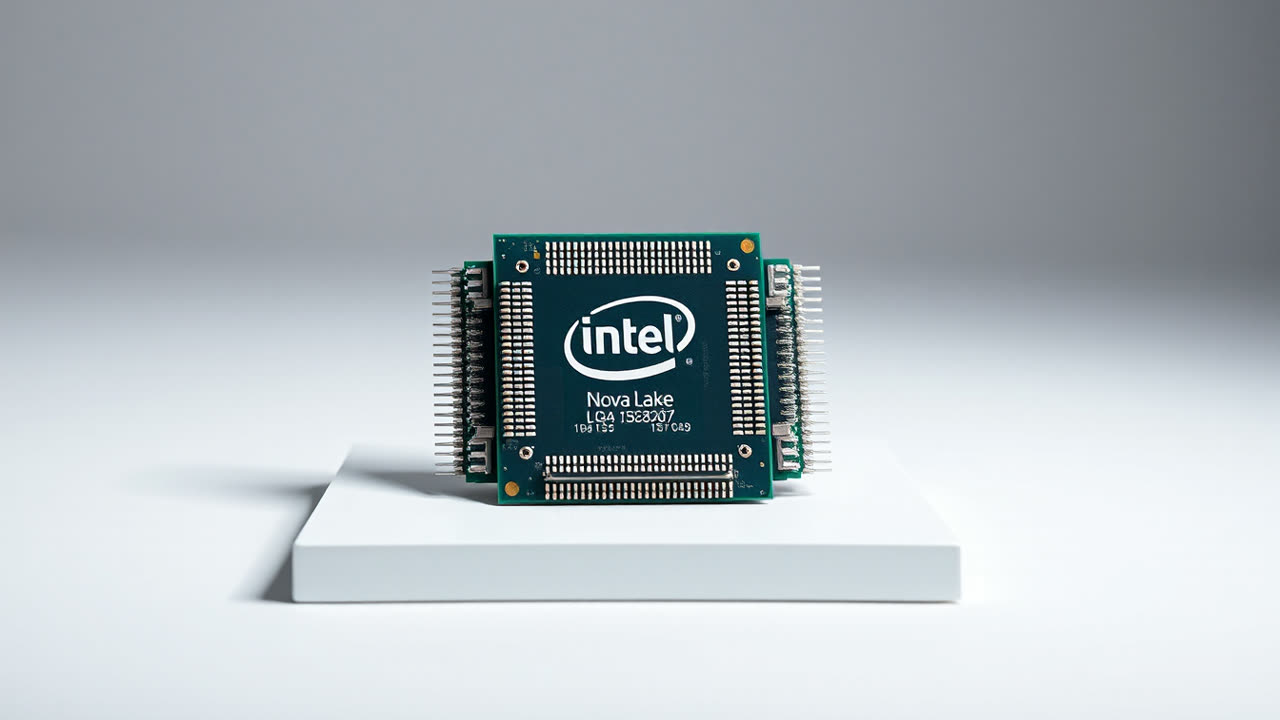
Intel's next-generation Nova Lake desktop CPUs are poised for mass production in Q4 2026, with initial 28-core variants expected to hit shelves in Q1 2027, marking a pivotal moment in the company's bid to reclaim desktop performance leadership. Flagship 52-core models, branded under the Core Ultra 400 series, are slated to follow later in 2027, potentially between May and September, according to recently leaked roadmaps and internal slides. This staggered release strategy, featuring a top-tier chip arriving after the initial wave, signals a departure from Intel's traditional launch cadence, potentially allowing for fine-tuning and a more impactful enthusiast debut for its most powerful silicon.
The most compelling detail emerging from these leaks is Nova Lake's introduction of "bLLC" (big Last Level Cache), designed to directly counter AMD's highly successful 3D V-Cache technology. With top-tier 52-core models rumored to feature up to 288MB of bLLC and 28-core variants equipped with 144MB, Intel is making a clear play for gaming dominance, promising a "leap in gaming performance" that has long been a stronghold for AMD's X3D processors. This strategic cache implementation, combined with new "Coyote Cove" Performance-cores and "Arctic Wolf" Efficiency-cores, suggests Nova Lake will represent the "most significant upgrade to the desktop platform in recent years," aiming for superior Instructions Per Clock (IPC) performance over AMD's upcoming Zen 6 architecture, despite Zen 6 potentially holding a clock speed advantage.
Crucially for consumers, Nova Lake will introduce a new LGA 1954 socket, but unlike Intel's historical tendency for frequent socket changes, this platform is expected to support at least three future CPU generations, including Razor Lake and Hammer Lake. This commitment to platform longevity is a direct response to a long-standing user desire and mirrors AMD's successful AM4 and AM5 strategies, offering a "one-time investment that lasts for many years" for motherboard upgrades. Such a move could significantly enhance consumer trust and reduce the total cost of ownership for PC enthusiasts, making Intel's ecosystem more attractive over the long term.
Beyond raw performance, Nova Lake is expected to bring substantial advancements in core count, with up to 52 cores in its most powerful configurations, a notable increase that could more than double the multi-threaded performance of AMD's upcoming Ryzen family, which is anticipated to scale up to 24 cores. This massive core count, particularly in dual-compute-tile configurations, positions Nova Lake to contend not only with mainstream high-end desktop (HEDT) segments but also potentially challenge AMD's Threadripper offerings. The platform will also support higher-speed DDR5-8000 memory and offer 24 PCIe 5.0 lanes, ensuring cutting-edge connectivity and bandwidth. The architecture also integrates a sophisticated Neural Processing Unit (NPU) for enhanced AI capabilities, challenging specialized mobile chips from rivals.
On the manufacturing front, Intel's strategy for Nova Lake signals a significant internal shift. While earlier rumors suggested a heavy reliance on TSMC's 2nm (N2) process, recent reports indicate Intel plans to manufacture the majority of Nova Lake-S CPUs in-house on its 18A node. This shift, driven by dramatically improved 18A yields (reportedly from 65% to 85%), underscores Intel Foundry's maturation and its ambition to reduce reliance on external fabs. This move is not only a win for Intel's manufacturing independence but also potentially impacts AMD by further constraining access to TSMC's advanced and increasingly in-demand fab capacity, particularly for future high-performance chips. However, the die sizes for Nova Lake's compute tiles, especially those with bLLC, are projected to be larger and more expensive to produce than previous generations, indicating that these high-performance parts may come at a premium.
Looking ahead, the LGA 1954 socket's longevity is a cornerstone of Intel's future roadmap. Following Nova Lake, the platform is expected to host Razor Lake in Q4 2027, featuring new "Griffin Cove" P-cores and "Golden Eagle" E-cores with a focus on IPC improvements. Further out, 2028 could see the introduction of Titan Lake, rumored to adopt a unified "Copper Shark" core architecture, potentially eschewing the P-core/E-core hybrid design for up to 100 E-cores fabricated on a 14A process. This long-term vision, combined with Nova Lake's "desktop-first" launch strategy—a direct counter to AMD's recent server-centric Zen 6 rollout—underscores Intel's renewed focus on the enthusiast PC market. While the high power requirements for Nova Lake's top-tier models, potentially drawing up to 474W (or over 700W with power limits removed), will necessitate robust cooling solutions, the anticipated performance gains and platform stability could re-establish Intel as a formidable competitor in the desktop CPU landscape. The concurrent prediction of a significant drop in DDR5 memory prices, driven by an impending oversupply, could further sweeten the deal for consumers considering a new high-performance Nova Lake system.