JMGO Iris Ultra Max 4K 120Hz Projector Launches Globally with Groundbreaking Dual-Iris Contrast
JMGO's new all-in-one Google TV projector, featuring a revolutionary dual-iris system for a 10,000:1 native contrast ratio, is now available outside China, challenging premium home entertainment standards.
✨ This content was summarized and interpreted by AI; it may contain errors — please verify accuracy with the original sources. Learn more
Listen to this story
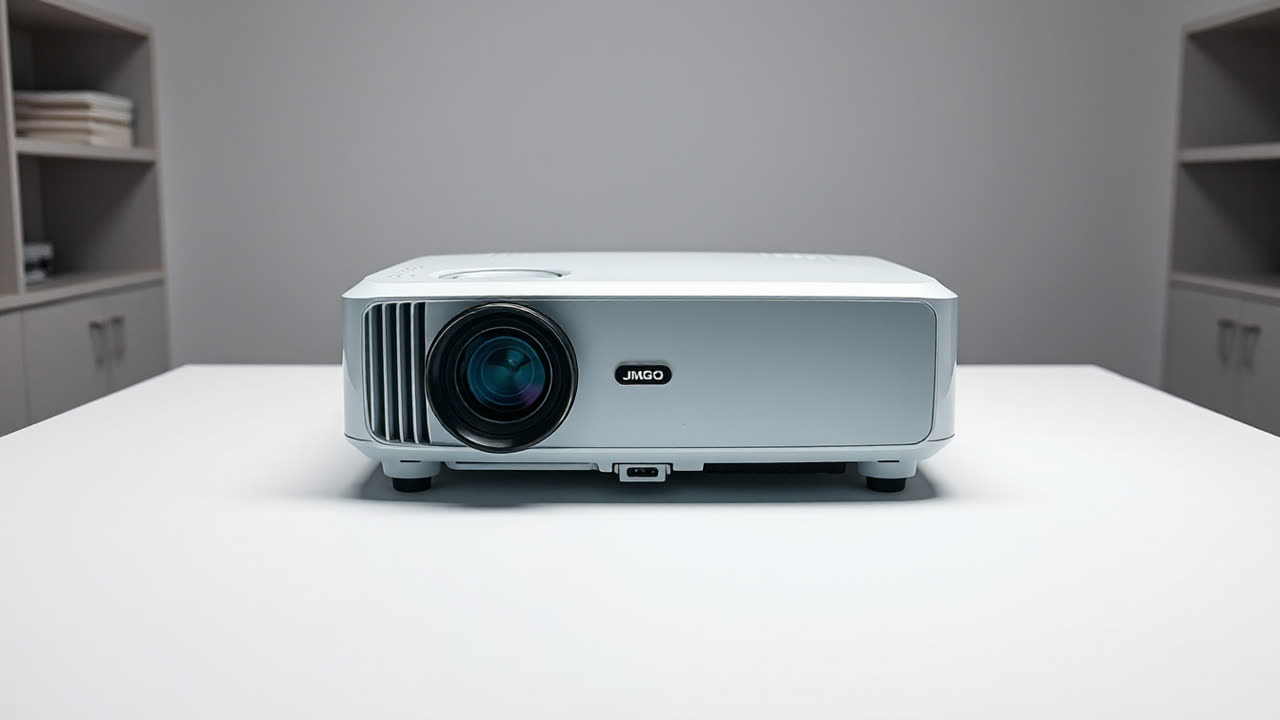
JMGO's Iris Ultra Max 4K 120Hz all-in-one Google TV projector has officially launched outside of China, introducing a groundbreaking dual-iris system that delivers a claimed 10,000:1 native contrast ratio, a figure that fundamentally redefines expectations for projector image depth and fidelity. This aggressive push into international markets with such a technically advanced product positions JMGO as a serious contender in the premium home entertainment space, particularly targeting the lucrative segments of avid gamers and sports enthusiasts.
The Iris Ultra Max distinguishes itself not just with its impressive contrast but also with a suite of features tailored for a high-performance viewing experience. Beyond its 4K resolution and 120Hz refresh rate, crucial for smooth motion in fast-paced content, the projector boasts a brightness of 2,800 CVIA lumens, ensuring vibrant images even in moderately lit environments. Its Google TV integration provides a comprehensive smart platform, offering access to a vast library of streaming services and applications without the need for external devices. The inclusion of Wi-Fi 6 and Bluetooth 5.2 connectivity further enhances its versatility, supporting seamless wireless casting and audio pairing. For gamers, the low input lag, reported to be as low as 8ms at 4K 120Hz, is a critical specification that directly impacts responsiveness and playability, placing it in direct competition with high-end gaming monitors and TVs.
The impact of the Iris Ultra Max on users, especially gamers and sports fans, is profound. For years, projectors have struggled to match the black levels and dynamic range of OLED televisions, often relegating them to niche home theater setups that require absolute darkness. The 10,000:1 native contrast ratio, facilitated by the dual-iris system, significantly narrows this gap, allowing for much deeper blacks and more nuanced shadow detail. This is revolutionary for dark, atmospheric games where detail can be lost in murky greys, and equally beneficial for sports broadcasts, where the crisp delineation of players against a stadium background enhances immersion. The large projected image size, often exceeding 100 inches, combined with this enhanced visual fidelity, offers an experience that even the largest consumer TVs cannot replicate, transforming a living room into a truly cinematic or stadium-like environment.
From an industry perspective, JMGO's innovation challenges established players and pushes the boundaries of projector technology. While other premium projectors offer high brightness and 4K resolution, achieving such a high *native* contrast without dynamic iris trickery or segmenting the image is a significant engineering feat. Brands like Epson, Sony, and JVC have long been lauded for their contrast performance, often utilizing advanced LCOS or 3LCD panels. JMGO's approach with a dual-iris system in a DLP-based projector indicates a new pathway to achieving superior image quality, potentially democratizing high contrast performance at a more accessible price point compared to some ultra-premium offerings. The projector also supports HDR10 and HLG, further enhancing its ability to display a wider range of colors and luminance levels, crucial for modern content.
Comparing the Iris Ultra Max to its rivals reveals a strategic positioning. While high-end laser projectors from brands like Optoma, BenQ, and XGIMI offer impressive brightness and smart features, few explicitly highlight native contrast ratios in the same league as the Iris Ultra Max. Many rely on dynamic contrast, which, while effective, can sometimes introduce visual artifacts or latency. The 120Hz refresh rate at 4K is also a key differentiator, as many projectors capable of 4K often drop the refresh rate to 60Hz or achieve 120Hz at a lower resolution. Previous generations of JMGO projectors, while offering strong value, didn't feature this level of contrast innovation, making the Iris Ultra Max a substantial leap forward for the company. Its all-in-one design, integrating Google TV and robust audio solutions, further streamlines the user experience, often requiring fewer peripheral devices than competing models.
Looking ahead, the success of the Iris Ultra Max could catalyze a new wave of innovation in the projector market. Other manufacturers may be compelled to invest more heavily in native contrast technologies, moving beyond simple brightness wars. We can expect to see increased focus on integrated smart platforms and lower input lag as projectors continue to encroach on traditional television territory for everyday viewing and gaming. JMGO's move also signals a growing maturity in the projector ecosystem, where a single device can genuinely serve as the central hub for all home entertainment needs, from casual streaming to competitive gaming. The future likely holds even brighter, higher-contrast projectors that are increasingly easier to set up and integrate into smart home environments, with JMGO having laid down a significant marker with the Iris Ultra Max.