Kawasaki Unveils Nyokkey: A Humanoid Robot Ambulance for On-Site Industrial Repairs
Kawasaki Heavy Industries has introduced 'Nyokkey,' a groundbreaking humanoid robot designed for immediate, autonomous repairs of industrial machinery directly on the factory floor, significantly reducing downtime.
✨ This content was summarized and interpreted by AI; it may contain errors — please verify accuracy with the original sources. Learn more
Listen to this story
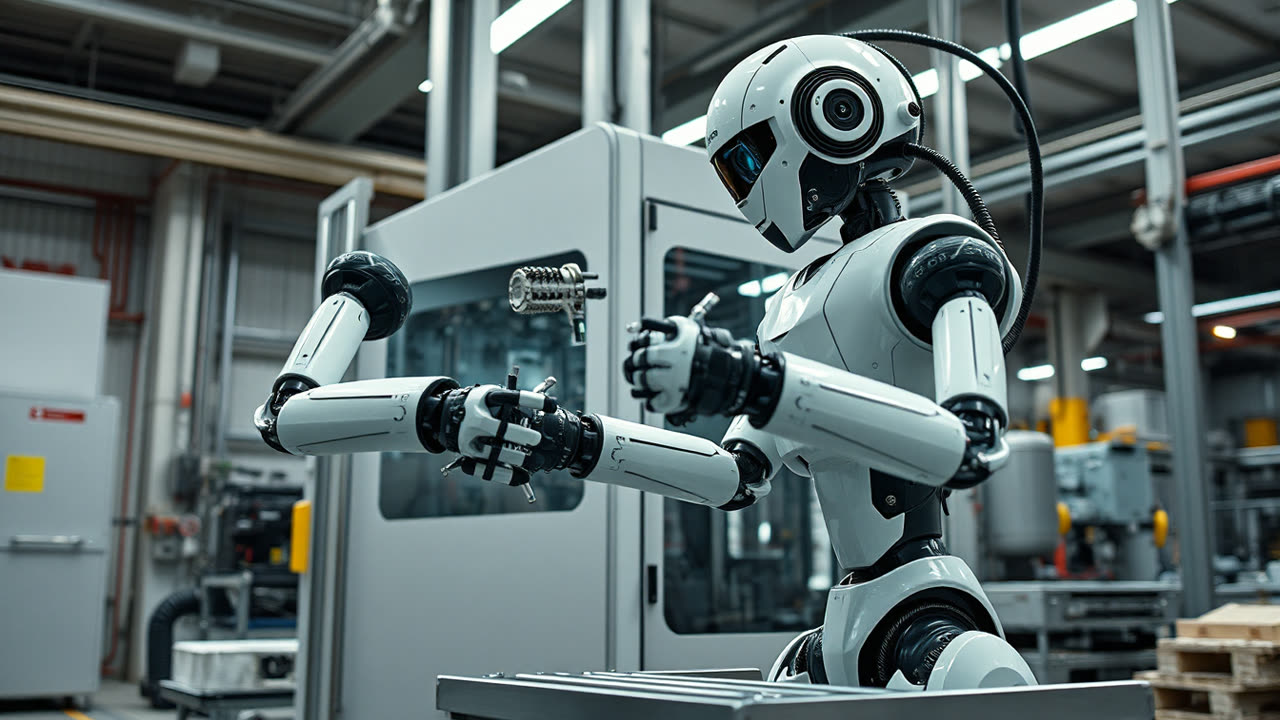
A groundbreaking development from Kawasaki Heavy Industries has unveiled a humanoid robot dubbed "Nyokkey," designed to provide immediate, on-the-spot repairs for industrial machinery, marking a significant leap in autonomous maintenance capabilities. This specialized "robot ambulance" aims to drastically reduce downtime by performing diagnostic checks and repairs directly at the point of failure within manufacturing facilities, addressing a critical bottleneck in industrial productivity. Unlike conventional robotic arms fixed to production lines, Nyokkey boasts a mobile base, allowing it to navigate complex factory environments and reach malfunctioning equipment, offering a flexible and responsive solution to unexpected breakdowns. Its dual-arm configuration, equipped with sophisticated grippers and interchangeable tools, enables it to manipulate objects with precision, mimicking human dexterity to execute intricate repair tasks that traditionally required human intervention.
This innovation profoundly impacts both users and the broader industrial landscape by transforming the paradigm of maintenance and repair. For manufacturers, the immediate benefit is a substantial reduction in Mean Time To Repair (MTTR), directly translating into increased operational efficiency and minimized production losses. By deploying Nyokkey, companies can mitigate the ripple effects of equipment failure, such as disrupted supply chains and missed production targets, which can cost millions of dollars annually. Furthermore, the robot's ability to operate in hazardous or confined spaces enhances worker safety by reducing the need for human technicians to enter dangerous environments. Beyond factories, the underlying technology holds potential for applications in critical infrastructure, energy sectors, and even disaster response, where rapid, autonomous repair is paramount. The industry stands to gain from a shift towards predictive and proactive maintenance strategies, with autonomous robots like Nyokkey serving as the frontline responders, enabling a more resilient and self-optimizing industrial ecosystem.
Historically, industrial maintenance has relied heavily on human technicians, often requiring significant time for diagnosis, part procurement, and manual repair, especially for complex machinery. While early forms of robotic automation have been present in manufacturing for decades, these were primarily confined to repetitive tasks or fixed-position operations. Prior generations of maintenance solutions often involved remote monitoring systems that would alert human operators, who would then physically travel to the site. The advent of mobile manipulation robots, like Nyokkey, represents a significant evolution, integrating mobility with advanced manipulation and perception capabilities. Rivals in the broader industrial robotics space, such as Boston Dynamics' Stretch robot, focus on logistics and material handling, while companies like Sarcos Robotics with their Guardian XT, offer teleoperated solutions that augment human strength and dexterity for heavy-duty tasks. Nyokkey differentiates itself by aiming for *autonomous* on-site repair, a more complex challenge involving real-time decision-making, object recognition, and precise tool handling without constant human input. Its humanoid form factor, while challenging to engineer, offers advantages in interacting with human-designed equipment and environments.
Looking ahead, the development of humanoid repair robots like Nyokkey signals a significant trend towards fully autonomous industrial operations. The next phase will likely involve enhanced AI and machine learning capabilities, allowing these robots to learn from each repair, adapt to new equipment types, and even anticipate potential failures before they occur. Integration with digital twins and sophisticated factory management systems will enable robots to access real-time schematics and historical performance data, further streamlining the repair process. We can expect to see increased collaboration between humanoid robots and other autonomous systems, such as drones for aerial inspection and automated guided vehicles (AGVs) for parts delivery, creating a holistic, self-managing factory floor. The challenges remain in refining their perception systems to handle unpredictable real-world conditions, improving battery life for extended operation, and developing more robust universal grippers and tool-changing mechanisms. As these technologies mature, the vision of fully autonomous factories, capable of self-diagnosis and self-repair, moves closer to reality, promising unprecedented levels of efficiency and resilience across global industries.