Keychron's Thunderbolt 5 Dock: A Strong Entry into High-End Peripherals
Keychron, known for its mechanical keyboards, has launched a $349.99 Thunderbolt 5 Dock, marking a significant and surprisingly strong entry into the high-end docking station market.
✨ This content was summarized and interpreted by AI; it may contain errors — please verify accuracy with the original sources. Learn more
Listen to this story
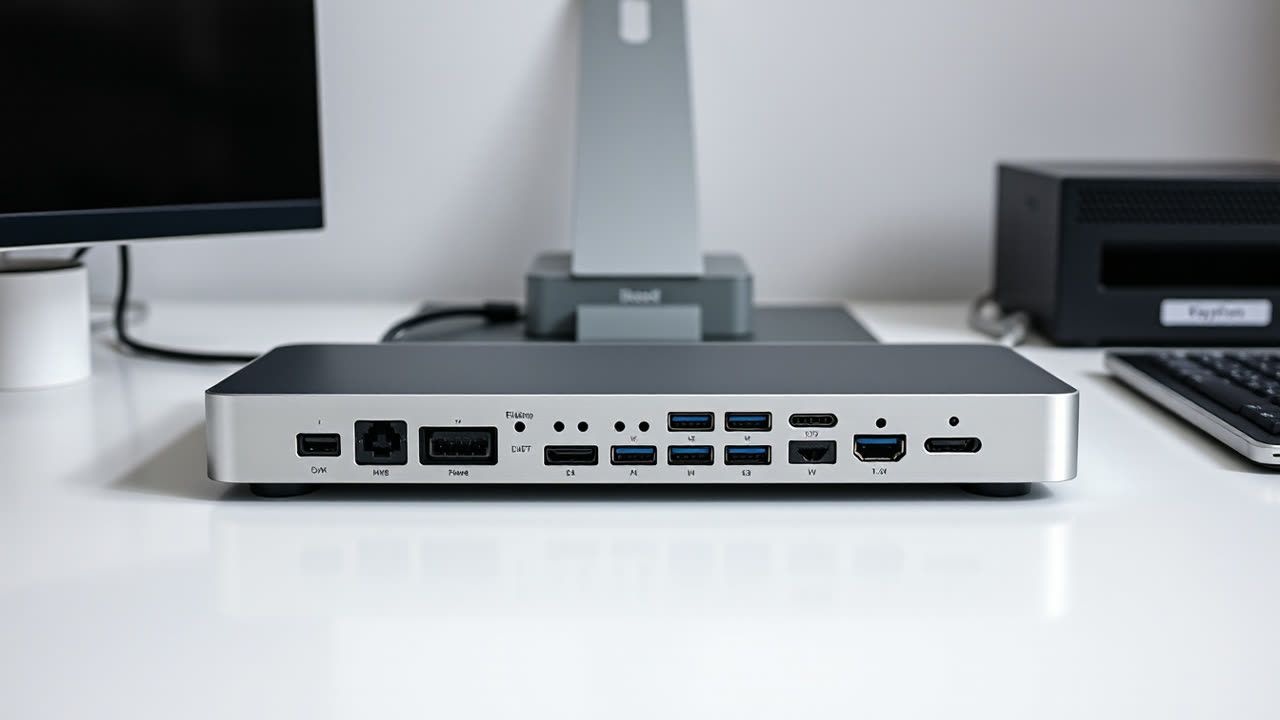
Keychron, a company primarily recognized for its mechanical keyboards, has made a significant and surprisingly strong entry into the high-end docking station market with its Thunderbolt 5 Dock, priced at $349.99 and launched in July 2026. This 14-in-1 peripheral immediately stands out, not merely as an expansion hub, but as a critical component in the evolving landscape of professional workstations, especially as computing devices increasingly adopt the high-bandwidth Thunderbolt 5 standard.
The core appeal of Keychron's Thunderbolt 5 Dock lies in its comprehensive connectivity and robust performance. It boasts 80Gbps bidirectional data transfer speeds, with a dynamic "Bandwidth Boost" mode that can reach up to 120Gbps upstream, specifically catering to video-intensive workflows. This translates into practical benefits like supporting dual 8K monitors at 60Hz or up to three 4K monitors at 144Hz, a substantial leap from Thunderbolt 4's dual 4K or single 8K display limitations. Additionally, the dock delivers up to 140W of upstream power, capable of charging most high-performance laptops, including 16-inch MacBook Pro models with M3, M4, or M5 Pro/Max chips.
Keychron’s offering provides a generous array of 14 ports, including three Thunderbolt 5 ports (one upstream, two downstream), five USB 3.2 Gen 2 ports (four Type-A, one Type-C, all offering 10Gbps speeds), two HDMI 2.1 outputs, a 2.5Gb Ethernet port, dual SD and microSD card slots, and a 3.5mm audio combo jack. This diverse selection, particularly the dual HDMI 2.1 ports, positions it favorably against rivals like CalDigit's TS5 ($399) and Razer's Thunderbolt 5 Dock Chroma ($379), which often omit HDMI or prioritize other features like integrated SSD bays or RGB lighting. The dock's fanless, CNC-machined aluminum chassis not only contributes to a minimalist, Apple-inspired aesthetic but also ensures silent operation through effective passive heat dissipation, a thoughtful design choice for quiet workspaces. Its ability to be oriented both vertically and horizontally further adds to its versatility in various desk setups.
This product matters significantly because it extends Keychron's philosophy of democratizing high-end functionality, previously seen in their popular mechanical keyboards and mice, into a new, complex peripheral category. For users, it promises to transform a laptop into a comprehensive desktop workstation or even a portable video and podcast studio with a single cable connection, simplifying setups and enhancing productivity. In an industry where many new technologies prioritize raw specifications, Keychron’s focus on reliability, comprehensive connectivity, and a sensible, quiet design offers genuine analytical value that transcends mere speed benchmarks. It addresses the growing need for single-cable solutions as modern laptops shed traditional ports, preventing the "dongle farm" syndrome common with less integrated solutions.
Keychron, founded in 2017 in Hong Kong, has built its reputation on manufacturing high-quality, often open-source, mechanical keyboards and mice, gaining a strong community following and recognition from major tech publications. Their move into docking stations, particularly at the cutting edge of Thunderbolt 5 technology, suggests a strategic expansion to capture a broader segment of the professional peripheral market. While Thunderbolt 4 docks typically offered 40Gbps bandwidth, 100W power delivery, and dual 4K display support, Thunderbolt 5, powered by Intel's Barlow Ridge controller, doubles the bidirectional bandwidth to 80Gbps, increases PCIe throughput to 64Gbps (from 32Gbps), and supports up to 240W power delivery, though Keychron's dock provides 140W. This generational leap is crucial for demanding tasks like 8K video editing, large-scale data transfers to external NVMe SSDs, and driving multiple high-refresh-rate displays.
Looking ahead, the Keychron Thunderbolt 5 Dock, despite its strengths, enters a market where Thunderbolt 5 itself is still ahead of widespread adoption. While essential for content creators, engineers, and power users who push the limits of resolution, refresh rates, and data throughput, many general office users may still find Thunderbolt 4 sufficient for their needs. The ongoing evolution of Thunderbolt 5 docks suggests a period of intense competition and innovation. Rivals like the Ugreen Revodok Maxidok offer an M.2 NVMe slot for integrated storage and active cooling, while others like the HyperDrive Next Thunderbolt 5 Dock share similar core chipsets, hinting at common OEM sources with varied feature sets. Keychron's initial foray, however, prioritizes a balanced, robust, and user-friendly experience at a competitive price point, particularly with its standout dual HDMI 2.1 support. This strategic focus on "sensible" design and comprehensive, high-performance connectivity, rather than chasing every niche feature, positions Keychron well to become a significant player beyond its keyboard roots as Thunderbolt 5 becomes the mainstream standard for high-end workstations.