Kia Offers Up to $10,000 Off EVs Amidst Price War and EV3 Launch
Kia is aggressively sweetening its electric vehicle deals with significant cash incentives and financing options, responding to a competitive market and the arrival of its new affordable EV3 model.
✨ This content was summarized and interpreted by AI; it may contain errors — please verify accuracy with the original sources. Learn more
Listen to this story
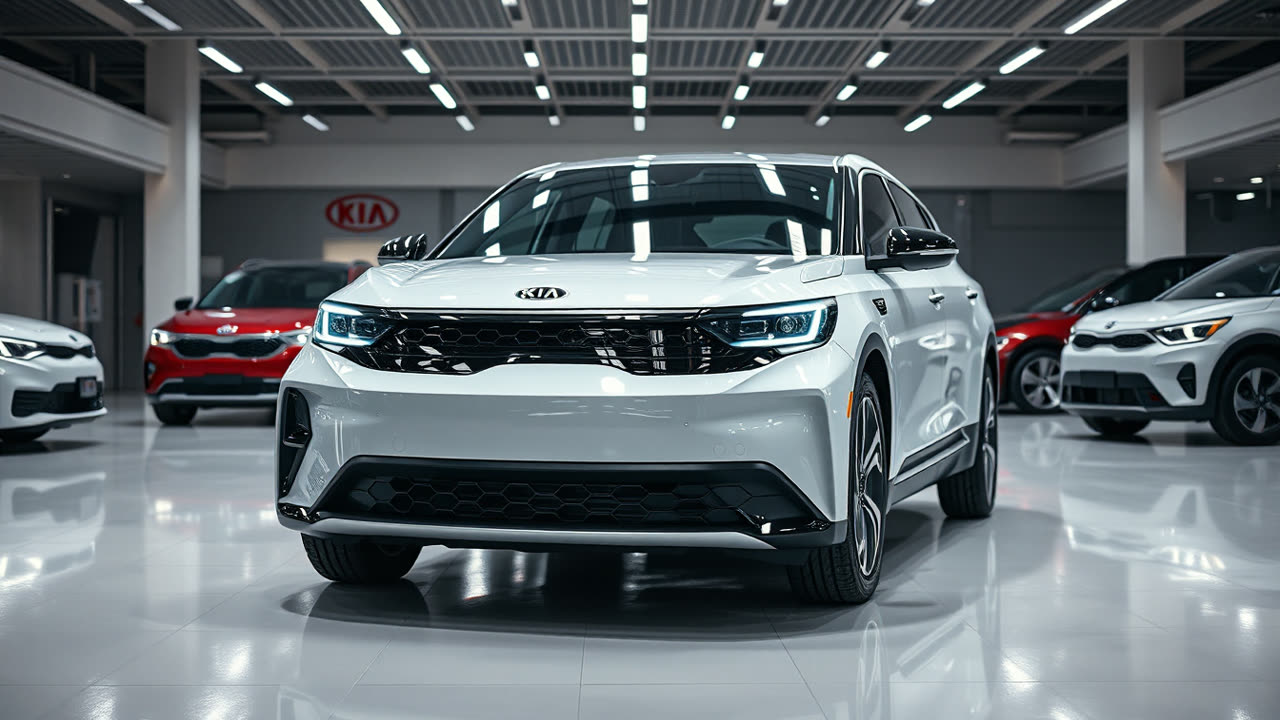
Kia is aggressively sweetening its electric vehicle (EV) deals with up to $10,000 in customer cash on select models, a strategic move coinciding with the arrival of the new 2027 EV3 at dealerships. This significant incentive push, effective until November 2, 2026, marks a clear effort by the South Korean automaker to stimulate demand in an increasingly competitive and price-sensitive EV market.
The most substantial discounts are currently applied to the 2026 Kia EV9 and the outgoing 2026 Kia Niro EV, both offering up to $10,000 in customer cash. For the three-row EV9, this incentive can be combined with 0% APR financing and an additional $5,000 APR Bonus Cash, making it a compelling package for buyers. Lease offers for the EV9 Light Long Range RWD start as low as $399 a month for 36 months, with $4,999 due at signing. Some dealers are even advertising up to $16,000 off the 2026 EV9, with lease deals as low as $459/month and $0 down on the Wind AWD trim, and lease cash rebates reportedly ranging from $11,000 to $15,000. The 2026 Kia EV6 also benefits from a $5,000 customer cash discount, with lease options starting at $369 per month for 36 months with $4,999 down, and 0% APR financing available. The 2027 EV3, Kia's most affordable EV starting at $29,890, enters the market with a more modest $1,500 customer cash discount or 0.90% APR for 48 months, though its Light trim currently has no special offer.
This aggressive pricing strategy is a direct response to a complex and evolving EV landscape. Globally, the EV market is experiencing a significant "price war" dynamic, transitioning from a focus on sheer scale to one of value competition. While overall new light-vehicle sales in the US recorded a SAAR of 16.8 million units in August 2026, a 1.5% increase year-over-year, the market share for battery electric vehicles (BEVs) has notably fallen. In August 2025, BEVs constituted 10.1% of new vehicle sales, but this dropped to just 6.2% in August 2026, a nearly 4 percentage point decline. This dip follows the expiration of the federal $7,500 EV tax credit in September 2025, which significantly impacted sales in Q4 2025, causing a 45% reduction compared to Q4 2024. Automakers are now largely shouldering the burden of incentives themselves to maintain momentum.
For Kia, these incentives are crucial. Despite a strong overall sales performance, with Kia America achieving its best September sales month since 1992 and being on track for a fourth consecutive record sales year, its dedicated EV sales have faced headwinds. In August 2026, Kia's three dedicated EV nameplates sold 44% fewer units than in August 2025, a period that saw buyers rushing to qualify for the expiring federal tax credit. The EV6, for example, saw sales down 39% in August 2026 compared to August 2025. The EV3, despite its global success with over 75,000 units sold worldwide and being named 2025 World Car of the Year, recorded only 514 sales in its first full month in the US (September 2026), indicating a need for strong initial market penetration.
The introduction of the EV3, starting at under $30,000, positions Kia to capture a segment of the market seeking more affordable electric options, competing with models like the Chevy Bolt EV and Nissan Leaf, but offering potentially longer range and available AWD. The EV3 Light FWD, for instance, offers an EPA-estimated range of 221 miles, while the Wind and Land FWD trims boast 321 miles. This contrasts with its larger siblings, the EV6 and EV9, which cater to more premium segments. The substantial discounts on the EV9 and Niro EV aim to clear existing inventory and maintain sales velocity for these models, especially as the Niro EV is described as "on its way out".
Compared to rivals, Kia's approach is aggressive but not isolated. Competitors like Hyundai have also extended aggressive lease offers for models like the IONIQ 5, while GM is offering $7,500 incentives on EVs that lost federal tax credits. Toyota is even offering a $3,000 "conquest cash" incentive to lure owners of rival EVs to its bZ models. This competitive environment underscores the industry's pivot from simply producing EVs to effectively selling them in a market where consumer hesitancy, infrastructure concerns, and upfront costs remain significant barriers.
Looking ahead, Kia's strategy reflects a dual approach: making its established EV models more accessible through aggressive pricing to counter slowing demand and the absence of federal incentives, while simultaneously launching new, more affordable models like the EV3 to broaden its market appeal. The company aims to expand its EV lineup to 14 models and achieve 1 million annual EV sales globally by 2030, with a target of 1.02 million units in the U.S. alone. This includes a strong focus on hybrid models, with plans to increase HEV sales from 690,000 units in 2026 to 1.1 million by 2030, indicating a recognition of diverse consumer preferences and a hedging strategy against pure BEV fluctuations. The success of these current incentives, ending in early November, will be a critical indicator of consumer responsiveness and may dictate whether similar or even deeper discounts become a permanent fixture in the battle for EV market share. The average new-vehicle monthly payment reaching a record $812 in August 2026, coupled with steady borrowing costs, suggests that affordability remains a key lever for driving sales. Kia's current maneuvers are not merely promotional; they are a calculated effort to navigate a maturing EV market, sustain growth, and solidify its position as a major player in the electrified future.