Kia's Larger PV7 Electric Van Poised to Expand Market Dominance in 2027
Kia is set to significantly expand its dominance in the electric commercial vehicle market with the forthcoming launch of its larger PV7 electric van in 2027, building on the unexpected success of its smaller PV5 sibling.
✨ This content was summarized and interpreted by AI; it may contain errors — please verify accuracy with the original sources. Learn more
Listen to this story
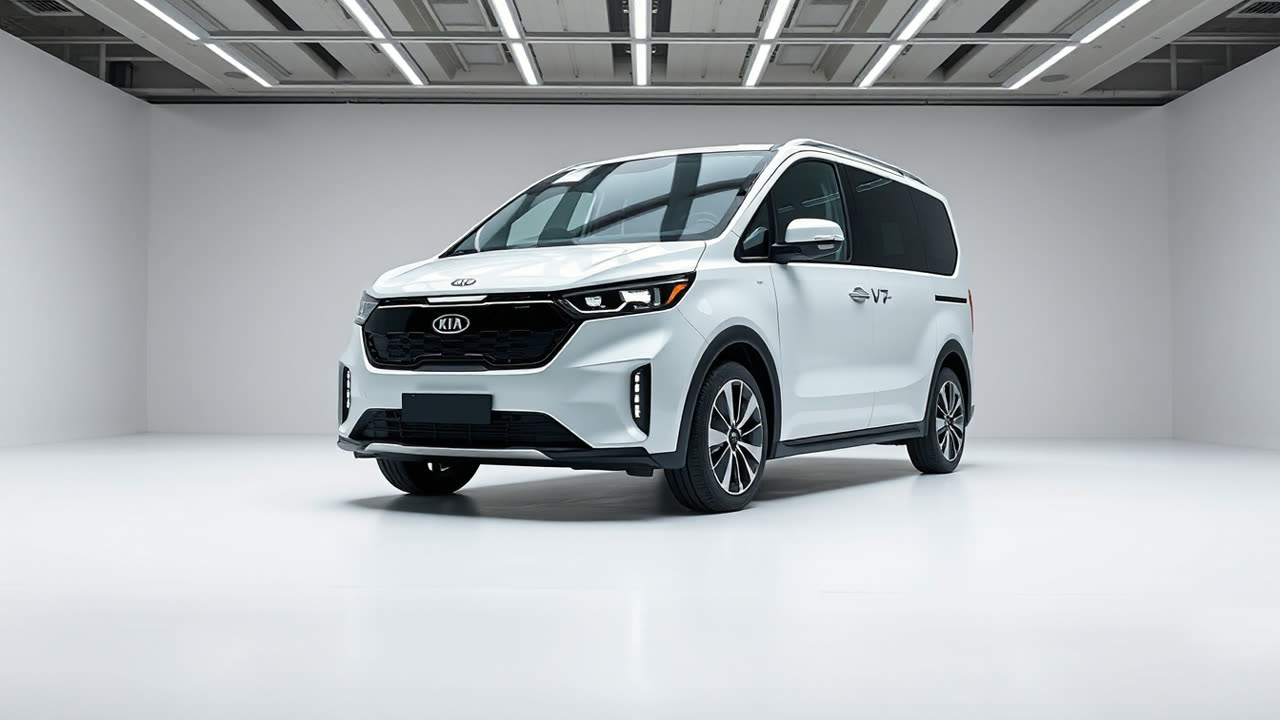
Kia is poised to significantly expand its dominance in the electric commercial vehicle market with the forthcoming launch of its larger PV7 electric van in 2027, building on the unexpected success of its smaller PV5 sibling. Recent sightings of the PV7 prototype with minimal camouflage confirm its substantial size, hinting at a vehicle designed to address a broader spectrum of commercial and passenger transport needs. This strategic introduction is a cornerstone of Kia's ambitious "Platform Beyond Vehicle" (PBV) strategy, which aims to redefine mobility solutions by offering highly customizable, software-defined electric vehicles.
The PV7, which was showcased as a concept at the 2024 CES, is significantly larger than the PV5, measuring 5,270 mm in length, 2,065 mm in width, and 2,120 mm in height, with a substantial 3,390 mm wheelbase. This places it firmly in the large-format commercial van segment, comparable to a standard Ford Transit, a notable step up from the mid-sized PV5's 4,695 mm length and 2,995 mm wheelbase. Powering this larger platform is an expected 103 kWh battery, leveraging an 800-volt architecture for rapid charging capabilities, with some projections suggesting a range exceeding 500 kilometers and 10-80% charging in under 30 minutes. The PV7 is also engineered for a robust payload capacity of 1,300 kg (2,866 lbs), underscoring its utility for heavy-duty logistics and delivery tasks.
The significance of the PV7 extends beyond its increased dimensions and power, lying primarily in its "hypermodular" design and advanced technological integration. As a PBV, it features "interchangeable life modules" that allow the vehicle to be rapidly configured for diverse applications—from cargo delivery and passenger shuttles to mobile workspaces or specialized service units. This modularity is a game-changer for businesses, reducing the need for multiple specialized vehicles and optimizing fleet efficiency by enabling quick adaptation to changing operational demands. Furthermore, the PV7 will incorporate Hyundai's Pleos infotainment system and advanced fleet software, alongside sophisticated driver assistance systems, autonomous driving technologies, and AI-backed controls, promising enhanced safety, efficiency, and connectivity for operators. Kia's commitment to OEM-level customization, including specific paint colors and graphics, further simplifies fleet management and branding for businesses.
The PV7's imminent arrival is particularly impactful given the remarkable market penetration of its predecessor, the PV5. Launched in late 2025, the PV5 quickly became the top-selling small (C-segment) electric van across Europe and the UK, capturing an impressive 37% of the market and leading sales in 12 countries by the first half of 2026. Kia sold 13,166 PV5s in the first six months of 2026 alone, with monthly UK registrations surpassing 1,000 units in July. This success, partly attributed to a Guinness World Record-setting 693.38 km (430.84 miles) on a single charge for the PV5 Cargo, demonstrates Kia's capability to deliver compelling electric commercial solutions. The PV7 is set to build on this momentum, directly challenging established rivals like the Ford E-Transit Custom, Volkswagen ID. Buzz Cargo, and Mercedes eSprinter in the larger van segment. Its 800V architecture provides a distinct advantage over the PV5's 400V system, offering faster charging crucial for commercial uptime.
Looking ahead, Kia's PBV roadmap is ambitious and clearly defined. The PV7's launch in 2027 will be followed by an even larger PV9 model in 2029, establishing a comprehensive lineup of purpose-built electric vans. Kia aims for global PBV sales of 232,000 to 250,000 units by 2030, with the PV7 alone targeted for 100,000 units, and Europe earmarked as a primary market with a target of 133,000 units. This aggressive strategy is underpinned by a dedicated PBV production facility, the EVO Plant in Hwaseong, South Korea, designed for flexible manufacturing and an annual capacity of 250,000 units. Beyond vehicle sales, Kia envisions a future where PBVs, integrated with cloud-based Open APIs and AI, will form the backbone of new mobility ecosystems, including subscriptions, car-sharing, and smart logistics, potentially extending to fully autonomous, ultra-small PV1 models post-2032. This holistic approach, combining advanced EV technology, unparalleled modularity, and software-defined capabilities, positions Kia not merely as a vehicle manufacturer, but as a transformative force in the future of sustainable, connected commercial mobility.