Laser Wireless Charging Achieves Record Efficiency for Indefinitely Airborne Drones
A new laser wireless charging system boasts an unprecedented 38.49% conversion efficiency, promising drones that can stay airborne indefinitely by eliminating the need for landings or battery swaps.
✨ This content was summarized and interpreted by AI; it may contain errors — please verify accuracy with the original sources. Learn more
Listen to this story
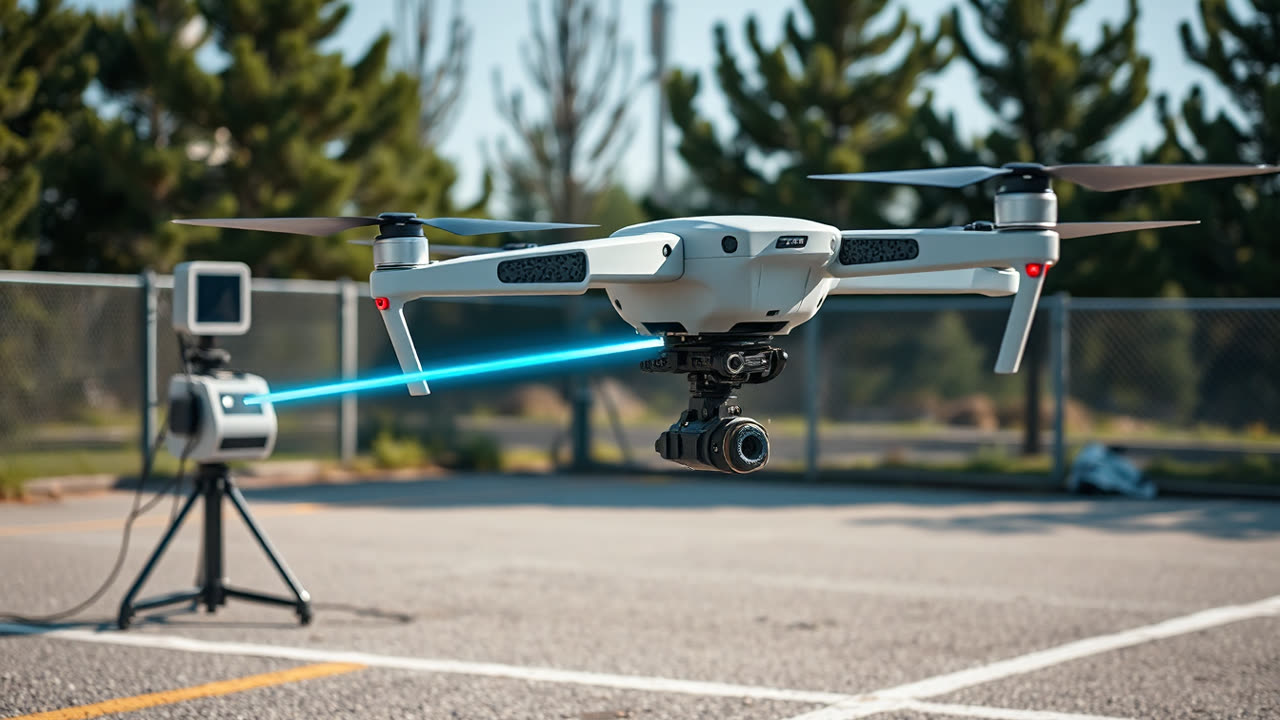
A new development in laser wireless charging has achieved an unprecedented 38.49% conversion efficiency for a drone receiver, utilizing nanocrystalline material to manage thermals and pushing the envelope for indefinitely airborne drones. This breakthrough, originating from the research efforts at the University of Washington's Air Force Research Laboratory (AFRL) and PowerLight Technologies, represents a significant leap from previous attempts at laser power beaming, which often struggled with heat dissipation and lower energy conversion rates, typically hovering below 10-20% for practical distances. The core innovation lies in a specialized photovoltaic receiver designed to efficiently capture energy from a ground-based infrared laser, converting it into usable electricity to power a drone without the need for landing or battery swaps.
This technological advancement fundamentally alters the operational paradigm for a multitude of drone applications, offering genuine analytical value that transcends mere extended flight times. For commercial drone operators, particularly those in logistics, infrastructure inspection, and precision agriculture, the elimination of frequent landings for recharging translates directly into vastly improved operational efficiency and reduced labor costs. Imagine a delivery drone capable of continuous operation throughout a shift, or an inspection drone monitoring vast pipelines or power lines without interruption, collecting data for hours on end. This sustained presence enables real-time data collection and immediate response capabilities previously limited by battery life. The potential for continuous surveillance in defense and security applications, where drones could maintain persistent oversight of critical areas, presents a transformative shift in intelligence gathering and force projection. Furthermore, the inherent safety risks associated with frequent take-offs and landings, as well as the logistical complexities of battery management and charging infrastructure in remote locations, are significantly mitigated.
Compared to current drone power solutions, this laser charging method stands out. Most commercial drones rely on lithium-ion batteries, offering flight times typically ranging from 20 to 45 minutes, necessitating frequent battery swaps or lengthy wired recharges. While tethered drones offer indefinite flight by drawing power from a ground station via a physical cable, their mobility is severely restricted, confining them to a limited radius. Other wireless charging approaches, such as inductive charging pads, require the drone to land precisely on a specific spot, negating the benefit of continuous flight. Solar-powered drones, while promising for long endurance, are highly dependent on weather conditions and light intensity, often requiring large, heavy solar arrays that compromise maneuverability and payload capacity. This laser charging system, by contrast, offers the best of both worlds: untethered mobility combined with near-continuous power supply, provided the drone remains within the laser's line of sight. The use of nanocrystalline material is particularly critical, as it addresses one of the most significant hurdles in high-power laser energy conversion: the generation of excessive heat, which can degrade photovoltaic cells and limit efficiency. By effectively dissipating this thermal energy, the system maintains optimal operating temperatures, ensuring sustained performance and longevity of the receiver.
Looking ahead, the path to widespread commercial adoption, while promising, faces several critical challenges. Safety regulations for high-power laser beaming in public airspace will be paramount, requiring rigorous testing and clear guidelines to prevent accidental exposure to humans or sensitive equipment. The scalability of the technology, including the ability to power multiple drones simultaneously from a single ground station and the effective management of power distribution across a fleet, will be key to its economic viability. Furthermore, extending the operational range and maintaining stable power transmission in varied atmospheric conditions (fog, rain, dust) will be crucial for real-world deployment. The cost of implementing such advanced laser beaming infrastructure, including high-power lasers and sophisticated tracking systems, will also need to decrease to make it accessible for smaller operators. However, the potential returns in efficiency and capability are so substantial that investment in overcoming these hurdles is highly likely. We can anticipate initial deployments in controlled environments, such as large warehouses for inventory management or secure industrial sites for continuous monitoring, before expanding to broader applications. Future iterations may see more compact and efficient receivers, potentially integrated directly into drone airframes, and the development of mobile laser charging units that can follow drones, further enhancing their operational flexibility. This laser wireless charging technology is not just an incremental improvement; it is a foundational shift that promises to unlock an entirely new era of autonomous flight and persistent aerial operations.