Leaked Images Reveal Lenovo's Googlebook Laptop and 2-in-1 Tablet
Leaked press renders offer the first look at Lenovo's forthcoming Googlebook models, signaling Google's strategic re-entry into premium computing hardware through a significant partnership.
✨ This content was summarized and interpreted by AI; it may contain errors — please verify accuracy with the original sources. Learn more
Listen to this story
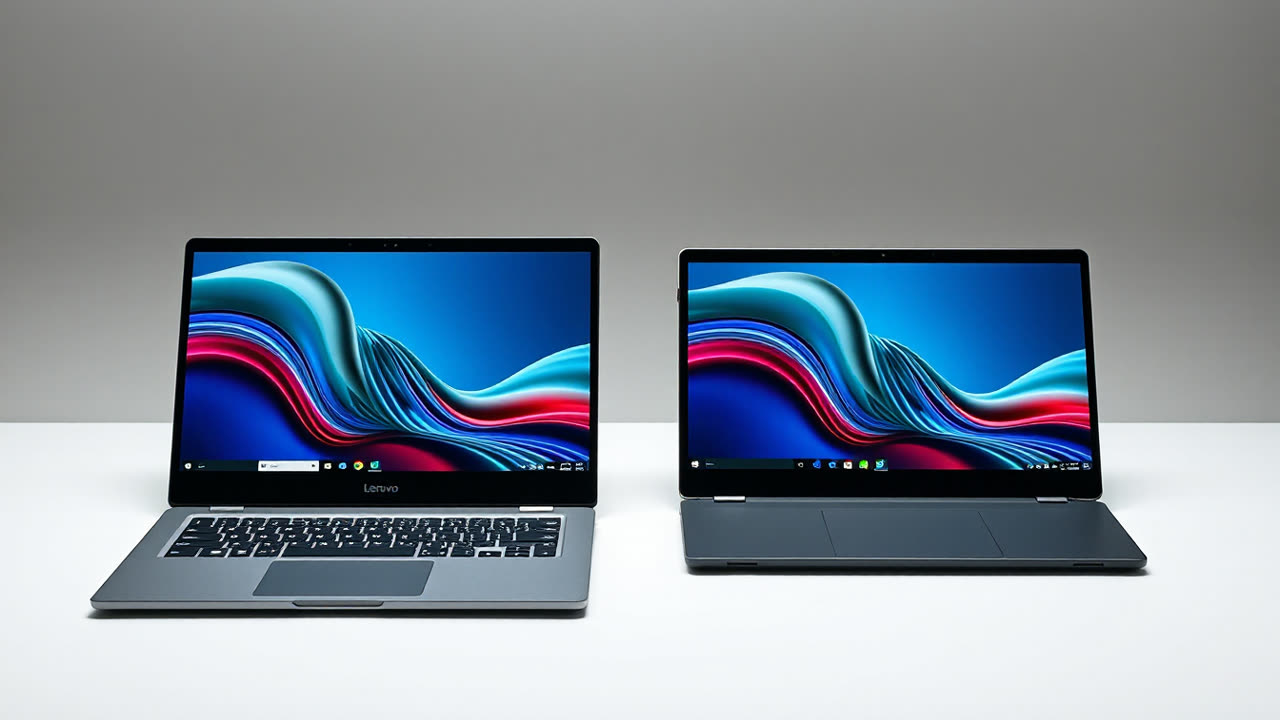
Leaked images have offered the first glimpse of Lenovo's forthcoming Googlebook models, revealing both a traditional laptop and a versatile 2-in-1 tablet, signaling Google's potential re-entry into the premium, first-party-esque computing hardware space through a strategic partnership. This move, if the leaks prove accurate, represents a significant evolution beyond the established Chrome OS ecosystem, suggesting a new, potentially more integrated software experience designed to challenge the dominance of Windows and macOS, while also providing a high-end alternative to existing Chromebooks and Android tablets. The detailed press renders, reportedly shared by Digital Citizen and Android Headlines, indicate a sophisticated design language, underscoring an ambition to capture a segment of the market increasingly demanding seamless productivity and entertainment across form factors.
The emergence of "Googlebook" as a distinct product category, rather than another iteration of Pixelbook or a standard Chromebook, carries profound implications for both users and the wider industry. For consumers, it could herald a more cohesive and powerful Google-centric computing experience, potentially merging the best aspects of Android's app ecosystem with Chrome OS's lightweight efficiency and security. This could translate into superior performance for demanding applications, enhanced AI capabilities integrated directly into the operating system, and a more unified interface across Google's hardware and software offerings. A premium Googlebook, especially a 2-in-1, could directly compete with Apple's iPad Pro and MacBook Air lines, as well as Microsoft's Surface devices, by offering a compelling alternative centered on Google's vast cloud services and AI advancements. The potential for deeper integration of Google Assistant, advanced machine learning for tasks like photo editing or content creation, and robust cross-device functionality with Android smartphones could redefine expectations for mobile computing.
From an industry perspective, a successful Googlebook launch would intensify competition in the premium laptop and 2-in-1 markets, forcing rivals to innovate further. For Lenovo, this partnership could solidify its position as a key hardware partner for Google, much like it has been for Microsoft's Windows ecosystem. Lenovo consistently ranks among the top global PC vendors, holding a significant market share, and its expertise in diverse form factors, from ultrabooks to detachables, makes it an ideal candidate to pioneer a new Google hardware initiative. This collaboration could provide Lenovo with a differentiated product line that stands out in a crowded market, potentially boosting its brand perception and profitability in the high-end segment. Furthermore, the introduction of a new Google-backed operating system or a heavily revamped Chrome OS under the "Googlebook" moniker could spur developers to optimize applications specifically for this new platform, fostering a richer software ecosystem that benefits all Google-powered devices. The move also signals Google's continued commitment to hardware, extending its "Made by Google" philosophy beyond smartphones and smart home devices into a more direct challenge to traditional computing paradigms.
The background to Googlebook lies in Google's prior attempts to carve out a niche in the laptop market. The Pixelbook series, while lauded for its premium design and Chrome OS experience, struggled to gain widespread traction against more established operating systems. Similarly, Android tablets have largely remained secondary devices, lacking the robust productivity features often found on laptops. The "Googlebook" initiative appears to be an attempt to learn from these experiences, possibly by introducing a new, unified platform that addresses the limitations of both Chrome OS and Android when used independently for primary computing. While Chrome OS has seen steady growth, particularly in education and budget-friendly segments, its perception as a "browser-only" OS, despite significant advancements, has limited its appeal to power users. A Googlebook, with its implied premium positioning and Lenovo's hardware prowess, could aim to shed this perception, offering a full-fledged computing experience. Comparisons to current rivals like Apple's M-series MacBooks and iPad Pros, or Microsoft's Snapdragon X Elite-powered Surface devices, would inevitably focus on performance, battery life, software ecosystem, and, crucially, AI integration. The market for AI PCs is projected to grow significantly, with AI features becoming a major differentiator. A Googlebook would need to deliver cutting-edge AI capabilities directly at the OS level to compete effectively.
Looking ahead, the success of the Googlebook will hinge on several critical factors. Foremost among these is the underlying operating system. If it's merely a rebranded Chrome OS, albeit with premium hardware, it might struggle to justify its likely higher price point against existing Chromebooks. However, if "Googlebook" signifies a genuinely new, possibly Fuchsia-based, or a deeply reimagined Chrome OS with seamless Android app integration and advanced AI capabilities, it could be a game-changer. Google's ongoing efforts to integrate AI across its product portfolio, from search to Workspace, suggest that a Googlebook would likely feature AI as a core differentiator, offering personalized experiences and intelligent assistance. The pricing strategy will also be crucial; to challenge established players, Googlebook will need to offer compelling value. Furthermore, developer support will be paramount. Google must incentivize developers to create optimized applications that leverage the unique capabilities of the Googlebook platform, ensuring a rich and diverse software ecosystem from day one. If executed effectively, Googlebook could carve out a significant segment in the premium computing market, pushing the boundaries of what a lightweight, cloud-centric, and AI-powered device can achieve. Failure to deliver a truly differentiated experience, however, could see it relegated to another niche product in Google's expanding hardware portfolio.