LG Unveils World's First Native 1,000 Hz Gaming Monitor
LG's new UltraGear 25G590B pushes display responsiveness to an unprecedented 1,000 Hz, targeting elite esports players with a $1,000 price tag.
✨ This content was summarized and interpreted by AI; it may contain errors — please verify accuracy with the original sources. Learn more
Listen to this story
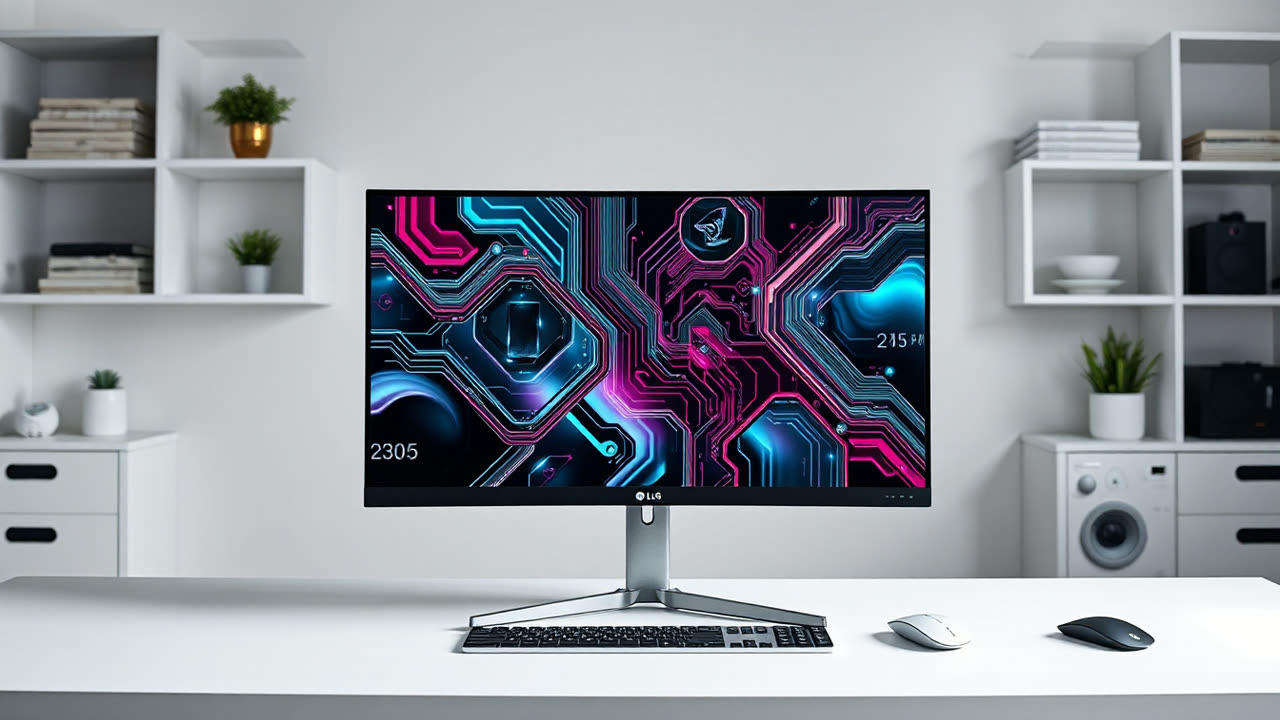
LG has launched its UltraGear 25G590B, a 25-inch 1080p gaming monitor boasting an unprecedented native 1,000 Hz refresh rate, available for preorder at a matching $1,000 price point, pushing the boundaries of display responsiveness to a new extreme. This monitor represents a significant, albeit niche, leap in refresh rate technology, targeting the absolute pinnacle of competitive esports where every millisecond counts. The 25G590B utilizes a TN panel, a deliberate choice for its inherent speed advantage over IPS or VA technologies, and features a 0.3 ms GtG (Gray-to-Gray) response time, further minimizing motion blur and input lag. It also supports AMD FreeSync Premium, ensuring tear-free gaming experiences by synchronizing the monitor's refresh rate with the GPU's output. Connectivity includes DisplayPort 1.4 and HDMI 2.1 ports, crucial for handling the immense bandwidth required for 1,000 Hz at 1080p.
The immediate impact on users, specifically professional esports players and extreme enthusiasts, is the potential for an even more fluid and responsive visual experience than previously thought possible. While the human eye's ability to discern differences beyond 240 Hz or 360 Hz is a subject of ongoing debate, competitive gamers often report a tangible advantage from higher refresh rates, citing improved target tracking and reaction times. The jump to 1,000 Hz, therefore, offers a theoretical peak performance ceiling, providing potentially imperceptible but measurable gains in scenarios where fractional differences decide outcomes. However, the practical application is severely limited by the hardware required to consistently drive games at 1,000 frames per second (FPS) at 1080p, even in less graphically intensive esports titles like *CS:GO* or *Valorant*. Current high-end GPUs, paired with top-tier CPUs, struggle to maintain such frame rates in many competitive games, let alone graphically demanding AAA titles, making this monitor's full potential largely theoretical for most users.
Historically, refresh rates have steadily climbed from 60 Hz to 144 Hz, then to 240 Hz, and more recently, 360 Hz and 540 Hz. For instance, monitors like Alienware's AW2524H offered a 500 Hz refresh rate at 1080p, priced around $650. ASUS also previously introduced a 540 Hz 1080p TN panel, the ROG Swift Pro PG248QP, which launched for $900. LG's 25G590B, at 1,000 Hz, dwarfs these existing high-refresh-rate displays, positioning itself as the undisputed leader in raw refresh rate numbers. However, its $1,000 price tag for a 25-inch 1080p TN panel is a significant premium, especially when compared to monitors offering higher resolutions (1440p or 4K) or superior panel technologies (OLED) at lower or comparable prices. For example, many high-refresh-rate 1440p OLED monitors, offering superior contrast and color accuracy, are available in a similar price bracket, albeit with lower refresh rates typically around 240 Hz or 360 Hz. This stark contrast highlights the 25G590B's singular focus on refresh rate above all else.
From an industry perspective, LG's move is a bold statement, pushing the envelope of what's technically feasible for gaming displays. It serves as a halo product, demonstrating LG's engineering prowess and potentially setting a new, albeit extreme, benchmark for other manufacturers to chase. This could spur further innovation in panel technology, driver boards, and display interface standards to support even higher refresh rates and resolutions concurrently. However, the market for such a specialized, high-cost, low-resolution monitor is exceedingly small. The practical limitations of achieving and perceiving 1,000 FPS mean that broader adoption is unlikely in the near term. Instead, the real innovation will likely be seen in the trickle-down effect, where technologies developed for this extreme monitor might optimize lower, more perceptible refresh rates (e.g., 540 Hz) at more palatable resolutions (e.g., 1440p) and price points. The future of gaming monitors will likely continue to diversify, with high-refresh-rate 1440p and 4K OLEDs becoming more mainstream for premium experiences, while ultra-high refresh rate 1080p monitors like the 25G590B will remain a niche for the most demanding competitive players, awaiting further advancements in GPU technology to truly unlock their full potential.