Liquid AI Unveils d1: A Groundbreaking Decision Model with Zero Output Tokens
Liquid AI's d1 model redefines AI decision-making by delivering calibrated probabilities for structured choices with unprecedented efficiency, bypassing the generative paradigm.
✨ This content was summarized and interpreted by AI; it may contain errors — please verify accuracy with the original sources. Learn more
Listen to this story
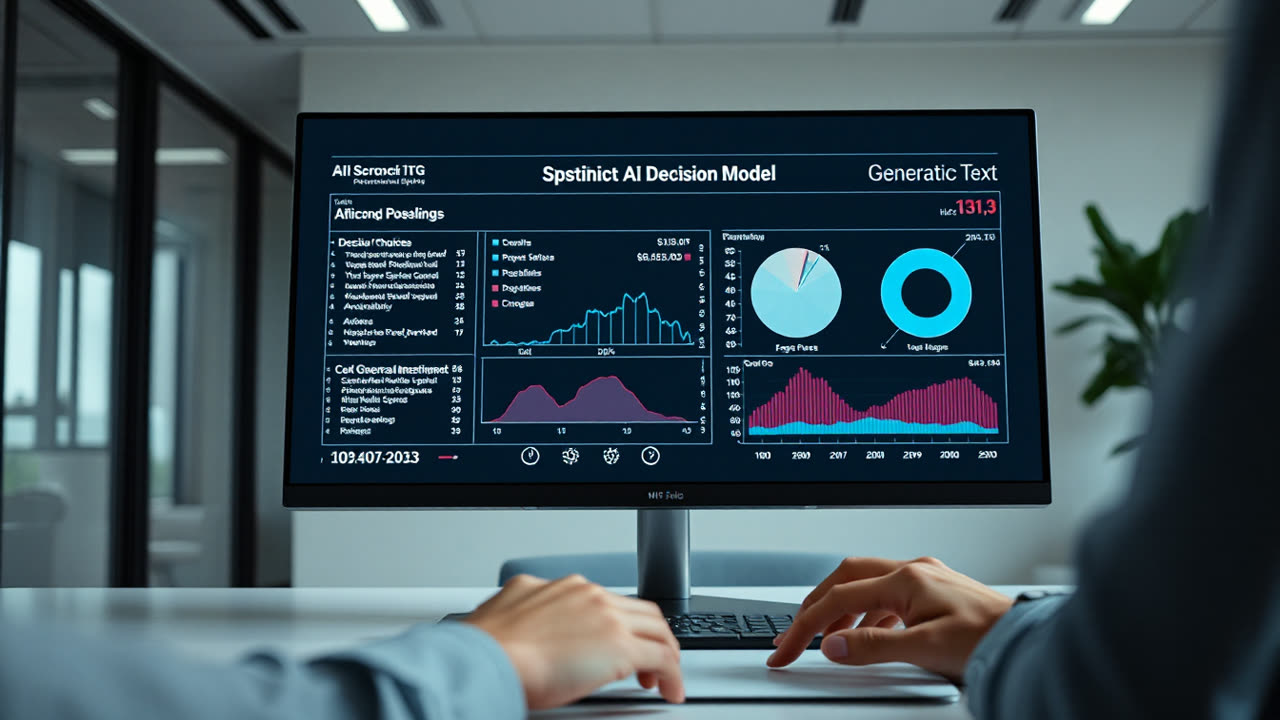
Liquid AI has unveiled d1, a groundbreaking decision model engineered to deliver calibrated probabilities for structured choices with the unprecedented efficiency of zero output tokens, marking a significant pivot from the generative paradigm dominating current AI discourse. This specialized architecture allows d1 to process context and a defined set of typed questions, returning a precise probability distribution across fixed outcomes in a single, atomic call. Unlike large language models (LLMs) that generate variable-length text, d1 eliminates the computational overhead and latency associated with token generation, offering a new benchmark for real-time, high-stakes decision-making.
The immediate impact on industries reliant on rapid, reliable probabilistic assessments is profound. Financial services, for instance, could leverage d1 for instantaneous credit scoring, fraud detection, or algorithmic trading decisions, where every millisecond and every percentage point of accuracy matters. Healthcare diagnostics could see d1 providing calibrated probabilities for disease likelihood based on patient data, aiding clinicians in triage and treatment pathways without the need to parse verbose text outputs. Furthermore, manufacturing and logistics stand to benefit from optimized resource allocation and predictive maintenance scheduling, driven by d1’s deterministic and auditable probabilistic outputs. The "zero output tokens" feature is not merely an efficiency gain; it fundamentally changes the interaction model with AI for structured tasks, making it akin to a highly sophisticated, real-time oracle rather than a conversational agent. This design choice inherently reduces potential for hallucination or irrelevant information, as the model is constrained to a predefined set of outcomes.
Liquid AI’s strategic decision to focus on calibrated probabilities addresses a critical gap in the current AI landscape. While LLMs excel at understanding and generating human-like text, their application in purely quantitative, high-consequence decision tasks often requires significant post-processing and external calibration to ensure trustworthiness. LLMs typically produce confidence scores that are not inherently calibrated; a model might express high confidence in an incorrect answer, a phenomenon that has plagued their adoption in critical applications. Calibrated probabilities, conversely, mean that if d1 states there's an 80% chance of a particular outcome, that outcome will indeed occur approximately 80% of the time across a large sample. This level of statistical rigor is paramount for regulatory compliance and user trust in domains like finance, insurance, and medical AI. Prior generations of decision support systems often relied on rule-based engines or simpler machine learning models that lacked the contextual understanding of more advanced AI. While some advanced neural networks can be fine-tuned for classification, d1’s explicit design for structured choices and calibrated probability output positions it as a distinct and purpose-built solution.
The company itself, Liquid AI, emerged from a vision to create more efficient and biologically inspired AI, co-founded by industry veterans and academics like Ramin Hasani and Mathias Lechner, known for their work on Liquid Neural Networks (LNNs). LNNs are characterized by their continuous-time dynamics and high expressivity with fewer parameters, offering a foundation for models that are robust and adaptive. This background suggests d1 is likely built upon principles that prioritize efficiency and interpretability, diverging from the sheer scale approach of many general-purpose LLMs. The release of d1 signals a broader industry trend towards specialized AI models that address specific use cases with optimized architectures, rather than relying solely on monolithic, general-purpose models. While LLMs continue to advance in their breadth of capabilities, there's a growing recognition that for certain critical tasks, a tailored approach can yield superior performance, reliability, and efficiency.
Looking ahead, d1's introduction could catalyze a new wave of domain-specific AI applications, particularly where computational resources are constrained, latency is critical, and probabilistic accuracy is non-negotiable. We can anticipate other AI developers exploring similar "zero-output-token" or highly optimized architectures for specialized tasks, leading to a more modular and efficient AI ecosystem. The emphasis on calibrated probabilities will likely push for greater transparency and explainability in AI outputs, as industries demand more than just an answer – they demand a statistically sound assessment of its likelihood. This paradigm shift could also democratize access to advanced AI for smaller enterprises that cannot afford the computational demands of large generative models but require precise decision support. The true test for d1, and for this emerging category of specialized decision models, will be its integration into existing enterprise systems and its demonstrated ability to consistently outperform general-purpose AI in real-world, high-stakes environments. Liquid AI's d1 is not just a new model; it's a statement about the future of focused, reliable, and profoundly efficient AI.