LONGi Shatters Solar Efficiency Record with 35.5% Perovskite Tandem Cell
Chinese solar giant LONGi has achieved an unprecedented 35.5% power conversion efficiency with its crystalline silicon-perovskite tandem solar cell, verified by the National Renewable Energy Laboratory (NREL).
✨ This content was summarized and interpreted by AI; it may contain errors — please verify accuracy with the original sources. Learn more
Listen to this story
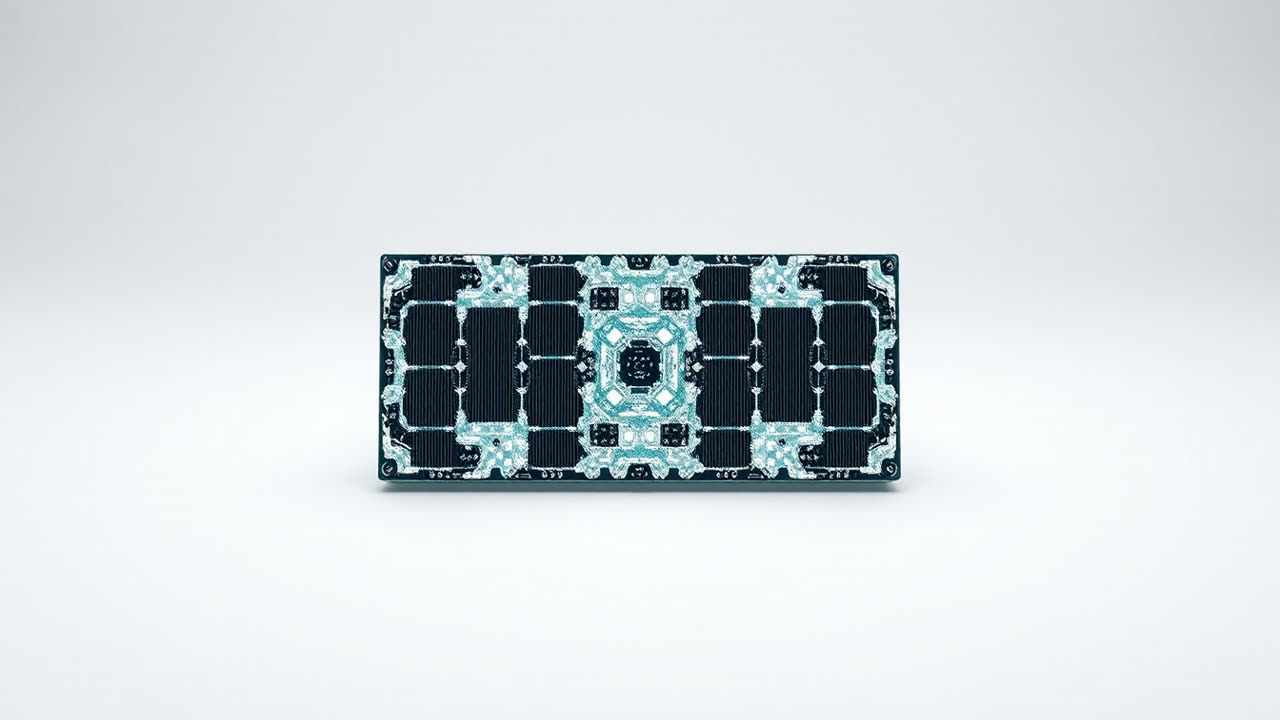
Chinese solar giant LONGi Green Energy Technology Co. has shattered efficiency records, announcing a crystalline silicon-perovskite tandem solar cell achieving an unprecedented 35.5% power conversion efficiency, a monumental leap verified by the National Renewable Energy Laboratory (NREL). This breakthrough, first reported in late 2023, represents the 17th time LONGi has set a world record for solar cell efficiency, underscoring its relentless pursuit of photovoltaic (PV) innovation and positioning the company, and indeed China, at the forefront of next-generation solar technology.
This new benchmark significantly surpasses the theoretical Shockley-Queisser limit of approximately 33.7% for single-junction silicon solar cells, a barrier that has long constrained traditional PV development. By integrating a perovskite layer atop a conventional silicon cell, LONGi leverages the distinct light absorption properties of both materials. Perovskites excel at converting the higher-energy blue and green light spectrum, while silicon efficiently captures the lower-energy red and infrared light. This synergistic arrangement allows for a much broader utilization of the solar spectrum, pushing efficiencies into territories previously considered unachievable for commercially viable materials. The previous record for this specific cell architecture was held by King Abdullah University of Science and Technology (KAUST) at 33.7%, and before that, LONGi itself had claimed 33.9% and 33.5% in successive advancements, demonstrating a rapid progression in this field.
The implications for the solar industry and global energy transition are profound. Higher efficiency directly translates to more electricity generated per unit area, meaning fewer solar panels are needed to achieve the same power output. For utility-scale solar farms, this reduces land requirements, a critical factor in densely populated regions or areas with competing land uses. For residential and commercial rooftop installations, it allows for greater energy independence in limited spaces, potentially making solar viable for properties where it was previously impractical due to insufficient roof area. This efficiency boost could accelerate the decarbonization of electricity grids, making solar power even more competitive against fossil fuels by driving down the levelized cost of electricity (LCOE) through increased output and potentially lower balance-of-system costs.
Beyond the immediate efficiency gain, LONGi's achievement validates the immense potential of perovskite tandem technology. While single-junction silicon cells are nearing their practical efficiency limits in mass production (typically ranging from 20-23% for commercial modules), perovskite tandems offer a clear pathway to efficiencies exceeding 30%, with theoretical limits extending beyond 40%. However, significant challenges remain before widespread commercialization. Perovskite materials, while highly efficient, have historically struggled with long-term stability, particularly when exposed to moisture, heat, and UV light. Degradation under real-world operating conditions is a primary hurdle that researchers, including those at LONGi, are actively working to overcome. Scalability in manufacturing is another key area; current perovskite deposition methods often involve solution processing, which needs to be adapted for high-volume, cost-effective production at the gigawatt scale.
Compared to other advanced PV technologies, such as III-V multijunction cells used in specialized applications like space exploration, perovskite-silicon tandems offer a far more cost-effective pathway to ultra-high efficiency. III-V cells can achieve efficiencies over 40% but are prohibitively expensive due to exotic materials and complex manufacturing processes. Perovskite tandems, by contrast, leverage abundant materials and can potentially integrate into existing silicon manufacturing infrastructure, promising a more accessible route to enhanced performance. While other companies and research institutions globally, including Oxford PV, Hanwha Q Cells, and numerous university labs, are also making significant strides in perovskite tandem development, LONGi's consistent record-breaking achievements solidify its leadership in translating research into tangible, verifiable results.
Looking ahead, the immediate focus for LONGi and the broader industry will be on improving the long-term reliability and manufacturability of these high-efficiency tandem cells. We can anticipate further incremental efficiency improvements, potentially pushing past 36% and even towards 37% in laboratory settings within the next few years, as material science and interface engineering continue to advance. The critical next phase will involve pilot production lines demonstrating consistent performance and durability under accelerated aging tests, moving towards a projected commercialization timeline that could see initial products entering specialized markets within five years, followed by broader adoption in utility-scale and rooftop applications by the early 2030s. The integration of artificial intelligence and machine learning in material discovery and process optimization will likely play a crucial role in accelerating this transition, helping to identify stable perovskite formulations and optimize manufacturing parameters. This record is not just an isolated scientific achievement; it signals a new era for solar power, promising a future where clean energy generation is even more efficient, more compact, and ultimately, more ubiquitous.