Lucid Motors Delays Crucial Sub-$50,000 EV, Pivots Hard to Robotaxis
Lucid Motors has pushed the release of its pivotal sub-$50,000 Cosmos EV to late 2027, a significant delay signaling a strategic shift towards financial discipline and an accelerated focus on its robotaxi program.
✨ This content was summarized and interpreted by AI; it may contain errors — please verify accuracy with the original sources. Learn more
Listen to this story
Lucid Motors has pushed the release of its crucial sub-$50,000 Cosmos EV to the second half of 2027, a significant delay from its original late 2026 target, signaling a profound strategic recalibration under new CEO Silvio Napoli. This postponement, announced during the company's Q2 2026 earnings call, underscores Lucid's pivot from aggressive expansion to a "back-to-basics" approach focused on financial discipline, quality execution, and a bold bet on the robotaxi market.
The delay of the Cosmos, a midsize crossover intended to compete with vehicles like the Tesla Model Y and Rivian R2, is a direct consequence of Napoli’s stated commitment to avoiding the "mistakes of the past." Napoli openly admitted that Lucid's earlier luxury models, the Air sedan and Gravity SUV, were launched "a bit in haste" and suffered from quality issues, particularly software bugs, leading to an ownership experience that fell short of expectations. The company's new mandate is to launch the Cosmos "only when every process and quality requirement have been met," prioritizing a flawless market entry over a rushed timeline. This meticulous approach is critical for a vehicle positioned in the high-volume, lower-margin segment, where consumer tolerance for imperfections is considerably lower than in the luxury market.
For prospective buyers, the delay means a longer wait for a potentially compelling, more accessible Lucid offering. The current U.S. market for affordable EVs remains relatively sparse, often described as an "empty showroom" for mass-market models. While rivals like the 2027 Chevrolet Bolt are available at around $28,995, and the Volvo EX30 starts at $35,000, Lucid’s entry promised a unique blend of performance and luxury at a more attainable price point. The extended wait could push some consumers towards established alternatives or upcoming models from Ford and others, which are also targeting the sub-$30,000 to $50,000 range by 2027.
Industrially, Lucid's operational reset highlights the immense challenges of scaling EV production and achieving profitability, even for companies with substantial backing. Lucid reported a widened net loss of over $1 billion in Q2 2026, despite a 56% year-over-year revenue increase to $405 million. Its gross margin remained deeply negative at -105%, reflecting persistent struggles with unit economics. In response, Lucid has launched a comprehensive $1.4 billion cash flow improvement plan for 2026, including significant cuts to inventory ($600-$800 million), capital expenditures ($500 million), and operating expenses ($200 million). This includes a June workforce reduction of 18% and the elimination of a second shift at its Arizona factory, expected to save $158 million annually. Such drastic measures, alongside an intentional moderation of production to align with demand, signal a shift from growth-at-all-costs to survival and efficiency.
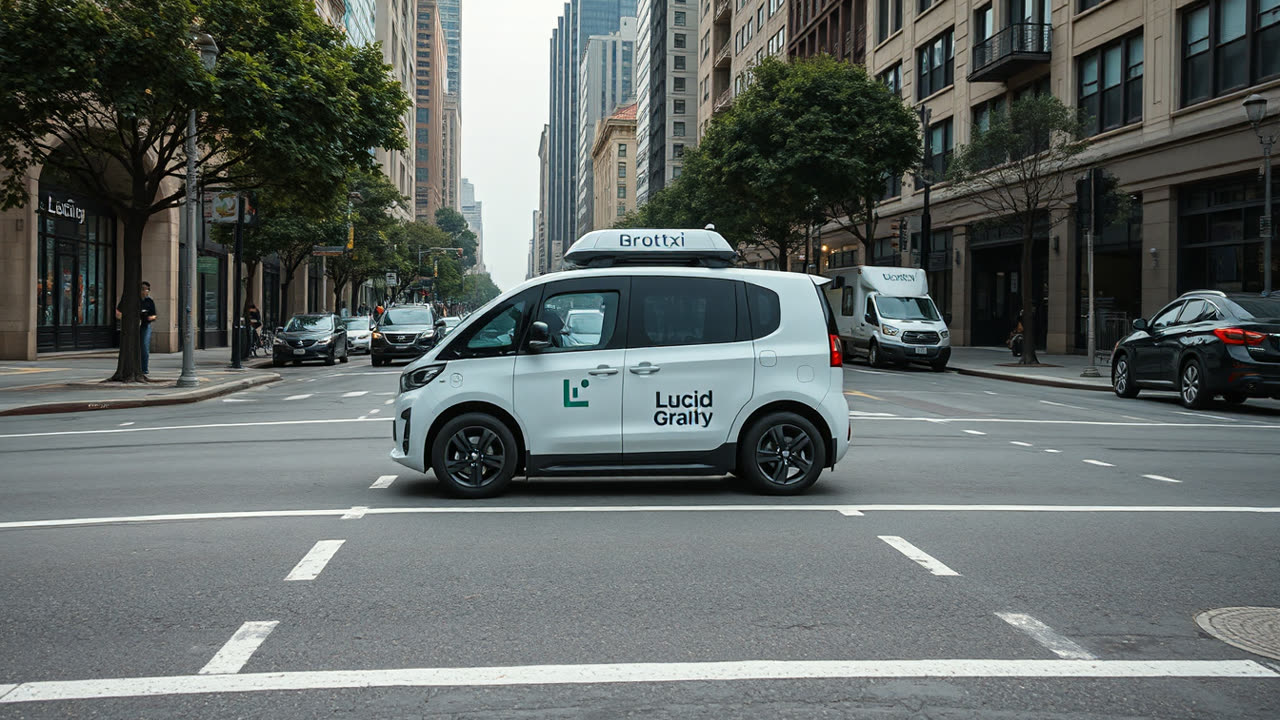
Crucially, the delay of the Cosmos is accompanied by an accelerated focus on Lucid's robotaxi program with Uber and Nuro, now designated a "top priority" and "must-win" project. This B2B pivot represents a significant strategic diversification for Lucid, aiming to leverage its advanced EV technology in the burgeoning autonomous vehicle sector. Testing is already underway with nearly 100 Lucid Gravity Production-Validation vehicles in the San Francisco Bay Area and Houston, with the "final" robotaxi slated for production in Q4 2026 and a late 2026 launch. CEO Napoli views robotaxi economics as potentially far exceeding those of traditional car sales, as vehicles earning fares around the clock could generate significantly more revenue than privately owned cars. This shift is not without risk, however, as the robotaxi market itself is still maturing and proving its scalability.
Looking ahead, Lucid's financial health remains precarious, yet it possesses $3.0 billion in total liquidity, which, combined with its aggressive cost-cutting, is projected to provide a runway "well into 2027." The Saudi Arabian Public Investment Fund (PIF) remains Lucid's largest backer, and the AMP-2 manufacturing facility in Saudi Arabia, where the Cosmos will eventually be built, reinforces the deep ties and patient capital supporting the company. However, Napoli has warned that 2026 production and delivery forecasts will fall below current consensus estimates, with Q3 and Q4 production expected to be lower than Q2 levels as the company re-evaluates its operational models.
The coming years will be pivotal for Lucid. The success of its robotaxi venture, coupled with the eventual, high-quality launch of the Cosmos, will determine if the company can transition from a niche luxury EV maker to a sustainable, diversified player in the broader electric mobility ecosystem. The operational reset, while painful in the short term, is a necessary gamble to solidify Lucid's foundation and ensure its long-term viability in a fiercely competitive and capital-intensive industry.