Mara Secures $7M to Deploy Backpack-Portable AI Counter-Drone System
Defense startup Mara has raised $7 million in pre-seed funding to accelerate the deployment of its Spike counter-drone system, which promises a 20x cost advantage against ubiquitous FPV attack drones by using AI-powered kinetic interceptors.
✨ This content was summarized and interpreted by AI; it may contain errors — please verify accuracy with the original sources. Learn more
Listen to this story
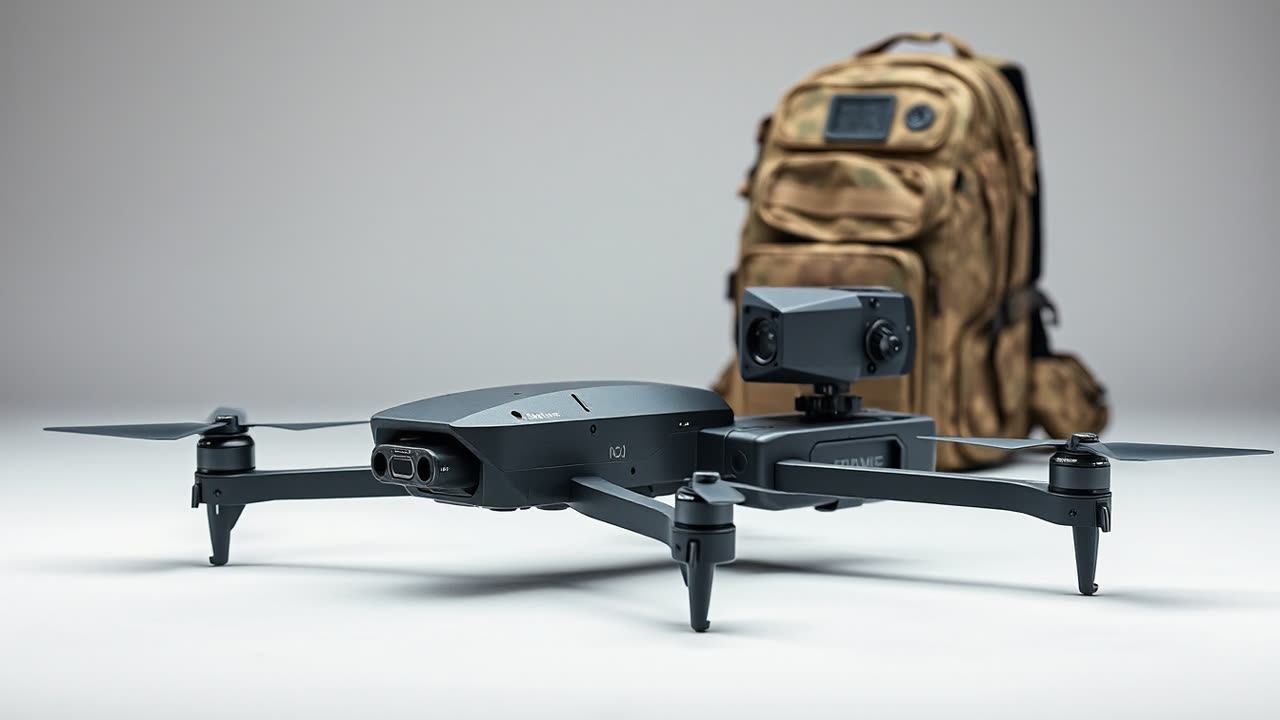
San Francisco-based defense startup Mara has secured a pivotal $7 million in pre-seed funding, spearheaded by Khosla Ventures, to propel its Spike counter-drone system from field testing into active combat deployment. This investment underscores a critical shift in modern warfare, where inexpensive, off-the-shelf drones, particularly first-person view (FPV) quadcopters costing only a few hundred dollars, have become the leading cause of combat casualties, capable of neutralizing armored vehicles worth millions. Mara's audacious claim of a 20x cost advantage over existing interceptors, priced one-for-one against these ubiquitous attack drones, signals a potential paradigm shift in how militaries and security forces approach the escalating drone threat.
The core innovation of Spike lies in its distributed, autonomous, and omnidirectional defense architecture, directly addressing the limitations of traditional counter-drone systems. Comprising two modular components – the "Spotter" targeting unit and "Seeker" kinetic interceptors – Spike is designed for rapid, responsive engagement against swarming threats. The Spotter unit employs a sophisticated fusion of visual, acoustic, and optional W-band radar sensors, coupled with Mara-developed AI, to detect and track drones day or night, in all weather conditions. Crucially, this sensor suite is effective against fiber-optic controlled or fully autonomous drones, which bypass conventional radio-frequency (RF) jamming techniques. Once a threat is identified, the tube-launched Seeker interceptors, weighing a mere 250 grams (approximately 8.8 ounces) and reaching speeds of up to 200 km/h (124 mph), are deployed. A single Spike launcher can hold up to 48 Seekers and reloads in under a minute, providing a deep magazine against sustained attacks. While the system operates autonomously, a human remains in the loop to set rules of engagement and can abort launches, balancing speed with ethical oversight.
This approach matters immensely because the current counter-drone landscape is largely ill-equipped for the nature of modern drone warfare. The proliferation of small, agile FPV drones, often attacking in waves of four to six simultaneously, overwhelms systems designed for larger, more predictable targets. Traditional electronic warfare systems, while effective against RF-controlled drones, are rendered useless by fiber-optic or pre-programmed autonomous threats. More advanced kinetic interceptors, such as those reaching speeds of 250-450 km/h, or directed energy weapons like high-energy lasers and high-power microwaves, often come with higher price tags per engagement or are limited by factors like single-target engagement for lasers or the need to overcome drone hardening for microwaves. For example, while the Pentagon's Joint Interagency Task Force 401 (JIATF-401) is actively testing directed energy weapons in "shoot-offs" as a cost-effective solution, these systems still face challenges in widespread operationalization and portability. Mara's Spike, with a complete system cost ranging from $30,000 to $100,000 depending on interceptor count, fundamentally shifts the cost-exchange ratio, a critical objective for the U.S. Department of Defense.
Compared to other portable counter-drone solutions, such as D-Fend Solutions' EnforceAir2 backpack system which uses non-kinetic RF cyber takeover technology to safely land drones, Spike offers a hard-kill kinetic solution. While cyber takeover is ideal for sensitive areas where a physical crash is undesirable, kinetic interceptors provide definitive neutralization, which is often preferred in combat zones. The ability to carry Spike in a backpack, with ground-mounted units expected by the end of 2026 and vehicle-mounted and man-portable variants planned for 2027, vastly increases the deployability and responsiveness for frontline units and special forces. This distributed, attritable (designed for replacement if lost) nature of Spike's components stands in stark contrast to the concentrated, high-value assets typically used for counter-UAS. Ukrainian forces have already utilized Spotter near the front line, successfully tracking FPV drones from 40 km away, demonstrating its real-world effectiveness.
The implications for the broader counter-drone market, valued at $2.71 billion in 2024 and projected to reach $11.12 billion by 2030, are significant. Mara's approach could pressure established defense contractors to develop more cost-effective, portable, and swarm-capable solutions. The emphasis on AI-driven autonomy for detection, tracking, and engagement aligns with the future trends of the counter-drone market, which increasingly seeks intelligent, networked, and layered defense systems. The U.S. military is already advocating for a layered defense, combining various kinetic and non-kinetic means, from AI-powered detection to shotguns as a last resort.
Looking ahead, Mara's vision extends beyond current deployments, aiming to mass-produce an "arsenal of cheap, tiny robots that dominate the line of contact in any battle: land, air, or sea." This suggests a future where counter-drone capabilities are not just defensive but potentially integrated into offensive doctrines, fundamentally altering tactical engagements. Further development will likely focus on refining AI algorithms to counter increasingly sophisticated drone swarm tactics, which involve coordinated attacks to overwhelm defenses. While the immediate focus is on ground and vehicle-mounted systems, the long-term trajectory points towards ubiquitous, adaptable counter-drone measures that can be deployed rapidly across diverse operational environments, democratizing protection against the pervasive and evolving drone threat. However, challenges will include scaling manufacturing to meet demand, continuous innovation to stay ahead of rapidly evolving drone capabilities, and navigating the complex ethical and regulatory frameworks surrounding autonomous kinetic systems.