Maynooth University Researchers Unveil Energy-Efficient DNA Computer for 100-Bit Calculations
A pioneering advancement from Maynooth University researchers has unveiled a DNA computer capable of executing 100-bit calculations without requiring a continuous supply of electricity, marking a significant stride in the quest for energy-efficient and biocompatible computing.
✨ This content was summarized and interpreted by AI; it may contain errors — please verify accuracy with the original sources. Learn more
Listen to this story
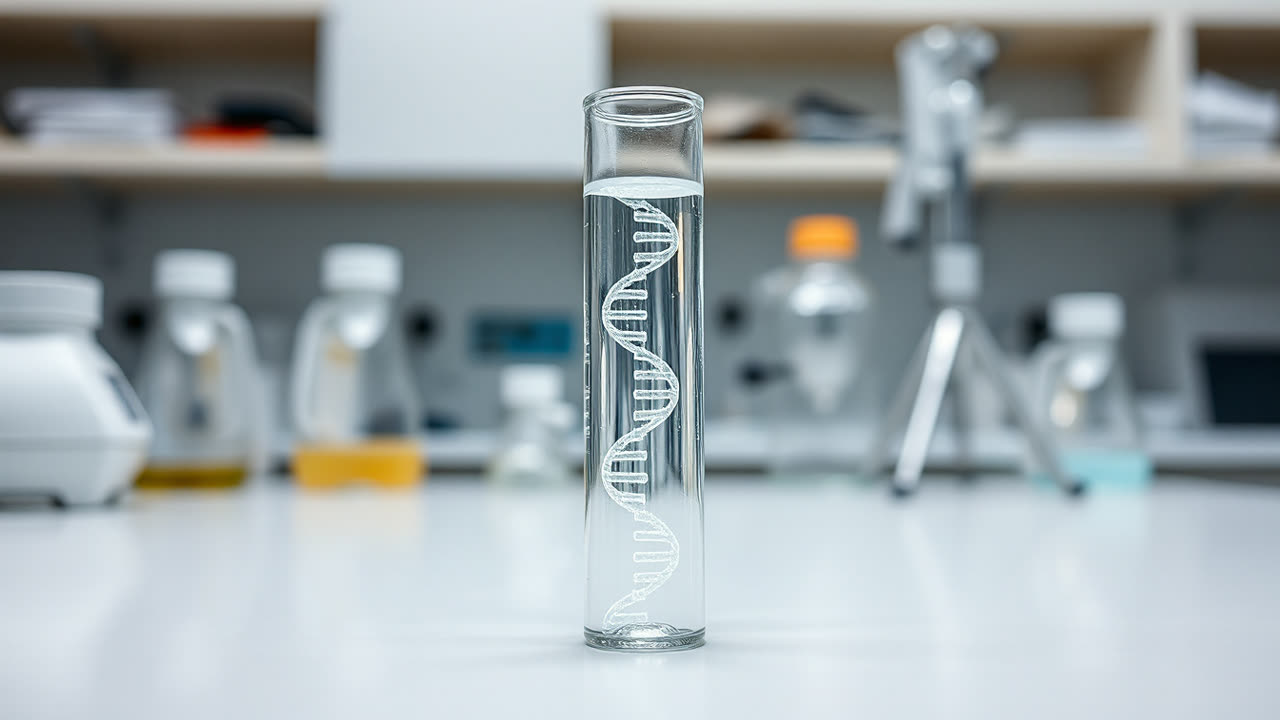
A pioneering advancement from Maynooth University researchers has unveiled a DNA computer capable of executing 100-bit calculations without requiring a continuous supply of electricity, marking a significant stride in the quest for energy-efficient and biocompatible computing. Published in *Nature* on September 16, 2026, the "Scaffolded DNA Computer (SDC)" utilizes self-assembling DNA strands to perform complex mathematical operations, demonstrating a potential paradigm shift away from traditional silicon-based architectures. This molecular system, designed via a technique known as DNA origami, involves mapping a long primary DNA strand and hundreds of shorter, custom-synthesized "staple" strands. When combined in a test tube with water and salt, then heated and cooled, these strands self-assemble into a microscopic computing grid, with the long strand serving as a structural scaffold. The system successfully ran 10 different molecular programs, including computations involving numbers in the range of 11 million to 34 million, which took up to 14 hours, while simpler additions like 10 plus 3 completed in 30 seconds. Unlike prior DNA computing efforts where DNA strands were often consumed in a single calculation, this Maynooth system is robust and reusable, performing up to 25 different calculations in a sequence without needing to change the underlying hardware, a critical innovation for practical application.
This breakthrough holds profound implications for both the computing industry and potential applications in biological systems. Current silicon-based computers are voracious energy consumers; for instance, computing and data storage alone account for 23% of Ireland's electricity usage. In stark contrast, the Maynooth DNA computer requires only an initial thermal energy input to kick-start chemical reactions, with the molecules naturally shifting towards a stable structural state that represents the mathematical answer, eliminating the need for continuous power. A typical DNA strand reaction consumes approximately 5 x 10^-20 joules, dramatically less than the 10^-9 joules required by silicon-based computers. This inherent energy efficiency positions DNA computing as a critical avenue for addressing the escalating energy demands of data centers, which currently consume about 1% of global electricity and are projected to double by 2030. Beyond energy conservation, the biocompatible nature of DNA computers opens pathways for revolutionary in-vivo applications, such as sophisticated disease detection, targeted therapies, and smart drug delivery systems that could operate autonomously within living cells.
The concept of DNA computing, pioneered by Leonard Adleman in 1994, emerged from the realization that DNA's unique structure could be leveraged for information processing. Adleman's seminal experiment solved the Traveling Salesman Problem for seven cities, demonstrating the massive parallelism inherent in DNA. While traditional silicon computers process information sequentially using binary (0s and 1s) and transistors, DNA computers operate on a four-character genetic alphabet (A, T, C, G) and excel at performing numerous simple calculations simultaneously. This parallel processing capability is a key advantage, allowing a small droplet containing billions of DNA strands to work concurrently. However, early DNA computing faced significant hurdles, including relatively slower individual reaction speeds, the need for specific biochemical conditions, and the impracticality of "making a new computer for every new calculation." The Maynooth SDC addresses some of these limitations by being one of the most complex and fastest molecular computers reported to date, capable of being reprogrammed to run different algorithms simply by selecting a different subset of its approximately 700 constituent strands. This architectural flexibility, where the same molecular "hardware" can run different "software," is a crucial step towards practical viability.
Looking ahead, the trajectory of DNA computing suggests a future where these molecular systems will complement, rather than entirely replace, conventional silicon computing. While silicon remains superior for tasks requiring high speed and complex sequential operations, DNA's strengths lie in massive parallelism, ultra-high data density, and unparalleled energy efficiency for specific problems. One gram of DNA could theoretically store 455 exabytes of information, remaining stable for thousands of years without power, making it an ideal candidate for long-term archival data storage. Indeed, the DNA Data Storage Alliance, comprising industry giants like Microsoft and IBM, anticipates the commercialization of DNA-based archival storage within 3-5 years.
The Maynooth University research, supported by a €4 million European Innovation Council grant for the "DISCO" project (DNA-based infrastructure for Storage and Computation), is indicative of the growing investment and confidence in this field. The global DNA computing market is projected to expand significantly, from USD 293.70 million in 2025 to USD 2.68 billion by 2032, demonstrating a robust compound annual growth rate of 36.76%. While challenges persist, particularly in improving reading and writing mechanisms for DNA and scaling up operations for broader computational tasks, the continuous advancements in DNA nanotechnology and enzymatic reactions are paving the way for integrated bio-silicon hybrid systems. The "nano apps" envisioned by researchers, capable of operating within biological environments, represent a frontier where computing merges with life itself, offering solutions that transcend the capabilities of current electronic devices.