Mazda's CX-6e Electric SUV Gets LiDAR, Advanced L2 Autonomy in China
Mazda's CX-6e electric SUV is now equipped with a roof-mounted Hesai ATX LiDAR unit, marking a significant leap in the automaker's autonomous driving capabilities and introducing "advanced L2" autonomy, Navigation on Autopilot (NOA), and automated parking to the Chinese market.
✨ This content was summarized and interpreted by AI; it may contain errors — please verify accuracy with the original sources. Learn more
Listen to this story
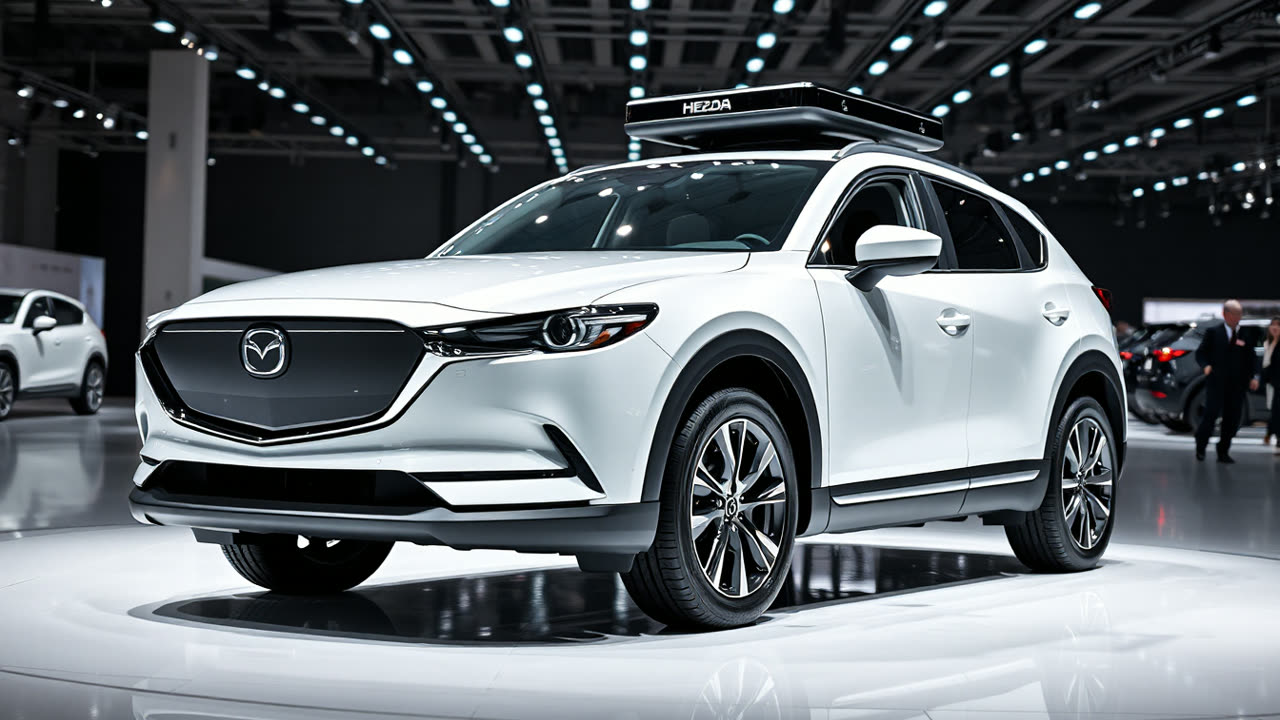
Mazda's CX-6e electric SUV is now equipped with a roof-mounted Hesai ATX LiDAR unit, marking a significant leap in the automaker's autonomous driving capabilities and introducing "advanced L2" autonomy, Navigation on Autopilot (NOA), and automated parking to the Chinese market. This strategic refresh, announced at the 2026 Chengdu Auto Show, sees LiDAR-equipped trims of the CX-6e (known as the EZ-60 in China) starting at an aggressive 145,900 yuan (approximately $21,700 USD), with deliveries slated to begin next month. This pricing positions the CX-6e to significantly undercut rivals like the Tesla Model Y in China, which starts at 263,500 yuan (approximately $39,300 USD).
The new sensor suite is comprehensive, combining the central Hesai ATX LiDAR with three millimeter-wave radars, 12 ultrasonic radars, and 11 high-definition cameras to provide "full-domain" perception. This robust hardware foundation enables the CX-6e to navigate over 200 "assisted driving scenarios," encompassing both highway and urban environments. On highways, the system operates across the full 0-130 km/h speed range, facilitating autonomous lane changes, on- and off-ramp navigation, and access to service areas with minimal driver intervention. For urban driving, the advanced L2 system functions up to 80 km/h, adeptly handling complex conditions such as intersections, roundabouts, U-turns, emergency lane changes, and even navigating between parallel main and side access roads. Furthermore, it offers remote, automated, and path-following parking maneuvers, with future over-the-air (OTA) updates expected to introduce memory parking and over 25 active safety functions.
This technological pivot is a profound shift for Mazda, an automaker traditionally celebrated for its "Jinba Ittai" philosophy emphasizing driver-centric engagement and a more measured approach to advanced driver-assistance systems (ADAS). The integration of LiDAR, particularly for its second new-energy vehicle (NEV) in China, underscores Mazda's urgent strategic imperative to remain competitive in the world's most dynamic EV market. For users, this means enhanced safety through more precise environmental perception, particularly in challenging visibility or complex urban scenarios where camera-only systems may struggle. The promise of smoother, more natural driving decisions aims to reduce driver fatigue and elevate convenience, validated by the CX-6e receiving a TOP Intelligence Intelligent Safety Challenge certificate from CATARC after undergoing rigorous real-world safety tests.
Industrially, Mazda's move intensifies the fierce competition within China's NEV segment. By adopting a LiDAR-centric approach and leveraging its joint venture with Changan Auto (the CX-6e is built on Changan's EPA1 platform and shares much with the Deepal S07), Mazda is directly challenging domestic powerhouses like Xpeng and Nio, who have aggressively deployed similar advanced ADAS. The aggressive pricing, nearly halving the cost of a Tesla Model Y in China for comparable EV trims, is a clear signal of Mazda's intent to capture market share. This also highlights a growing divergence in ADAS strategies, with many automakers, including Mazda, embracing LiDAR for its robust perception capabilities, contrasting with Tesla's camera-first "Tesla Vision" approach. The fact that the CX-6e's platform-mate, the Deepal S07, already offers Huawei's LiDAR-equipped "Qiankun" ADS indicates Mazda's necessary alignment with localized, cutting-edge Chinese automotive technology.
Previously, Mazda's ADAS offerings, while competent, focused on foundational Level 2 features such as adaptive cruise control and lane-keeping assist, with a notable "Driver Emergency Assist" system introduced in 2022 to mitigate driver incapacitation. The current LiDAR integration represents a significant leap beyond these earlier systems, pushing the CX-6e into the "advanced L2" category, meaning supervised autonomy that demands driver attention, rather than "eyes-off" Level 3. The CX-6e has already proven a relative success for Mazda in China, with NEV models accounting for 45% of its total brand sales in August 2026, and the LiDAR refresh is expected to further level the playing field against domestic rivals. Notably, the non-LiDAR versions of the CX-6e destined for other markets, such as Australia, will initially rely on conventional radar and camera hardware, underscoring the localized nature of this advanced rollout.
Looking ahead, this rollout is a critical stepping stone for Mazda's long-term autonomous driving ambitions. While currently advanced L2, Mazda was previously anticipated to offer Level 3 capabilities on some models from 2025, with Level 4 expected later. The robust sensor suite and software architecture, including OTA update capabilities, suggest a clear pathway for future enhancements and potential upgrades towards higher levels of autonomy. While this advanced CX-6e is initially China-exclusive, its "global product" designation implies that this LiDAR technology could eventually expand to other international markets, albeit with adaptation to varying regulatory landscapes and consumer preferences. The significant price disparity between the LiDAR-equipped CX-6e in China and its non-LiDAR counterparts in Europe (e.g., starting at £42,990 or $57,000 USD in the UK) illustrates the market-specific strategies at play. Mazda's commitment, even through a joint venture, to integrate LiDAR signifies a broader industry trend towards its adoption as a foundational technology for achieving safer and more capable automated driving, pushing the boundaries of what consumers can expect from mainstream vehicles.