Meta Launches Muse for Mac: A Local-First AI Agent Challenging Cloud Dominance
Meta Platforms has introduced Muse for Mac, its first personal AI agent designed to operate directly on a user's computer, interacting natively with local files and applications while prioritizing privacy.
✨ This content was summarized and interpreted by AI; it may contain errors — please verify accuracy with the original sources. Learn more
Listen to this story
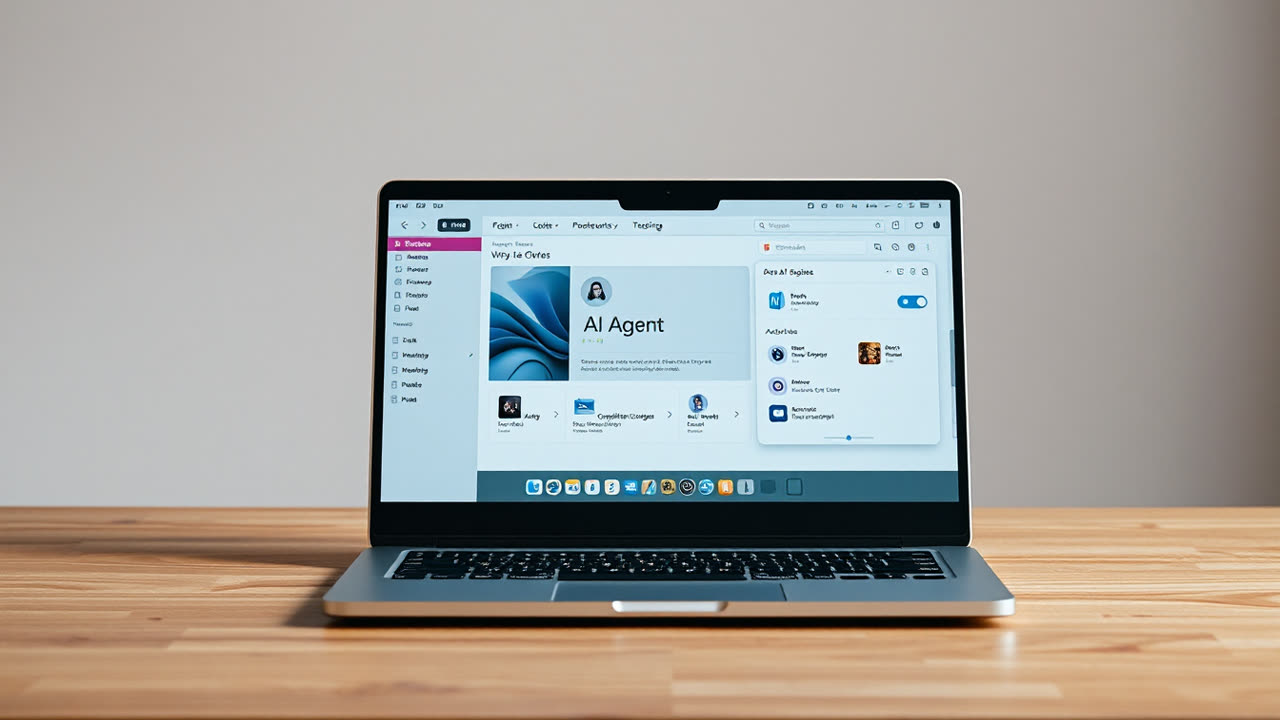
Meta Platforms has launched Muse for Mac, introducing the first iteration of its personal AI agent capable of executing tasks directly on a user's computer, interacting natively with local files, applications, mail, messages, calendar, and notes. This move signifies a critical pivot for Meta, extending its AI ambitions beyond its social platforms into the desktop environment with a focus on on-device processing, directly challenging the prevailing cloud-centric models dominant in the personal AI agent landscape. By integrating deeply into the macOS operating system, Muse aims to offer a seamless, context-aware experience, leveraging the data where it already resides, rather than transmitting it to Meta's servers.
This emphasis on local processing is Muse for Mac’s most striking differentiator and carries profound implications for user privacy and control, a growing concern in the era of ubiquitous AI. Unlike many mainstream AI tools that default to sending user conversations, files, and credentials to cloud servers for processing and model training, Muse’s local-first architecture is designed to keep sensitive data on the user’s machine. This architectural choice addresses a significant user apprehension, offering a verifiable commitment to data privacy beyond mere policy statements. For users, this means enhanced security for banking data, health information, or legal documents, as these remain within their physical control, never leaving their network boundary. The promise of sub-20ms inference latency for local operations also suggests a snappier, more responsive user experience for routine tasks, freeing users from the vagaries of internet connectivity and server load.
Meta's foray into the desktop AI agent space with Muse for Mac positions it squarely against established tech giants like Apple, Google, and Microsoft, each with their own evolving strategies. Apple, for instance, has centered its 2026 AI strategy on "Apple Intelligence," embedding AI directly into the operating system and leveraging on-device model inference alongside a privacy-preserving Private Cloud Compute for more demanding tasks. Apple is also reportedly investing heavily in its own server infrastructure with M8 Ultra chips to support secure on-premises AI processing, further underscoring a commitment to data sovereignty. Its revamped Siri, expected in 2026, is set to be powered by Google's Gemini models, highlighting a hybrid approach to AI capabilities.
Google, a strong contender, launched a native desktop Gemini app for Windows on September 10, 2026, building on its earlier Mac release in late 2024. This application, accessible via an Alt+Spacebar shortcut, offers deep integration with Google Workspace applications like Gmail, Drive, and Calendar, providing features such as custom AI personas ("Gems") and a real-time voice mode ("Gemini Live"). Similarly, Microsoft's Copilot, pre-installed on Windows 11, is deeply interwoven with Microsoft 365 applications, utilizing OpenAI's GPT-5.6 models as of July 2026 to automate tasks across Word, Excel, Outlook, and Teams, and even controlling web and desktop apps through its "computer use" capabilities. While Google and Microsoft offer robust desktop integrations, their primary models often rely on cloud infrastructure, with data typically processed externally, albeit with enterprise-grade security and privacy commitments.
Meta's broader AI strategy, articulated by CEO Mark Zuckerberg, envisions "personal superintelligence" that empowers individuals through augmentation rather than automation, a philosophy that aligns well with a local-first desktop agent. The company has made substantial investments in AI, with projected capital expenditures potentially reaching $600 billion by 2028, and has actively promoted its open-source Llama models, which have seen over a billion downloads since launch. Muse for Mac could potentially leverage these Llama models, offering a customizable and transparent AI experience, a significant advantage over proprietary, black-box cloud models. This also builds on Meta's existing AI agent efforts in advertising automation and customer service, where AI agents are already handling complex strategic decisions and customer interactions across its platforms.
Looking ahead, the emergence of Muse for Mac signals a significant acceleration in the competition for personal AI agent dominance, particularly in the desktop environment. The future of AI agents is increasingly seen as a hybrid model, where local agents handle privacy-sensitive, routine, and high-frequency tasks, while more powerful cloud agents manage complex reasoning and resource-intensive operations. Muse's local-first approach positions Meta strongly in the former, potentially fostering a new ecosystem of privacy-conscious applications and workflows. However, challenges remain in scaling local AI capabilities to match the raw power and vast knowledge bases of frontier cloud models. Future iterations of Muse will likely need to explore seamless, intelligent routing between local and cloud processing, enabling users to benefit from both privacy and advanced capabilities without manual intervention. This strategic move by Meta suggests a future where personal computing devices become true "personal superintelligence" hubs, deeply integrated into daily life, with the battle for user trust and data control becoming paramount.