Meta's Muse Glimmer Democratizes AI Image Generation on Consumer PCs
Meta's new open-source Muse Glimmer model dramatically lowers the barrier to entry for local AI deployment, allowing advanced image generation on a single consumer-grade computer.
✨ This content was summarized and interpreted by AI; it may contain errors — please verify accuracy with the original sources. Learn more
Listen to this story
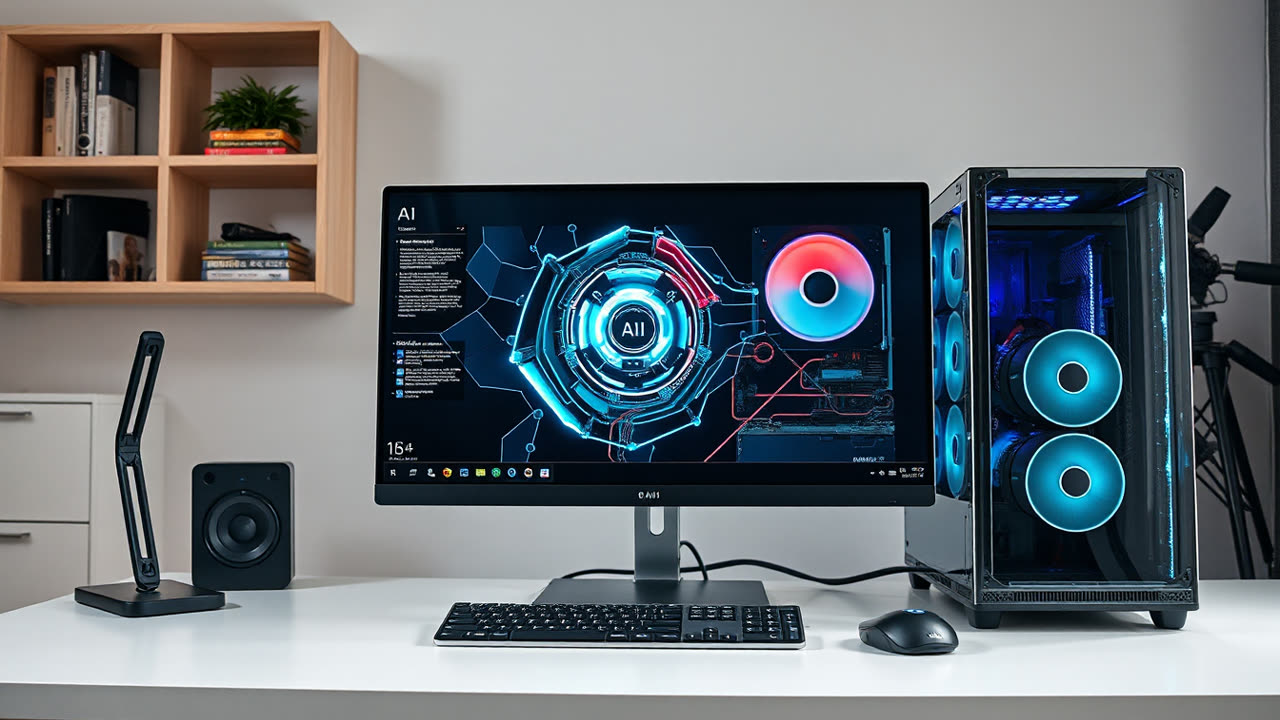
Meta's new Muse Glimmer model, a slimmed-down 'open-source' AI image generation tool, dramatically lowers the barrier to entry for local AI deployment, capable of running efficiently on a single consumer-grade computer rather than relying on extensive cloud infrastructure. This significant development, announced recently, positions Glimmer as a critical step towards democratizing generative AI, shifting powerful capabilities from data centers to individual machines. The model, part of Meta's broader Muse family, is designed for text-to-image generation, offering a lightweight alternative to more resource-intensive models. Its ability to operate independently on local hardware, often with less than 16GB of RAM and a consumer GPU, fundamentally alters the accessibility landscape for developers, researchers, and hobbyists who previously faced prohibitive computational costs or privacy concerns associated with cloud-based solutions.
This move by Meta is a strategic play to accelerate innovation within the open-source AI community, fostering a decentralized ecosystem where experimentation and customization can thrive without the bottleneck of centralized processing. By making advanced image generation locally viable, Muse Glimmer empowers users with greater control over their data, enhancing privacy by keeping sensitive information off third-party servers. Furthermore, it opens new avenues for offline applications, critical for environments with limited or no internet connectivity, and reduces latency by eliminating the need for network roundtrips. For developers, this translates to faster iteration cycles, enabling rapid prototyping and deployment of AI-powered features directly into applications without incurring continuous API costs. The inherent transparency of an open-source model like Glimmer also allows for greater scrutiny and understanding of its internal workings, fostering trust and enabling the community to identify and mitigate potential biases or ethical concerns more effectively than with opaque proprietary systems.
Comparing Muse Glimmer to its contemporaries reveals its strategic niche. Unlike behemoths such as DALL-E 3 or Midjourney, which are proprietary and exclusively cloud-based, Glimmer aligns more with the philosophy of Stable Diffusion, another prominent open-source image generator. However, Glimmer distinguishes itself by pushing the boundaries of efficiency, reportedly requiring significantly less computational overhead than earlier iterations of Stable Diffusion for comparable tasks. While it may not match the absolute fidelity or artistic nuance of the most advanced, larger models in every scenario, its core value lies in its pragmatic deployability. Previous Meta models, like the Llama series, have focused on large language models, but Muse Glimmer extends Meta's open-source commitment into the generative image space with a focus on resource efficiency. This lean architecture is achieved through optimizations in its neural network structure and potentially through more efficient quantization techniques, allowing it to perform complex inference tasks on hardware typically found in a standard gaming PC or even some high-end laptops.
The implications for the industry are profound. Muse Glimmer's emergence signals a growing trend towards edge AI, where processing power is distributed closer to the data source rather than concentrated in distant data centers. This paradigm shift could lead to a proliferation of personalized AI tools, custom-trained for specific user needs without uploading personal data. For hardware manufacturers, it creates a new demand for optimized consumer GPUs and specialized AI accelerators that can efficiently handle these local workloads. Expect to see a rise in integrated AI capabilities within creative software, graphic design tools, and even consumer operating systems, leveraging models like Glimmer for real-time image manipulation, asset generation, and personalized content creation. The competitive landscape will likely intensify as other tech giants consider similar lightweight, open-source releases to maintain relevance in a market increasingly valuing local processing and user control.
Looking ahead, Meta's release of Muse Glimmer is likely just the beginning of a wave of increasingly efficient, specialized AI models designed for local execution. The next evolution could involve even further optimization for mobile devices, enabling sophisticated AI generation directly on smartphones and tablets, transforming how users interact with their devices and create content on the go. Challenges remain, particularly in balancing model size with output quality and mitigating potential misuse of locally runnable generative AI. However, the open-source community's ability to rapidly iterate and improve upon foundational models suggests that these issues will be actively addressed. We can anticipate community-driven refinements, fine-tuned versions for specific artistic styles, and integrations into a broader array of everyday applications, ultimately making advanced AI image generation a ubiquitous, personalized, and private experience for millions.