Meta Unveils Ray-Ban Smart Glasses Pro and Quest 4, Pushing On-Device AI and Spatial Computing
Meta's Connect 2026 keynote revealed a significant leap in its hardware ambitions with the Ray-Ban Meta Smart Glasses Pro and Meta Quest 4, signaling a concerted effort to weave advanced AI directly into daily life and democratize spatial computing, directly challenging rivals in the nascent AR/VR market.
✨ This content was summarized and interpreted by AI; it may contain errors — please verify accuracy with the original sources. Learn more
Listen to this story
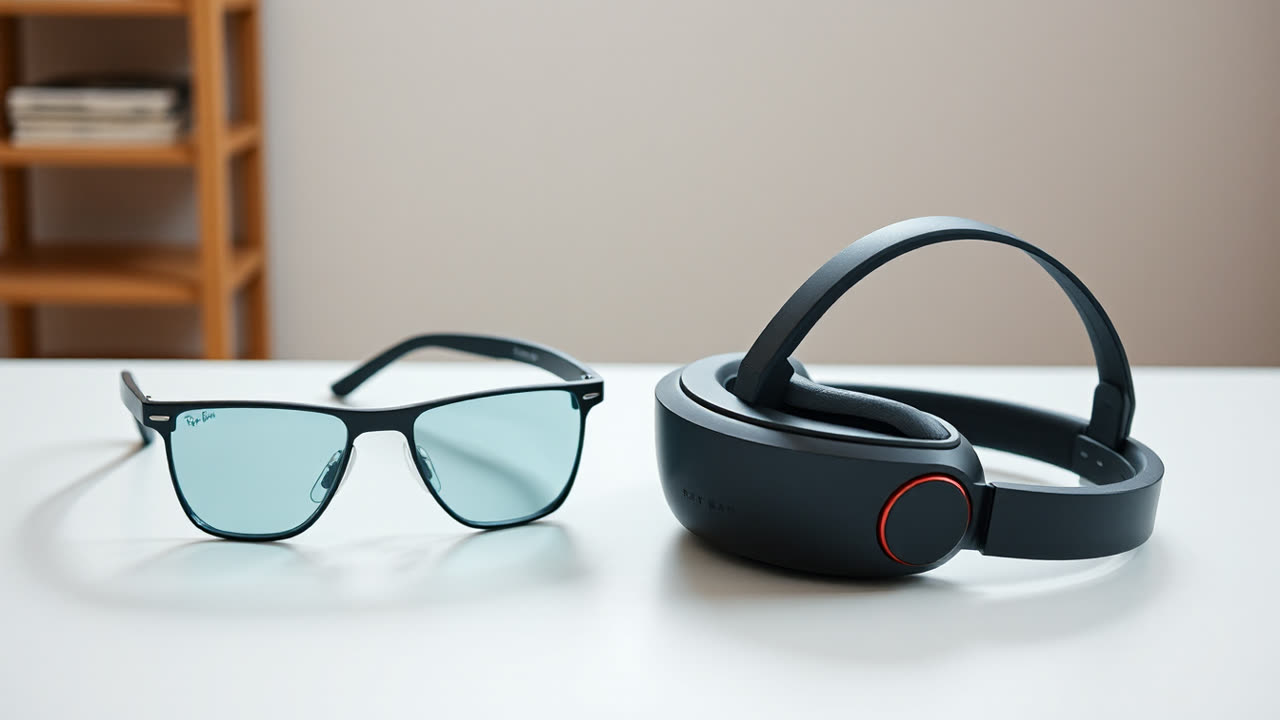
Meta's long-anticipated Connect 2026 keynote revealed a significant leap in its hardware ambitions, headlined by the unveiling of the Ray-Ban Meta Smart Glasses Pro and the Meta Quest 4, signaling a concerted effort to weave advanced AI directly into daily life and push the boundaries of spatial computing. The new Ray-Ban Meta Smart Glasses Pro, priced at a premium starting at $499, introduce a subtle yet revolutionary micro-LED display capable of delivering contextual augmented reality overlays, moving beyond simple notifications to provide real-time, interactive information directly within the user's field of view. This iteration significantly enhances the on-device AI capabilities, powered by a compact version of Meta's Llama 5 model, allowing for more sophisticated voice commands, real-time language translation, and visual search functions without constant cloud reliance. The design maintains the stylish aesthetic of its predecessors, a crucial factor for mainstream adoption, while integrating improved cameras and longer battery life, now boasting up to 10 hours of mixed usage.
This move into integrated AR overlays with on-device AI is a pivotal moment for Meta, directly challenging the nascent spatial computing market dominated by devices like Apple's Vision Pro. While the Ray-Ban Meta Smart Glasses Pro are not a direct competitor to a full-fledged mixed reality headset, their emphasis on unobtrusive, always-on AI assistance in a familiar form factor aims to capture a broader consumer base for everyday use, unlike the more immersive, but often cumbersome, VR/MR devices. The Pro model's ability to process complex queries and provide visual feedback locally addresses privacy concerns and latency issues inherent in cloud-dependent smart devices, offering a glimpse into a future where AI assistants are truly ubiquitous and seamlessly integrated into our perception of the world. For the industry, this sets a new benchmark for wearable AI, forcing rivals to consider how to deliver meaningful augmented experiences without sacrificing design or user comfort.
Simultaneously, the Meta Quest 4 was introduced at $599, positioning itself as the definitive mainstream VR headset with substantial upgrades across the board. Boasting a 4K per eye resolution via custom pancake lenses, the Quest 4 achieves a remarkable 50% increase in pixel density over the Quest 3, delivering unparalleled visual clarity for both gaming and productivity applications. The passthrough video quality has been dramatically improved, now offering full-color, high-fidelity views of the real world with minimal latency, blurring the lines between virtual and physical environments more effectively than any prior Quest device. Under the hood, a new custom Meta Reality chip, built on a 4nm process, provides a 2x performance boost for graphics and AI processing, enabling more complex virtual worlds and sophisticated AI-driven avatars within Horizon Worlds and other metaverse experiences. This processing power also facilitates advanced eye-tracking and foveated rendering, optimizing visual fidelity where the user is looking and extending battery life to approximately 3-4 hours of continuous use.
The Quest 4's enhancements are critical for solidifying Meta's lead in the standalone VR market. Its superior passthrough and processing power directly address common criticisms of earlier VR headsets, which often suffered from lower resolution and less convincing mixed reality capabilities. Compared to the more expensive, tethered PC VR headsets, the Quest 4 offers a compelling blend of performance and portability, making high-quality VR accessible to a wider audience. The integration of improved hand tracking and haptic feedback, potentially hinting at future haptic glove compatibility, further immerses users, making interactions feel more natural and intuitive. This iteration also features a more ergonomic design, reducing the overall weight by 15% and redistributing it for enhanced comfort during extended sessions.
Looking ahead, Meta's strategy is clear: to democratize spatial computing and AI. The Ray-Ban Meta Smart Glasses Pro lay the groundwork for a future where subtle, context-aware AR is commonplace, acting as an everyday interface for digital information and AI interaction. The Quest 4, on the other hand, pushes the boundaries of immersive experiences, preparing users for a richer, more visually stunning metaverse. The deeper integration of advanced AI, particularly the on-device Llama 5, across both product lines indicates a future where Meta's AI assistant will be a central operating system for personal computing, evolving from a voice interface to a multimodal, context-aware companion that understands and anticipates user needs. The challenge for Meta will be to maintain this delicate balance between cutting-edge technology and user accessibility, ensuring that these powerful tools genuinely enhance daily life rather than becoming another digital distraction. The success of these devices will ultimately hinge on developer adoption and the creation of compelling applications that leverage their unique capabilities, transforming Zuckerberg's vision of the metaverse from an abstract concept into a tangible, indispensable reality.