Microsoft Launches Copilot 'Super App,' Aiming for Office-Level Impact
Microsoft officially launched its new Copilot 'super app,' integrating chat, coding, and autonomous agents into a unified interface, signaling its ambition for a foundational impact on productivity akin to Microsoft Office.
✨ This content was summarized and interpreted by AI; it may contain errors — please verify accuracy with the original sources. Learn more
Listen to this story
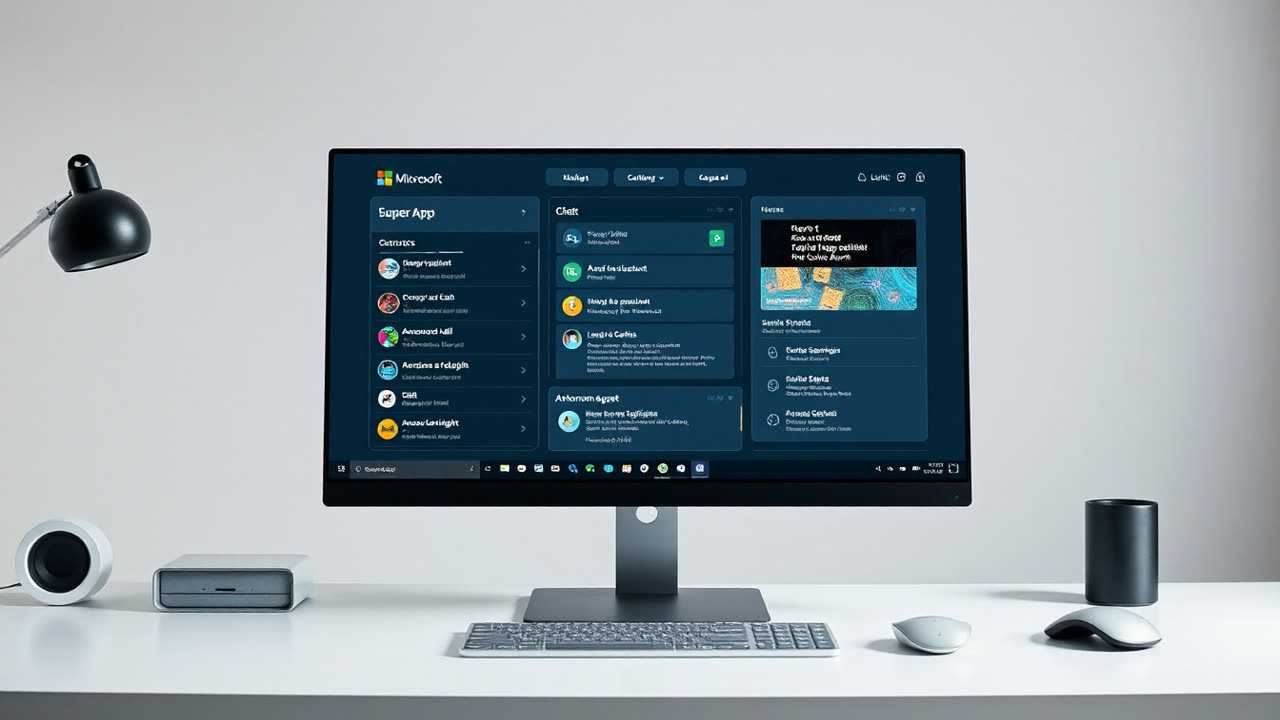
Microsoft's new Copilot "super app" officially launched, integrating chat, coding, and autonomous agents into a unified interface, signaling the company's ambition for it to achieve a foundational impact on productivity akin to Microsoft Office. This consolidation represents a significant strategic pivot, moving Copilot beyond a contextual assistant within Microsoft 365 or Windows to a standalone, cross-platform AI powerhouse designed to streamline complex workflows and intelligent automation across diverse user needs. The app’s unveiling emphasizes a vision where AI is not merely a feature but the central operating system for digital interaction, promising to redefine how individuals and enterprises approach tasks from content generation to software development and data analysis.
The "super app" designation itself underscores Microsoft's intent to create a single, indispensable hub for AI-driven productivity, a strategy that could profoundly reshape user expectations for software utility. By bundling chat for natural language interaction, sophisticated coding assistance for developers, and autonomous agents capable of performing multi-step tasks, Copilot aims to transcend the limitations of current generative AI models that often operate in siloed applications. This integrated approach is critical; instead of requiring users to switch between tools for different AI functions, Copilot seeks to offer a seamless environment where a single prompt can trigger a cascade of actions, from generating code snippets to drafting comprehensive reports and even managing scheduling, all within one application. For users, this could translate into unprecedented efficiency gains, drastically reducing the cognitive load associated with managing multiple AI tools and accelerating project completion times. The impact on developers, in particular, is poised to be transformative, as the integrated coding capabilities promise to not only suggest code but also debug, refactor, and even scaffold entire application components, potentially democratizing advanced programming and accelerating development cycles significantly.
This strategic move positions Copilot as a direct competitor to a growing ecosystem of specialized AI tools, from OpenAI's ChatGPT and Google's Gemini to various niche coding assistants and automation platforms. Unlike its rivals, many of which excel in specific domains, Microsoft’s Copilot super app’s strength lies in its expansive integration across the vast Microsoft ecosystem – Windows, Microsoft 365, Edge, and GitHub, among others. This deep integration provides Copilot with a rich contextual understanding of user data and workflows, enabling more personalized and effective AI assistance. While previous iterations of Copilot, such as Microsoft 365 Copilot, focused on enhancing productivity within specific applications like Word or Excel, the super app aims for a ubiquitous presence, acting as an intelligent layer over the entire digital experience. This holistic approach contrasts with Google’s strategy, which often embeds Gemini across its suite of products like Workspace and Search, but perhaps without the same declared "super app" consolidation. The challenge for Microsoft will be to ensure that this breadth does not come at the expense of depth, maintaining cutting-edge performance in each of its bundled capabilities while delivering a cohesive user experience.
Looking ahead, the success of the Copilot super app will hinge on several critical factors: its ability to seamlessly integrate new AI models and functionalities, its adaptability to evolving user needs, and its capacity to maintain robust data privacy and security standards. Microsoft’s aggressive push into AI suggests a future where the distinction between operating systems, applications, and AI assistants blurs further, with Copilot potentially evolving into the primary interface for computing. This could necessitate a rethinking of software development paradigms, shifting focus from discrete applications to AI-orchestrated services. The long-term outlook for Microsoft is ambitious; if Copilot can indeed deliver on its promise of intuitive, integrated AI across all facets of digital work, it has the potential to become as indispensable as Office has been for decades, fundamentally altering how we interact with technology and creating new benchmarks for enterprise and consumer productivity. The immediate next steps for Microsoft will likely involve aggressive marketing, developer outreach to build out the agent ecosystem, and continuous refinement based on early user feedback to solidify Copilot’s position as the definitive AI super app.