Microsoft Revamps Copilot into Unified Enterprise AI Workspace with Agentic Capabilities and Multi-Model Support
Microsoft is aggressively consolidating its consumer and enterprise Copilot versions into a single, robust business-focused AI workspace, adding crucial support for third-party frontier models and introducing advanced agentic features like Autopilot, signaling a major strategic pivot towards corporate productivity.
✨ This content was summarized and interpreted by AI; it may contain errors — please verify accuracy with the original sources. Learn more
Listen to this story
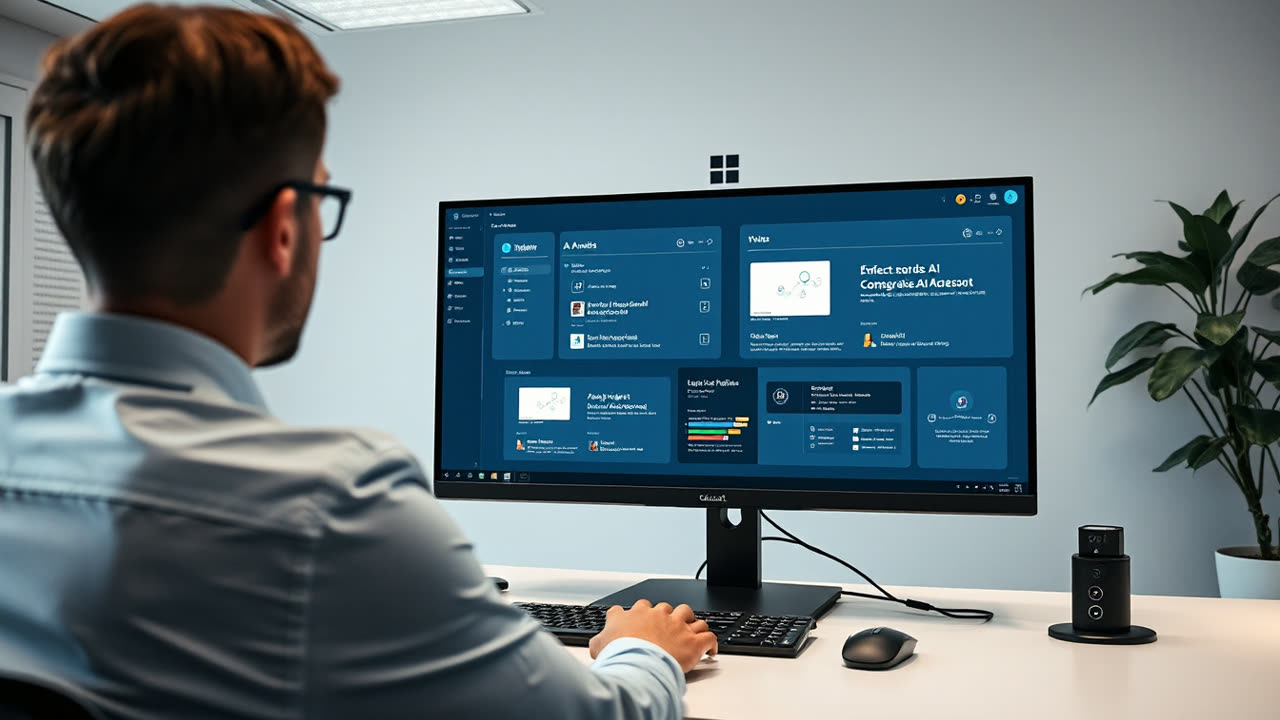
Microsoft is aggressively revamping Copilot into a unified AI workspace, strategically consolidating its consumer and enterprise versions into a more robust, business-focused offering. This significant overhaul, which has been in development for the past six months and is now rolling out through the "Frontier program," introduces a singular application experience designed to blend projects and agents, while crucially adding support for third-party frontier models. This move signals a deliberate pivot away from the personal AI companion market, where rivals like OpenAI's ChatGPT, Google's Gemini, and Meta's Muse currently dominate, to focus entirely on corporate productivity.
The "new Copilot" is structured around three core sections: Home, Code, and Autopilot. "Home" acts as a central hub, integrating existing conversational AI (Chat) with task delegation capabilities (Cowork), allowing users to organize and connect meetings, documents, emails, and applications. A new "Office in Copilot" feature will enable collaborative editing of Word, Excel, and PowerPoint documents directly within the app, ensuring work remains synchronized with native Office applications. "Code" is designed to empower non-technical employees to build custom applications, dashboards, automations, and workflows using natural language, leveraging the same underlying technology as GitHub Copilot within a secure, sandboxed environment. This functionality, which previously existed as "App Builder" for Frontier participants, now broadens to support editable code with Git version management and offers Microsoft-operated hosting for compatible third-party development tools via an SDK. The most transformative addition is "Autopilot," a rebranding of the earlier "Scout" initiative, which functions as a persistent, semi-autonomous digital agent. Autopilot can be assigned objectives and roles, capable of monitoring projects, coordinating with employees, managing recurring tasks, and resuming work without continuous prompting, operating within an organization's Microsoft 365 environment.
This strategic pivot matters immensely for several reasons. For users, it promises a more cohesive and powerful AI experience, moving beyond simple chat-based assistance to genuine AI-driven task orchestration. The integration of "Home" aims to streamline daily workflows by centralizing productivity tools and AI agents, potentially saving over 8 hours per user per month and accelerating new employee onboarding by more than 20%. The "Code" feature democratizes application development, allowing business users to create custom tools without extensive coding knowledge, a significant step towards enabling broader digital transformation within enterprises. Autopilot, as a persistent agent, represents a shift towards truly autonomous AI in the workplace, capable of handling complex, multi-step tasks across various applications and data sources. This agentic AI capability is a crucial evolution, as the AI assistant market is projected to grow from USD 3.35 billion in 2025 to USD 21.11 billion by 2030, driven by enterprises adopting domain-specific AI and plug-in ecosystems. The enterprise AI agent adoption market alone is expected to reach US$142.35 billion by 2035, growing at a CAGR of 36.9% from 2026.
For the industry, Microsoft's move to support third-party frontier models, such as Anthropic's Claude and OpenAI's Astra and Fable, alongside its own latest OpenAI GPT models, signals a commitment to a model-agnostic backend. This approach prevents vendor lock-in and allows enterprises to leverage the best available AI capabilities, with Copilot automatically selecting the optimal model for a given task based on factors like accuracy, speed, and cost. This expands Copilot Studio's capabilities, enabling developers to build custom Copilots that can integrate with various services, including Microsoft's own SharePoint and Dataverse, as well as third-party platforms like ServiceNow and Salesforce, through prebuilt or custom connectors. This openness contrasts with some rivals that may prioritize their proprietary models, positioning Microsoft as a platform orchestrator rather than a single-source provider. The inclusion of "FinOps for AI" is also a critical development for enterprise adoption, allowing administrators to manage AI spending, set policies, and control which model families are available to different user groups, addressing a key concern for organizations scaling AI deployments.
Comparing this to the prior generation, earlier iterations of Copilot primarily functioned as an AI assistant within individual Microsoft 365 applications, offering real-time support for tasks like drafting emails or summarizing documents. While effective, these were largely reactive, prompt-based interactions. The revamped Copilot, particularly with Autopilot and Cowork, moves towards proactive, goal-driven agentic AI that can execute complex, multi-step workflows autonomously. This aligns with broader industry trends where "agents are the new benchmark," with models like Claude 4.5 Sonnet demonstrating 30-hour autonomous runs. Rivals like Google have also announced similar "AI Agents," indicating a competitive push towards more autonomous AI capabilities.
Looking ahead, Microsoft's revamped Copilot, particularly its focus on enterprise-grade agents and multi-model support, positions it strongly in a rapidly evolving market. The company reported over 30 million paid Copilot enterprise subscriptions as of July, representing approximately a third of its Microsoft 365 commercial user base. This strong traction, combined with the new features, suggests a significant push to deepen AI integration into core business operations. The shift to a split pricing model, combining fixed-rate subscriptions for everyday use with usage-based billing for intensive agent tasks and frontier models, reflects a maturing understanding of AI consumption patterns and aims to provide greater flexibility and cost management for enterprises. Microsoft plans to reveal more Copilot features at its Ignite event in November, indicating a continuous roadmap for innovation. The broader enterprise AI market is projected to reach $150-200 billion by 2030, with a compound annual growth rate exceeding 30%. Microsoft's aggressive strategy with Copilot, particularly its emphasis on agentic workflows and responsible AI governance through tools like Agent 365, will be crucial for capturing a substantial share of this burgeoning market and shaping the future of work. The success will hinge on how effectively these advanced capabilities translate into tangible productivity gains and seamless integration within diverse enterprise environments, overcoming challenges related to data silos and governance that currently limit full-scale agent deployment for some organizations.