Mind-Bending Piet Quine GIF Replicates Itself Byte-for-Byte, Blurring Code and Art
A groundbreaking achievement in computational art sees a Piet Quine manifest as a GIF image capable of printing an exact, byte-for-byte copy of itself, blurring the lines between program and visual output in a way rarely witnessed.
✨ This content was summarized and interpreted by AI; it may contain errors — please verify accuracy with the original sources. Learn more
Listen to this story
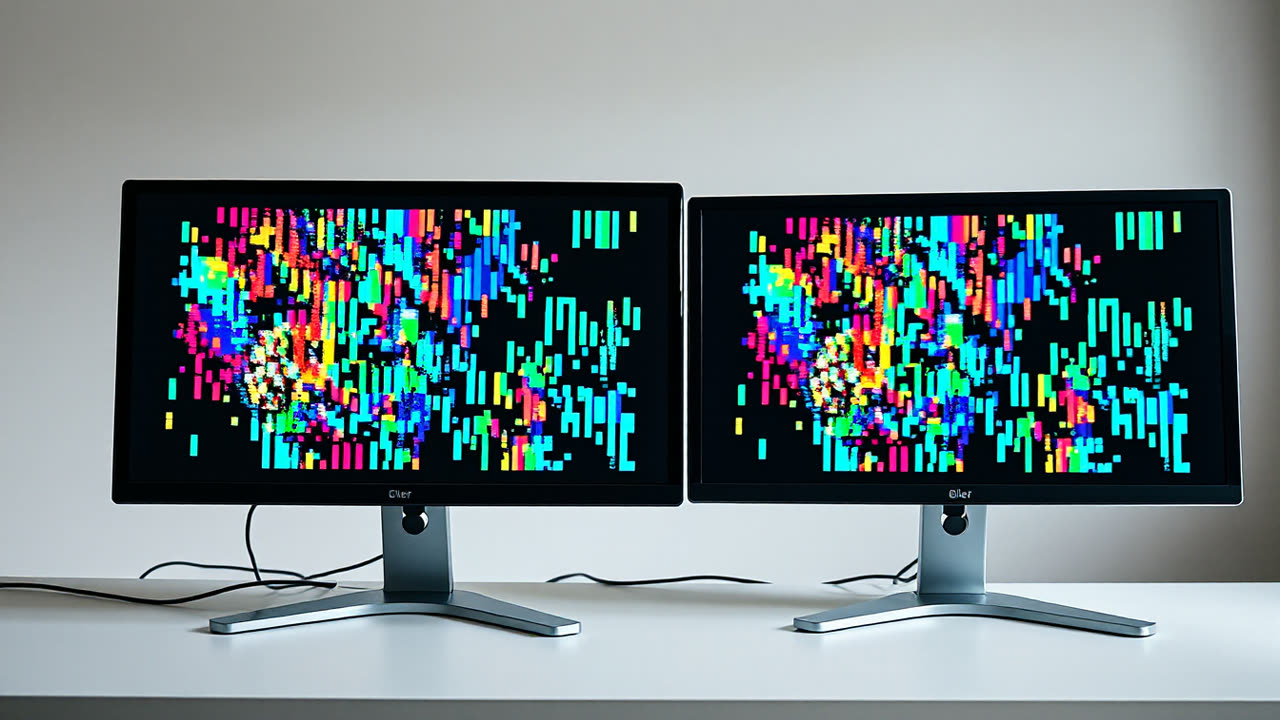
A groundbreaking achievement in computational art and esolangs has seen a Piet Quine manifest as a GIF image capable of printing an exact, byte-for-byte copy of itself, blurring the lines between program and visual output in a way rarely witnessed. This intricate creation, championed by coder Daniel Temkin, represents a significant evolution in the niche but intellectually rich field of self-replicating code, transforming an abstract concept into a tangible, visually compelling piece of digital media. Unlike traditional quines, which are programs that produce their own source code as output, Temkin's Piet Quine elevates the technique by using a graphic programming language to render its own visual representation, a GIF, which then effectively "prints" its identical twin.
The significance of this development extends far beyond mere technical novelty, offering profound implications for the understanding of digital self-reference, the nature of programming languages, and the burgeoning intersection of art and computation. At its core, a quine is a program that takes no input and produces a copy of its own source code as its only output. While often seen as a recreational programming exercise, quines delve into the fundamental paradoxes of self-reference, mirroring concepts found in Gödel's incompleteness theorems or the Liar Paradox in logic. Temkin's work pushes this philosophical boundary into the visual realm. Piet, the esoteric programming language employed, is unique for its program code being an image – specifically, a bitmap composed of 20 distinct colors. Program execution in Piet is determined by a "pointer" moving across these colored blocks, with operations triggered by changes in hue and lightness between adjacent pixels. This inherently visual nature makes a Piet Quine a particularly elegant and conceptually resonant form of self-replication, as the program *is* the image that it replicates.
Historically, quines have been a staple of programming challenges and academic curiosities, often written in text-based languages like Python, C, or Lisp. Early examples demonstrated the theoretical possibility of self-reproducing automata, laying groundwork for ideas ranging from biological replication to the design of self-modifying code. Temkin's Piet Quine differentiates itself by leveraging a language where the source code is inherently visual, making the output – the duplicated GIF – not just a textual representation but an aesthetic artifact identical to its progenitor. This moves the concept from the abstract syntax of characters to the concrete aesthetics of pixels, presenting a challenge orders of magnitude more complex than typical quines due to the dual constraints of program logic and visual fidelity. Achieving byte-for-byte replication of a GIF, a compressed image format, requires meticulous control over both the Piet language's instruction set and the GIF's internal structure, including its color palette, pixel data, and metadata, ensuring that the generated output is not merely visually similar but digitally identical.
The impact on users, particularly in the creative coding and digital art communities, is one of inspiration and expanded possibility. It challenges creators to think about code not just as a set of instructions, but as a medium with inherent aesthetic properties. For the broader industry, especially in fields like generative art, secure coding, or even data compression, this demonstration highlights the often-overlooked creative potential within highly constrained systems. It underscores how seemingly rigid programming paradigms can yield astonishingly fluid and self-referential results. This 'meta-art' form encourages a deeper engagement with the digital medium itself, prompting questions about authorship, originality, and the very definition of a "program" versus "data."
Looking ahead, Temkin's Piet Quine could catalyse further exploration into self-generating and self-modifying visual systems. We might see the development of "evolving" image programs that not only replicate but subtly mutate their visual output over generations, leading to new forms of algorithmic art. This technique could also inspire advancements in steganography, where information is hidden within images, by demonstrating extreme control over image data at a programmatic level. Furthermore, the principles behind constructing such a complex visual quine could inform the design of more robust and self-validating digital artifacts, potentially enhancing data integrity or creating novel forms of digital signatures where the signature *is* the verified data. As AI models increasingly generate visual content, the concept of a self-replicating visual program could offer new avenues for understanding and controlling the provenance and authenticity of synthetic media, ensuring that an image is precisely what it claims to be, down to its very bytes. This convergence of art, esolangs, and computational theory suggests a future where the digital canvas is not merely painted upon, but actively participates in its own creation and replication.