Minisforum Unveils AI Agent NAS N5 & AI Mini Workstation MS-S1 with AMD Ryzen AI Max+ Pro 495
Minisforum's new NAS N5 and MS-S1 mini-workstation, powered by AMD's Ryzen AI Max+ Pro 495 processors with up to 192GB unified memory, promise to revolutionize local AI computing by shifting powerful models from the cloud to the edge.
✨ This content was summarized and interpreted by AI; it may contain errors — please verify accuracy with the original sources. Learn more
Listen to this story
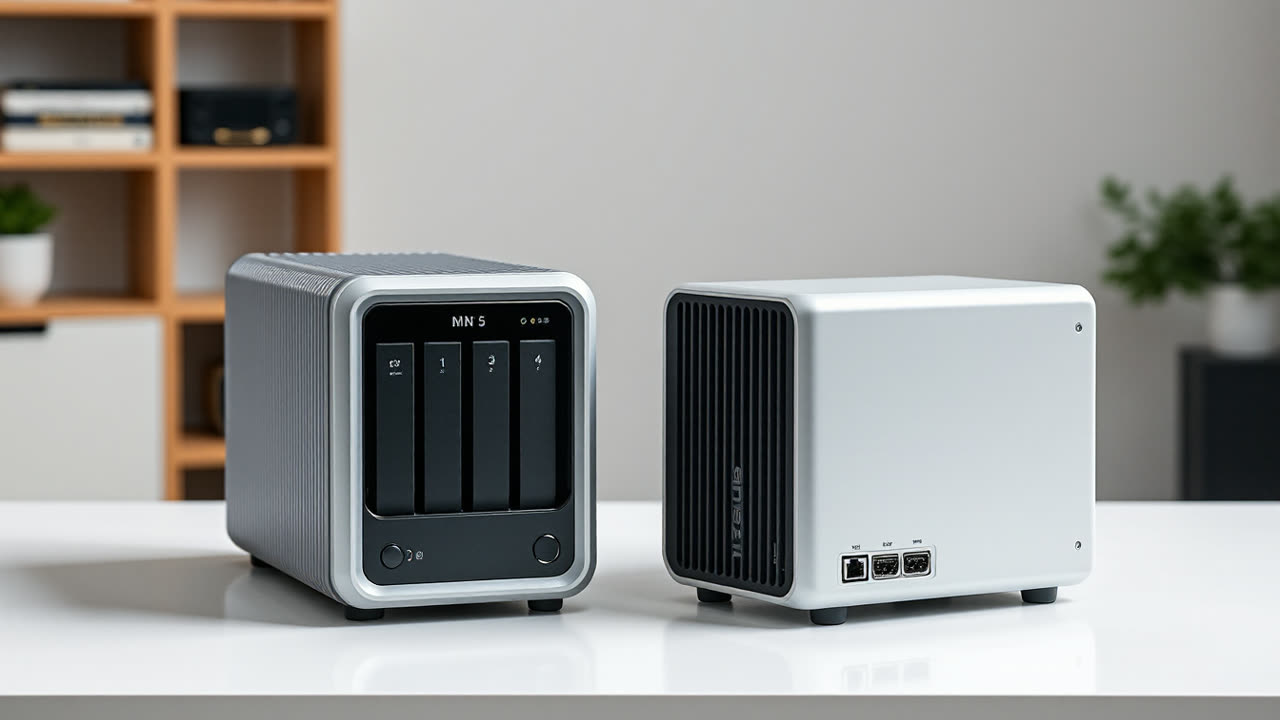
Minisforum has unveiled its AI Agent NAS N5 and AI Mini Workstation MS-S1 at IFA 2026, marking a significant leap in local AI computing by integrating AMD's powerful Ryzen AI Max+ Pro 495 processors. These new systems are designed to run demanding AI models directly on-device, featuring up to a massive 192GB of unified LPDDR5x-8533 MT/s memory and boasting a combined AI performance of up to 131 TOPS (Trillions of Operations Per Second). The core of these machines, the AMD Ryzen AI Max+ Pro 495, part of the "Gorgon Halo" family launched in May 2026, packs 16 Zen 5 CPU cores clocking up to 5.2 GHz, a 40-CU RDNA 3+ Radeon 8065S integrated GPU, and a 55 TOPS XDNA 2 Neural Engine. This formidable hardware is poised to democratize access to advanced AI capabilities, shifting the paradigm from cloud-centric processing to powerful, private edge computing.
This development matters immensely for both individual users and the broader technology industry, fundamentally reshaping how AI is accessed and deployed. For users, the ability to run large language models (LLMs) and sophisticated AI agents locally on a personal device or network-attached storage offers unprecedented levels of data privacy and security. Instead of relying on external cloud servers, where sensitive information might be exposed to third parties or data breaches, users can retain complete control over their data, processing it entirely on their own hardware. This is particularly critical for professionals handling confidential data, businesses protecting trade secrets, and anyone concerned about the privacy implications of cloud-based AI. Beyond privacy, local AI significantly reduces latency, enabling real-time inference for applications like video editing, 3D rendering, and AI development, where immediate feedback is crucial. The long-term cost benefits are also substantial, as users can avoid recurring cloud subscription fees by owning the hardware outright. The NAS N5, with its capacity for up to 200TB of local storage combined with AI compute, is particularly compelling as an "AI backend" for persistent AI workloads, including RAG knowledge bases, embeddings, databases, and local AI agents such as OpenClaw and Hermes. This integrated storage and compute solution positions it as a centralized hub for data, models, and long-running AI tasks at the edge. The AI Mini Workstation MS-S1, meanwhile, is designed for intensive local AI tasks and engineering workflows in an ultra-compact footprint.
The industry impact is equally profound. Minisforum's new offerings accelerate the broader trend of "AI PCs" and "Edge AI," validating a burgeoning market for dedicated local AI hardware. The sheer memory capacity of 192GB, dynamically allocated as unified memory between the CPU and GPU, directly addresses one of the most significant bottlenecks in running large AI models: VRAM limitations. While traditional systems often struggle with the explicit copying of data between separate CPU RAM and GPU VRAM, unified memory streamlines this process, allowing larger models (e.g., 70B parameter models requiring 40GB+ of VRAM) to fit and run efficiently. This approach, popularized by Apple's M-series chips, now finds a powerful x86 counterpart in AMD's Ryzen AI Max+ Pro line, offering a compelling alternative for developers and users invested in the Windows or Linux ecosystems.
Compared to its predecessor, the Ryzen AI Max+ 395 ("Strix Halo"), the Ryzen AI Max+ Pro 495 is more of a capacity and clock speed refinement, but a crucial one. While CPU performance sees a modest increase of around 2-4% from its 16 Zen 5 cores clocked up to 5.2 GHz (compared to the 395's 5.1 GHz), the jump from 128GB to 192GB of unified memory is a 50% increase in capacity, directly translating to the ability to run even larger and more complex AI models locally. The Radeon 8065S iGPU, with its 40 RDNA 3+ compute units and 3000 MHz frequency, is AMD's most powerful integrated GPU as of May 2026, capable of outperforming lower mid-range desktop graphics cards like the GeForce RTX 4050 and allocating up to 160GB of graphics memory. This positions it favorably against some discrete GPU solutions for AI workloads that benefit from large memory pools. Rival offerings from NVIDIA, such as the recently announced RTX Spark PCs at IFA 2026, also emphasize local AI with powerful Blackwell GPUs (up to 1 Petaflop) and Grace CPUs, featuring up to 128GB of unified memory. While NVIDIA's raw GPU TOPS might be higher for some specific workloads (e.g., an RTX 4090 offers 1,321 TOPS but with 24GB VRAM), AMD's unified memory approach with its substantial capacity offers a different advantage for memory-hungry LLMs. Intel's Core Ultra chips, while competitive in CPU performance, would need to demonstrate comparable NPU and unified memory capabilities to match Minisforum's AI focus in this specific segment.
Looking ahead, the trajectory for local AI hardware points towards continued advancements in NPU performance, memory bandwidth, and energy efficiency. The Minisforum NAS N5 and MS-S1 are not merely products but foundational components for a future where AI is deeply integrated into personal and small-business infrastructure. We can anticipate further optimization of local AI frameworks like llama.cpp and Ollama, alongside the emergence of more sophisticated local AI agents and applications that fully leverage these powerful edge devices. The ability to deploy multiple MS-S1 units in a compact AI cluster to handle massive models, such as a four-unit cluster successfully running the DeepSeek-R1 671B Q4 large model, highlights the scalability of this approach for enterprises and research teams. However, challenges remain, particularly in ensuring robust security against potential "AI poisoning" attacks even in local environments, and in developing intuitive software ecosystems that make these powerful tools accessible to a broader audience. Minisforum's strategic focus on high-capacity, unified memory solutions, coupled with AMD's potent Ryzen AI Max+ Pro processors, positions them as a key player in shaping the next generation of AI computing at the edge.