MiTale Uses IBM Quantum Simulator for C.L.A.Y. Game Content Generation
Finnish studio MiTale has leveraged an IBM quantum simulator to generate maps, characters, and graphics for its upcoming RPG C.L.A.Y., claiming it as the 'first commercial game utilizing quantum computing.'
✨ This content was summarized and interpreted by AI; it may contain errors — please verify accuracy with the original sources. Learn more
Listen to this story
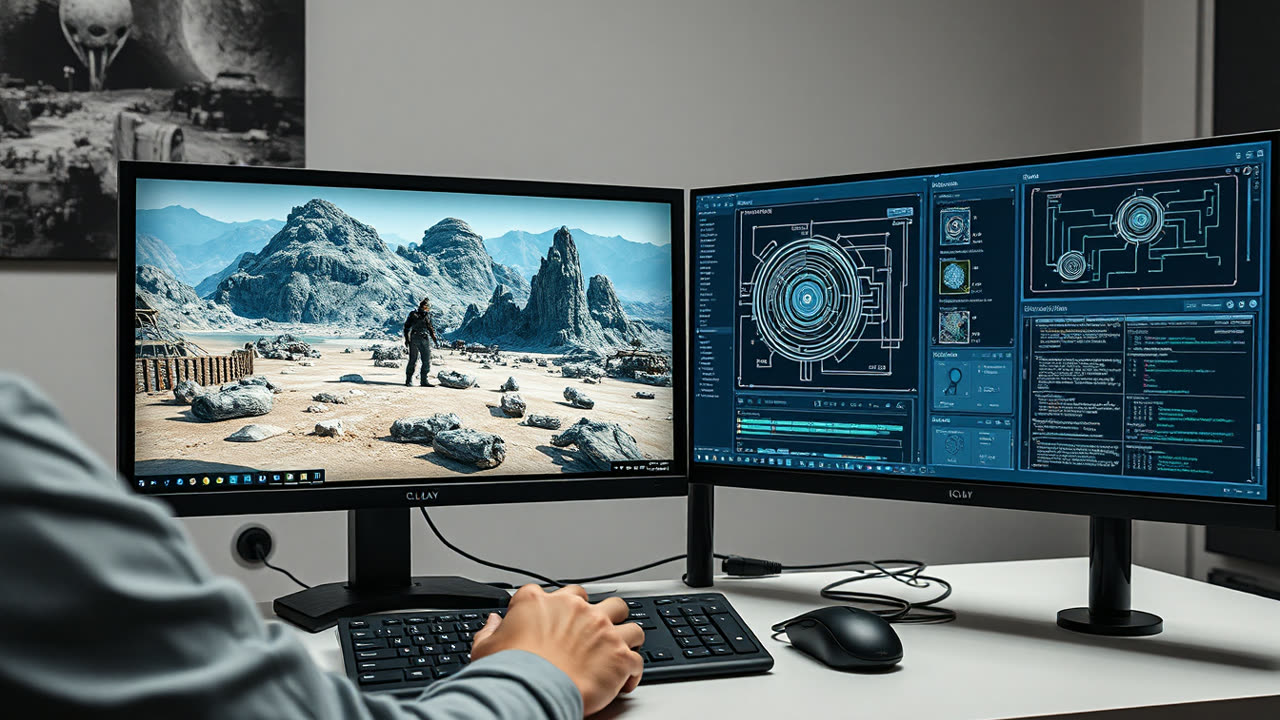
The Finnish independent studio MiTale Ltd. has claimed a significant milestone in technology integration, leveraging an IBM quantum simulator to generate maps, characters, and graphics for its upcoming narrative-driven post-apocalyptic RPG, C.L.A.Y.. This bold move, which MiTale promotes as the "first commercial game on the market utilizing quantum computing," marks a nascent, yet profound, shift in how developers might approach procedural content generation and complex system design within interactive entertainment.
The immediate impact on users, while not yet fully manifest in a commercial release, promises a new frontier in emergent gameplay and dynamic world-building. Traditional procedural generation, while powerful, often relies on deterministic algorithms or extensive rule sets that, despite their complexity, can eventually lead to predictable patterns or a sense of "sameness" across generated content. Quantum algorithms, by contrast, harness principles like superposition and entanglement, potentially enabling the creation of truly novel, non-obvious, and less repetitive content. For C.L.A.Y., this could translate into environments that feel genuinely unique with each playthrough, character interactions that are subtly nuanced, and graphical elements that possess an unprecedented level of organic unpredictability, fostering deeper immersion and replayability. Players might experience worlds that are not just randomly assembled but possess an emergent coherence that classical methods struggle to achieve.
From an industry perspective, MiTale's endeavor is a crucial proof-of-concept, signaling the eventual viability of quantum computing as a tool in the creative pipeline, beyond its established applications in scientific research, finance, and materials science. While the studio utilized an IBM quantum simulator rather than a full-fledged quantum computer—a pragmatic decision given the current stage of quantum hardware development—it demonstrates that even simulated quantum environments can offer distinct advantages. This pioneering step could inspire larger studios to invest in R&D for quantum applications, potentially leading to a new arms race in game engine capabilities. The immediate challenge for broader adoption lies in the accessibility and steep learning curve associated with quantum programming, typically involving languages like Qiskit for IBM's quantum experience. However, as quantum software development kits mature and higher-level abstractions emerge, the barrier to entry will undoubtedly lower, allowing more developers to experiment with these powerful tools.
The background of procedural generation in gaming stretches back decades, from early roguelikes like *Rogue* to modern epics such as *No Man's Sky* and *Minecraft*, which rely heavily on algorithms to create vast, explorable universes. These classical methods, often employing techniques like Perlin noise, fractals, and cellular automata, have achieved remarkable results, generating billions of unique planets or infinite landscapes. However, they are fundamentally limited by classical computational models. Quantum computing, even in its nascent "noisy intermediate-scale quantum" (NISQ) era, offers a different paradigm. Quantum algorithms, such as Grover's algorithm for search or Shor's algorithm for factorization, hint at exponential speedups for specific problem types, which could be adapted for generating highly complex, optimized, or truly random content that would be computationally intractable for classical systems. The C.L.A.Y. project, using quantum circuits to influence elements like map topography and character attributes, begins to tap into this potential, pushing beyond the conventional limits of pseudo-randomness and deterministic complexity.
Looking ahead, the integration of quantum computing into game development is likely to follow a phased evolution. Initially, as seen with MiTale, it will serve as a specialized tool for tasks demanding extreme computational power or genuinely unpredictable outcomes, such as generating highly detailed, non-repeating textures, designing intricate puzzle mechanics, or even simulating complex AI behaviors with emergent properties. We might see quantum-enhanced physics engines capable of simulating materials and interactions with unprecedented realism, or narrative systems that dynamically adapt story arcs based on quantum-influenced player choices, leading to truly branching and unique playthroughs. As quantum hardware advances, moving beyond simulators to fault-tolerant quantum computers, the scope will expand dramatically. This could eventually lead to "quantum-native" games, designed from the ground up to leverage quantum principles for entire game worlds, potentially creating experiences that are currently unimaginable. The next five to ten years will likely see increased investment from tech giants and gaming publishers into quantum research labs, with open-source quantum libraries and engines emerging to democratize access. Ultimately, quantum computing's greatest contribution to gaming may not be just in generating content, but in fundamentally redefining the very nature of interactive experiences, moving towards emergent, intelligent, and truly unpredictable digital realities.