Modal Motors Pioneers Rare-Earth-Free Electric Motors to Counter China's Monopoly
Farmington Hills-based startup Modal Motors is developing innovative Transverse Flux Motors, entirely free of rare earth magnets, to secure domestic supply chains and disrupt China's dominance in critical electric motor components.
✨ This content was summarized and interpreted by AI; it may contain errors — please verify accuracy with the original sources. Learn more
Listen to this story
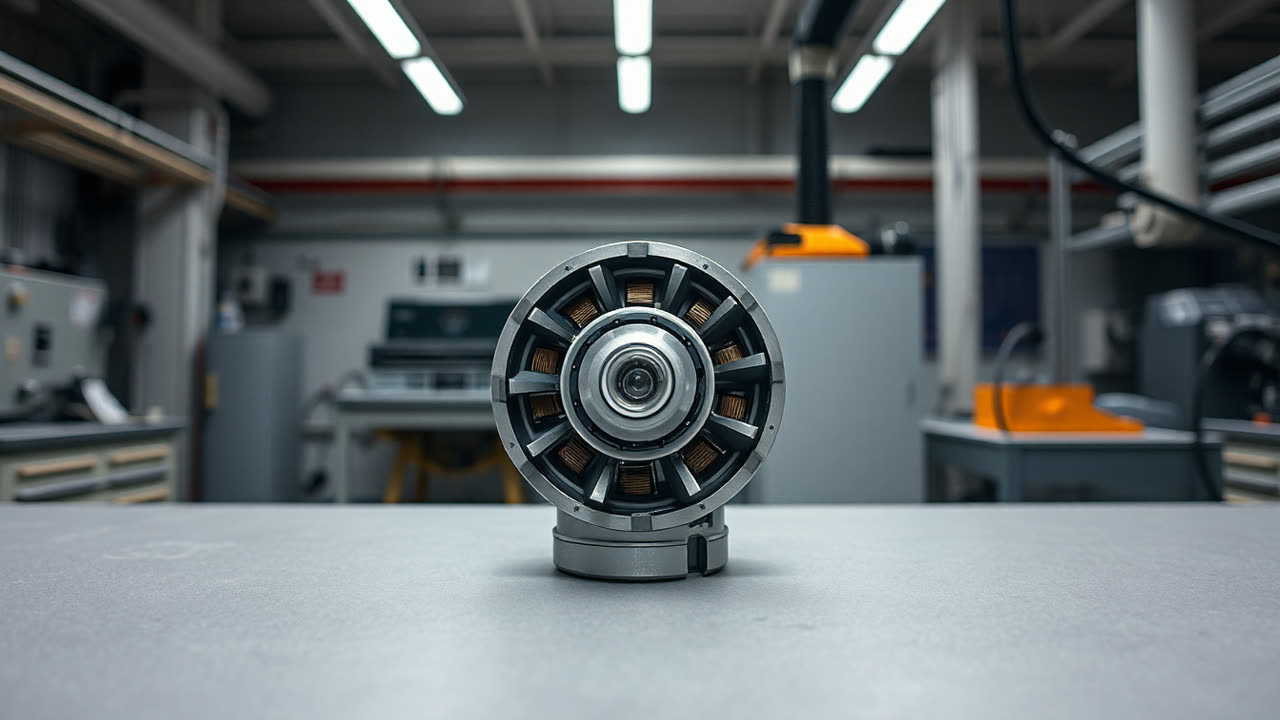
In a bold move to dismantle China's near-monopoly on critical electric motor components, Modal Motors, a Farmington Hills, Michigan-based startup, is pioneering a new generation of small, lightweight electric motors entirely free of rare earth magnets. This innovative approach, centered on a patent-pending Transverse Flux Motor (TFM) architecture, aims to secure domestic supply chains, reduce manufacturing costs, and reshape the landscape for applications ranging from drones and robotics to fans and automotive systems. The company, which spun off from Veolectra Inc. in 2024, has raised $2.1 million in seed funding as of October 2025 to commercialize its technology.
Modal Motors' core innovation lies in its ability to harvest all magnetic flux within the motor, achieving high torque density and efficiency without relying on the back irons and yokes that are major sources of loss in conventional designs. Their motors can even incorporate aluminum coil windings instead of copper, further diversifying material sourcing. This design is bolstered by a collaboration with MPP, which supplies soft magnetic composite (SMC) stator tips to enable a 3D flux path, disrupt eddy currents, and offer geometric flexibility that traditional laminations cannot. This advanced manufacturing process is designed for fully automated, cell-based robotic assembly in the USA, promising scalability and cost-effectiveness with low capital and minimal labor touch.
The significance of Modal Motors' endeavor extends far beyond mere technological advancement; it directly addresses a profound geopolitical vulnerability. China currently dominates the rare earth supply chain, controlling approximately 90% of global refined rare earth output and an estimated 94% of permanent magnet production. This dominance grants Beijing significant geopolitical and economic leverage, enabling it to influence global manufacturing, trade negotiations, and even national security policies. Instances like China's 2010 reduction in rare earth export quotas, which caused a sharp spike in global prices, underscore the fragility of relying on a single source for these critical materials. The International Energy Agency (IEA) estimates that if China were to fully implement rare earth export restrictions, the annual economic value of downstream production outside China potentially exposed to disruption could reach an staggering US$6.5 trillion.
Rare earth elements, particularly neodymium and dysprosium, are integral to permanent magnet synchronous motors (PMSMs), which comprise over 80% of electric vehicle (EV) traction motors due to their high magnetic strength, compact size, and efficiency. However, this reliance introduces significant risks, including volatile prices, supply chain disruptions, and environmental concerns associated with mining and processing, which can generate wastewater, atmospheric pollution, and radiation. Neodymium prices, for example, surged from $65/kg in 2020 to $223/kg in 2022, settling near $123/kg in 2025, demonstrating the market's instability.
Modal Motors' rare-earth-free approach, which likely utilizes technologies akin to synchronous reluctance motors (SynRMs) or switched reluctance motors (SRMs), offers a compelling alternative. While historically associated with trade-offs like lower power density or more complex control compared to NdFeB magnets, modern advancements in power electronics, control algorithms, and material science are rapidly closing these performance gaps. For instance, SynRMs can achieve 92% to 96% efficiency and offer lower component costs (18% to 25% less than permanent magnet alternatives), while SRMs provide superior torque density at low speeds. The global rare-earth-free motor market, valued at an estimated $6.5 billion in 2026, is projected to reach $15.1 billion by 2033, growing at a compound annual growth rate of 12.8%. This growth is driven by accelerated EV adoption, the imperative for supply chain resilience, and the expansion of industrial automation and renewable energy integration.
The immediate impact of Modal Motors' success could be most keenly felt in the drone sector, where they are set to deliver OR3627-900kV drone motors starting in Q4 2026. The global drone motor market, valued at $7.28 billion in 2026, is projected to reach $16.3 billion by 2034, making it a critical area for supply chain security, particularly for defense and surveillance applications. By providing domestically sourced, rare-earth-free motors, Modal Motors directly contributes to national security and reduces the drone industry's reliance on overseas manufacturing for mission-critical components.
Looking ahead, Modal Motors' strategy represents a significant step towards a more diversified and resilient global electric motor ecosystem. The company's focus on high torque density and efficiency, coupled with its "USA-and-allied supply chain," positions it as a vital player in the ongoing industrial reshoring efforts. Should their technology prove scalable across larger applications, such as the broader automotive and industrial sectors, it could fundamentally alter the competitive landscape. While traditional permanent magnet motors will likely retain a significant market share, especially in high-performance segments, the increasing viability and cost-effectiveness of rare-earth-free alternatives will push manufacturers worldwide to rethink their material strategies. The long-term outlook suggests a future where geopolitical stability and environmental stewardship are as crucial to motor design as efficiency and power density, with companies like Modal Motors leading the charge towards a truly independent and sustainable electrification.