Modder Unlocks Up to 127% DLSS Performance Boost by Offloading Neural Rendering to Second GPU
An innovative ReShade add-on allows gamers to significantly boost frame rates by dedicating a secondary GPU to Nvidia's DLSS neural rendering, reminiscent of older PhysX acceleration.
✨ This content was summarized and interpreted by AI; it may contain errors — please verify accuracy with the original sources. Learn more
Listen to this story
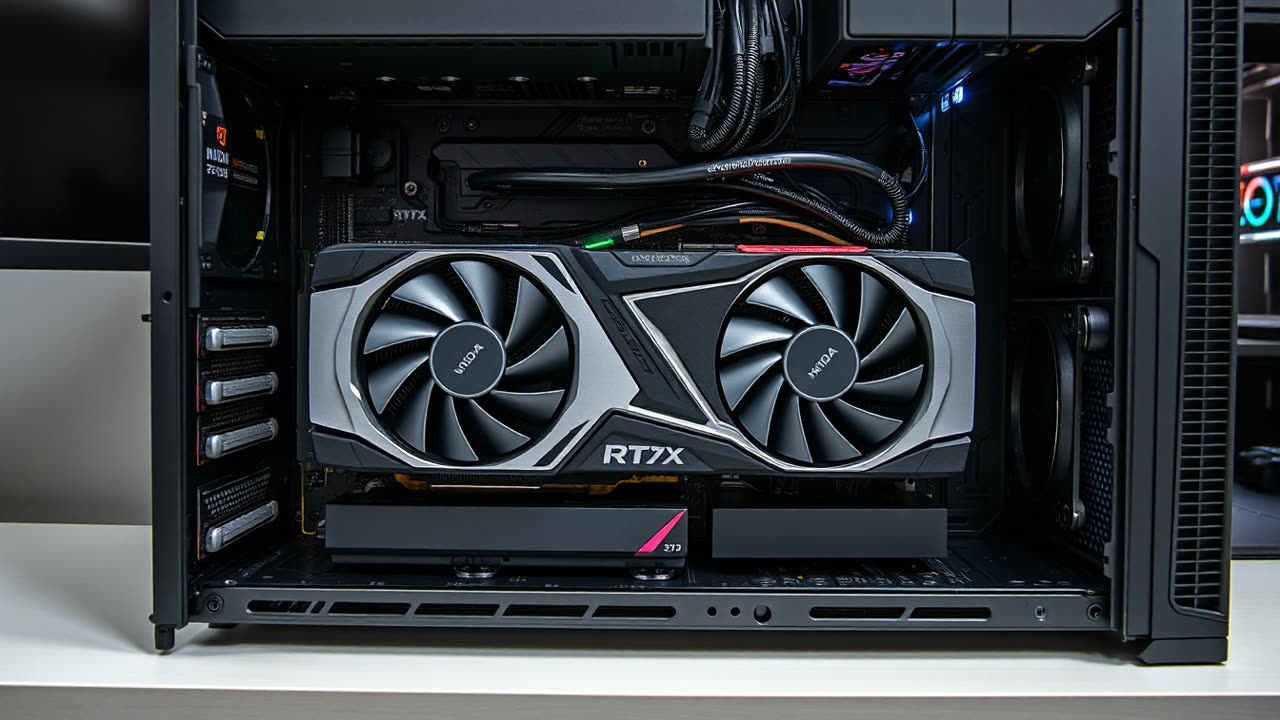
A groundbreaking modification has demonstrated the capacity to significantly boost gaming performance, achieving up to a 127% increase in frame rates by offloading advanced neural rendering components of Nvidia's Deep Learning Super Sampling (DLSS) to a secondary graphics processing unit (GPU). This innovative ReShade add-on, developed by modder 'PureDark,' allows the primary GPU to handle traditional game rendering while a second, dedicated GPU processes the computationally intensive neural network operations, effectively distributing the workload in a manner reminiscent of older dedicated PhysX acceleration cards.
This development carries profound implications for both gamers and the wider graphics card industry. For users, it offers a compelling new pathway to enhance performance without necessarily investing in a single, top-tier GPU upgrade. Many enthusiasts possess older, still-capable Nvidia GPUs gathering dust, or could acquire a budget-friendly second card, potentially revitalizing their existing systems. This setup could prove particularly attractive for those whose primary GPU struggles with the AI-driven demands of modern upscaling and frame generation techniques, allowing them to unlock higher frame rates and smoother gameplay, especially in titles heavily reliant on DLSS 3's Frame Generation or DLSS 3.5's Ray Reconstruction. The economic benefit is tangible, as a secondary, less powerful RTX card could provide a significant uplift for a fraction of the cost of a flagship GPU.
From an industry perspective, this mod challenges the prevailing single-GPU paradigm for high-performance gaming and highlights the increasing specialization of computational tasks within modern graphics pipelines. Nvidia's DLSS, particularly its Frame Generation component, relies heavily on Tensor Cores for neural network inference. By demonstrating that these specific workloads can be effectively separated and parallelized across multiple GPUs, PureDark's mod implicitly suggests a potential architectural evolution. It signals that future GPU designs or software ecosystems might benefit from a more modular approach to hardware acceleration, where dedicated AI processing units could be scaled independently or even externally. This could potentially influence how Nvidia, AMD, and Intel approach multi-GPU configurations, moving beyond the largely failed general-purpose scaling of SLI/CrossFire towards task-specific heterogeneous computing.
Historically, multi-GPU configurations like Nvidia's SLI and AMD's CrossFire largely faded from mainstream relevance due to several critical challenges. These included inconsistent performance scaling, significant driver overhead, increased input latency, and a lack of widespread developer support, which often left users with suboptimal experiences or even negative performance in some titles. The exception was Nvidia's PhysX acceleration, which, for a period, allowed dedicated PhysX cards to offload physics calculations, providing a noticeable visual enhancement in supported games without directly impacting core rendering performance. This mod's approach echoes the PhysX model by isolating a specific, computationally intensive task (neural rendering) onto a separate processor, thereby circumventing many of the traditional pitfalls associated with general-purpose multi-GPU rendering. Unlike general-purpose SLI, the mod specifically targets the neural rendering aspect, which is a relatively self-contained and parallelizable workload compared to the complex interdependencies of traditional frame rendering.
While the "DLSS 5" designation used by the modder is unofficial and likely refers to the latest advanced neural rendering features found in DLSS 3 and 3.5—Nvidia has not publicly announced a DLSS 5—the mod's reported performance gains are compelling. However, this unofficial solution is not without its limitations. As a mod, it lacks official support, meaning potential instability, compatibility issues with future game patches or driver updates, and a reliance on community support for troubleshooting. Running two GPUs inevitably increases power consumption, heat generation, and system complexity. Furthermore, the effectiveness of the performance boost will depend heavily on the specific game, the primary GPU's existing bottlenecks, and the capabilities of the secondary GPU. The latency implications of passing data between two distinct GPUs for frame generation, while potentially mitigated by the mod's design, remain a critical consideration for competitive gamers.
Looking ahead, this mod could serve as a powerful proof-of-concept, potentially influencing future hardware and software development. It might prompt GPU manufacturers to explore official API support for splitting neural rendering workloads across multiple accelerators, or even design GPUs with more explicit internal partitioning for such tasks. Imagine a future where a relatively modest primary gaming GPU could be paired with a highly specialized, low-power AI accelerator card dedicated solely to DLSS-like operations, offering a scalable and efficient upgrade path. This could also breathe new life into the used GPU market, as older RTX cards, even lower-end ones, could find a renewed purpose as dedicated neural rendering engines. Ultimately, as AI and machine learning increasingly permeate game development, solutions that efficiently distribute these specialized workloads, whether through official channels or ingenious community mods, will be crucial for pushing the boundaries of visual fidelity and performance.