MSI Claw 8 EX AI Plus: Intel's Costly Bid to Dominate Handheld Gaming
Despite a record-breaking price of up to $1,799, the MSI Claw 8 EX AI Plus, powered by Intel's new Arc G3 Extreme, sets a new performance benchmark in handheld PC gaming, directly challenging AMD's market stronghold.
✨ This content was summarized and interpreted by AI; it may contain errors — please verify accuracy with the original sources. Learn more
Listen to this story
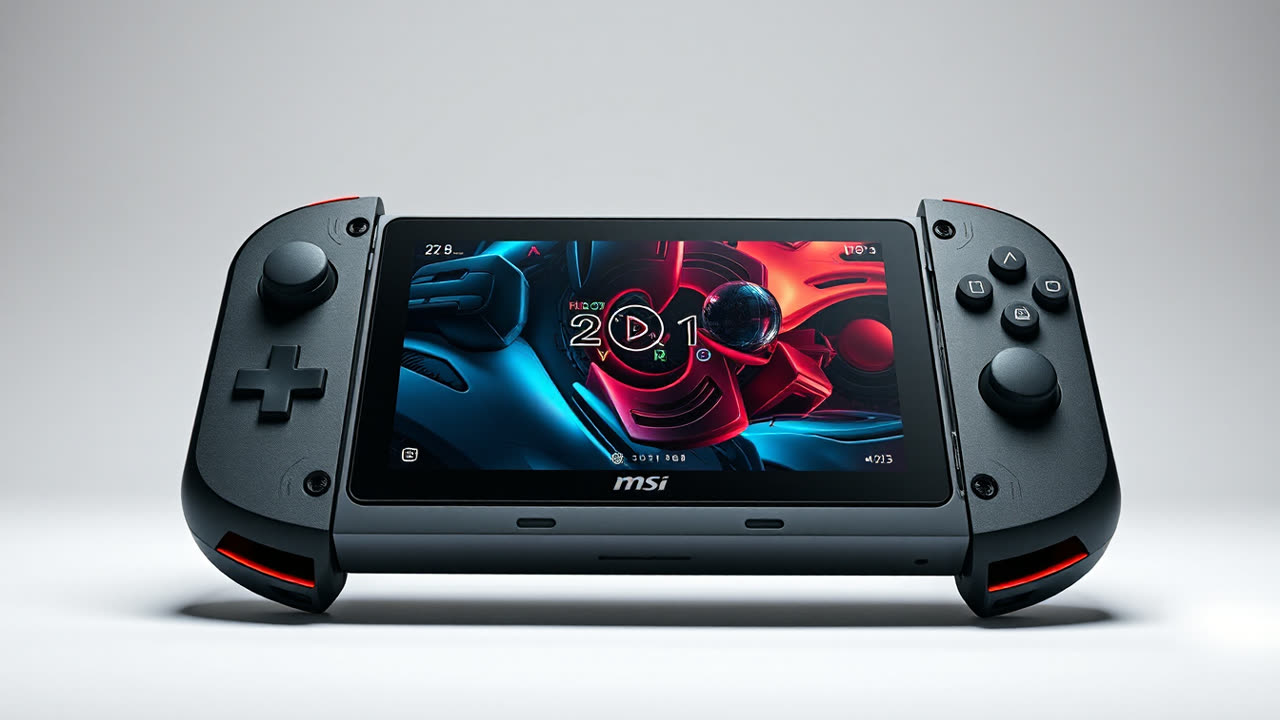
The MSI Claw 8 EX AI Plus, launched on June 23, 2026, represents a pivotal moment for Intel's presence in the handheld PC gaming market, despite its eye-watering retail price ranging from $1,699 to $1,799. This premium cost positions it as the most expensive handheld gaming PC to date, significantly surpassing rivals such as the Lenovo Legion Go 2 at $1,199 and the ROG Ally X at $999.99. While The Verge's resident handheld reviewer acknowledged its "major milestone" status, the device received a 6 out of 10 score, with the recommendation against purchase largely due to its cost and identified shortcomings.
At its core, the Claw 8 EX AI Plus is powered by Intel's cutting-edge Arc G3 Extreme processor, built on the Panther Lake platform, featuring a 14-core CPU and 12 Xe3 GPU cores (Arc B390 graphics). This marks Intel's dedicated foray into high-performance handheld silicon, moving beyond adapted laptop chips. The hardware package is completed with 32GB of LPDDR5X RAM, a 1TB NVMe SSD, an 8-inch 1920x1200 120Hz IPS touch display, and a robust 80Wh battery. Key design refinements over the original Claw include enhanced LB/RB buttons and the integration of Hall Effect joysticks and triggers, aimed at eliminating stick drift. Connectivity is also robust, with dual Thunderbolt 4 ports and Wi-Fi 7 support.
The significance of the Claw 8 EX AI Plus lies in Intel's aggressive challenge to AMD's long-standing dominance in the handheld APU space. Early benchmarks paint a compelling picture of Intel's new architecture. In 3DMark Time Spy, a Panther Lake-class chip (Core Ultra X9 388H) scored 4297 at 17W and 5766 at 25W, substantially outperforming the AMD Ryzen Z2 Extreme's scores of 2917 at 17W and 3495 at 25W. In real-world gaming scenarios, the Arc G3 Extreme achieved 73 frames per second (FPS) in Cyberpunk 2077 at 1080p High with XeSS at 35W, compared to the AMD Z2 Extreme's 52 FPS with FSR. Some tests indicate the Claw 8 EX AI+ can be up to 41% faster on average across various games when compared to the ROG Xbox Ally X's AMD Ryzen AI Z2 Extreme at identical 35W power limits. This performance leap is a critical validation for Intel's Xe3 (Celestial) architecture, demonstrating its capability to lead in integrated graphics for demanding gaming loads.
However, the "wouldn't buy one" caveat is almost entirely due to its premium pricing. Selling for similar money as a dedicated gaming laptop, the Claw 8 EX AI Plus forces a direct comparison where larger screens, physical keyboards, and often more powerful discrete GPUs become available. MSI has attributed the steep price partly to a 250% surge in LPDDR5X memory costs, driven by enterprise AI demands. MSI's Product Marketing Lead, Andy Chu, openly described 2026 as a "tough year" for OEMs due to these supply chain pressures. This pricing strategy positions the device for a highly niche audience, alienating many mainstream gamers. Furthermore, the absence of an OLED display, a feature present in more affordable competitors like the Steam Deck OLED and the Lenovo Legion Go 2, further detracts from its value proposition. While the Claw 8 EX AI+ offers a comfortable ergonomic design and a vibrant 8-inch IPS screen, the software experience on Windows 11, a persistent concern with the original Claw, remains a potential hurdle for user satisfaction. The original MSI Claw (A1M) suffered from poor gaming performance, software glitches, and overheating, making the Claw 8 EX AI+ a crucial redemption for both MSI and Intel.
The Claw 8 EX AI Plus marks a significant generational improvement for MSI. Intel claims a 44% performance boost over its Lunar Lake predecessor. In comparison to rivals: the ROG Ally X, at $999.99, offers a compelling price-to-performance ratio despite being slower. The Lenovo Legion Go 2, priced at $1,199, boasts an 8.8-inch 144Hz 2K OLED screen and detachable controllers, providing distinct advantages that some users may prioritize over the Claw's raw performance. The Steam Deck OLED, while having seen a price increase, remains a more budget-friendly, Linux-based alternative focused on a curated gaming experience. The undeniable performance leadership demonstrated by the Arc G3 Extreme is a significant achievement for Intel, especially following the mixed reception of their previous integrated Arc graphics.
Looking ahead, the MSI Claw 8 EX AI Plus undeniably raises the performance bar for Windows handhelds, largely thanks to Intel's Panther Lake architecture. Its emergence solidifies Intel's commitment to the handheld segment and intensifies the competitive landscape with AMD, likely spurring further innovation in power efficiency and integrated graphics from both chipmakers. The primary challenge for MSI, and by extension Intel, will be to make this performance more accessible. The current pricing, akin to that of a full gaming laptop, coupled with the lack of an OLED display, creates a substantial barrier for most consumers. Future iterations will need to focus on optimizing the software experience, refining ergonomics, and, critically, managing component costs to offer a more competitive value proposition. While the Claw 8 EX AI+ is a technical marvel and a strong proof-of-concept for Intel's capabilities, its widespread adoption hinges on whether its performance leadership can be translated into a product that is not only powerful but also practically affordable for the broader gaming market.