Musk Admits Tesla Robotaxi's Night Vision Flaw, Reigniting Lidar Debate
Elon Musk publicly acknowledged a critical limitation in Tesla's camera-centric autonomous driving system, specifically its inability to reliably detect low-contrast objects like small animals at night, highlighting a fundamental challenge for its Robotaxi ambitions and prompting a re-evaluation of sensor strategies.
✨ This content was summarized and interpreted by AI; it may contain errors — please verify accuracy with the original sources. Learn more
Listen to this story
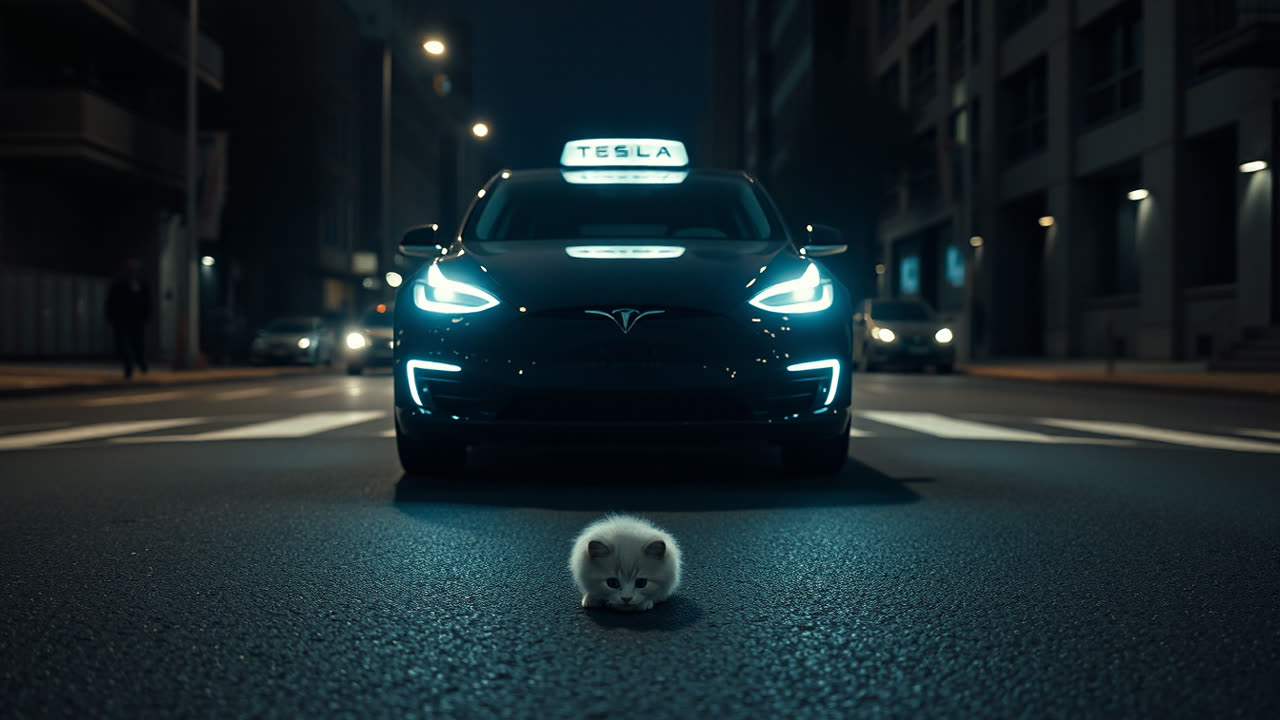
Elon Musk has openly acknowledged a significant hurdle for Tesla's Robotaxi ambitions: the inability of its camera-centric autonomous driving system to reliably detect low-contrast objects, specifically small animals like "grey kittens on grey tarmac," during nighttime operations. This candid admission, made as Tesla's Robotaxi service in Austin recently extended its operating hours to 11 PM, highlights a fundamental limitation of vision-only autonomy and reignites the long-standing debate over sensor suites in self-driving vehicles. Musk's example underscores a "low-light, low-contrast detection problem," a textbook weakness of camera systems, which he implicitly suggests lidar and radar are designed to handle.
This revelation is particularly striking given Musk's historical dismissal of lidar (Light Detection and Ranging) as a "fool's errand" and an "expensive, unnecessary crutch" for autonomous driving. For years, Tesla has championed a "pure vision" approach, asserting that neural networks fed by optical cameras could replicate and surpass human driving capabilities. While Tesla's Full Self-Driving (Supervised) system has shown improvements in low-light scenarios, with recent software updates enhancing neural network vision encoders for "rare and low-visibility scenarios," the challenge of accurately perceiving all objects in extreme darkness persists. The system still requires an attentive driver ready to intervene, particularly in conditions of low visibility or complex interactions with other road users.
The implications for users are substantial. The primary goal of Robotaxi services is ubiquitous, safe, and on-demand autonomous transportation. Tesla's Robotaxi service, which launched limited operations in Austin, Texas, in June 2025 and expanded to Dallas, Houston, Miami, Orlando, and Tampa by July 2026, relies on a fleet primarily consisting of Model Y vehicles, with purpose-built Cybercabs recently introduced in Austin. While the fleet has surpassed 1 million unsupervised miles as of September 2026, the inability to operate safely and consistently during all night hours directly impacts service availability and revenue potential. More critically, it raises significant safety concerns for vulnerable road users, including pets, pedestrians, and cyclists, who are inherently harder to detect in low-light conditions.
For the broader autonomous vehicle industry, Musk's statement offers a degree of validation for the multi-sensor approach widely adopted by Tesla's competitors. Companies like Waymo and Cruise have long integrated a robust suite of sensors, including lidar, radar, and high-resolution cameras, to create a comprehensive 360-degree environmental perception system. Waymo's sixth-generation Driver, for instance, combines 13 cameras, four lidars, and six radar units to identify objects up to 500 meters away in darkness or adverse weather conditions, demonstrating a capability to "see" where cameras alone might struggle. Lidar's ability to emit laser pulses and construct precise 3D maps of surroundings, independent of ambient light, directly addresses the low-contrast, low-light problem that Tesla is now acknowledging. Radar further complements this by accurately measuring object distance and velocity, even through rain, fog, and snow.
The ongoing advancements in lidar technology also make its integration increasingly feasible. The lidar market is projected to grow significantly, from USD 3.11 billion in 2025 to USD 44.51 billion by 2035, with a compound annual growth rate of 30.7% from 2026 to 2035. Crucially, the cost of lidar sensors has steadily decreased, with high-resolution, automotive-grade units ranging from $600 to $1,500 USD per sensor in 2025, and projections for further reductions through solid-state lidar advancements. This mitigates one of Musk's primary historical objections to the technology.
Looking ahead, this admission from Tesla could signal a potential, albeit gradual, shift in its hardware strategy. While Tesla's Autopilot Director, Ashok Elluswamy, publicly reinforced the company's vision-only stance as recently as April 2026, the practical limitations now articulated by Musk may force a re-evaluation for achieving full Level 4/5 autonomy. Regulatory bodies are increasingly scrutinizing autonomous vehicle safety, with recent laws in California, effective July 2028, imposing stricter oversight and penalties for AVs that interfere with emergency services. The ability to demonstrate robust, all-conditions perception is paramount for widespread regulatory approval and public trust, especially after incidents involving other robotaxi operators.
Tesla faces a strategic choice: continue to invest massively in refining its vision AI to overcome these inherent low-light physical limitations, or acknowledge the complementary strengths of lidar and radar by integrating them into future hardware iterations. The latter would represent a significant pivot but could accelerate the path to truly unsupervised, all-weather, 24/7 Robotaxi operations. While a retrofit of existing vehicles might be challenging, future Cybercabs and Model Ys could potentially incorporate these sensors. The market is increasingly demanding "superhuman" safety from autonomous vehicles, a benchmark that may require the combined strengths of multiple sensing modalities rather than a single, albeit highly advanced, vision system. The coming years will reveal if Tesla's commitment to "pure vision" remains absolute, or if practical safety and operational demands will prompt a more diversified sensor approach for its ambitious Robotaxi network.