Near-Packaged Optics Overtakes Co-Packaged Optics as Data Centers Pivot for AI
As Co-Packaged Optics faces significant integration hurdles, the industry is rapidly adopting Near-Packaged Optics as the pragmatic solution for escalating AI/ML demands in hyperscale data centers.
✨ This content was summarized and interpreted by AI; it may contain errors — please verify accuracy with the original sources. Learn more
Listen to this story
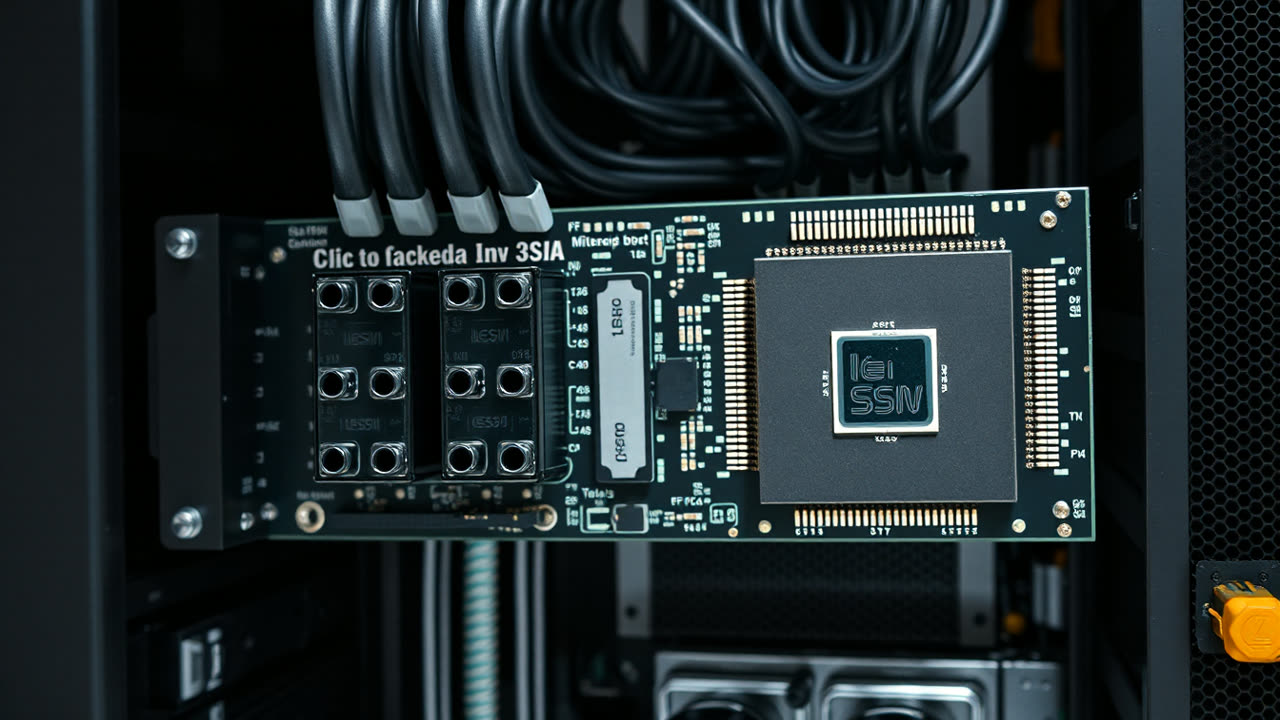
The industry is rapidly pivoting towards Near-Packaged Optics (NPO), with analysts predicting significant volume for NPO silicon photonics products extending until the end of the decade, as the inherent complexities and escalating "growing pains" of Co-Packaged Optics (CPO) become increasingly apparent. This strategic shift reflects a crucial hedging maneuver by hyperscalers and data center operators to manage the escalating demands of AI/ML workloads and high-bandwidth interconnects without fully committing to the more radical, and currently more challenging, integration model of CPO.
The core distinction between NPO and CPO lies in the proximity of the optical engine to the host ASIC. CPO integrates the optical transceivers directly onto the same substrate as the network switch ASIC or CPU, aiming for ultra-short electrical traces to minimize signal degradation, power consumption, and latency. However, this tight integration introduces formidable challenges in thermal management, manufacturing complexity, and testability. For instance, the differing thermal expansion coefficients of optical components and silicon can lead to reliability issues under operational stress. Furthermore, the "rip-and-replace" scenario for a failed optical engine within a CPO module is prohibitively expensive, often requiring the replacement of the entire switch ASIC, leading to significant downtime and cost implications. Early CPO deployments have highlighted these hurdles, slowing broader adoption despite its theoretical power and performance benefits.
NPO, by contrast, places the optical engines in a separate package, but still much closer to the host ASIC than traditional pluggable optics, often within the same line card. This "near" proximity still offers substantial improvements over traditional pluggables by shortening electrical traces from inches to millimeters, thereby reducing power consumption and improving signal integrity. A recent example is Broadcom's NPO implementation, where optical engines are packaged separately but placed adjacent to the switch ASIC. This approach allows for independent testing and replacement of the optical module, significantly de-risking deployment and maintenance compared to CPO. It also leverages existing manufacturing processes more readily, accelerating time to market and reducing initial capital expenditure.
The impact on data center infrastructure is profound. As data rates surge to 800GbE and beyond, the power consumed by electrical traces connecting traditional pluggable optics to the switch ASIC becomes a significant bottleneck, contributing to higher operational costs and increased heat generation. NPO addresses this by bringing the optical conversion closer, reducing power consumption for SerDes (serializer/deserializer) lanes by as much as 50% compared to traditional pluggables. This translates directly into lower energy bills and less strain on cooling infrastructure, which is a critical concern for hyperscale data centers grappling with ever-increasing rack densities and power footprints.
Moreover, NPO's modularity offers a strategic advantage in the rapidly evolving landscape of AI/ML. These workloads demand unprecedented bandwidth and low latency, often across vast GPU clusters. The ability to upgrade or replace optical engines independently of the main ASIC allows data center operators to adapt to new optical standards or higher speeds without undertaking a complete system overhaul. This flexibility provides a crucial hedge against rapid technological obsolescence, offering a more palatable upgrade path than the all-or-nothing proposition of CPO.
While CPO remains an aspirational goal for ultimate power efficiency and density, its current challenges in thermal management, manufacturing yield, and repairability have made NPO the more pragmatic and commercially viable solution for the near to medium term. Companies like Broadcom, NVIDIA, and Intel are actively investing in silicon photonics technologies that underpin both NPO and CPO, but the current market momentum clearly favors NPO for volume deployment. NVIDIA's Spectrum-X platform, for instance, utilizes NPO to deliver high-bandwidth, low-latency connectivity for AI clusters, demonstrating its immediate applicability and performance benefits in real-world scenarios.
Looking ahead, NPO is not merely a stopgap but a foundational step. The ongoing refinement of silicon photonics technology, including advancements in integrating lasers directly onto silicon and improving coupling efficiencies, will further enhance NPO's performance envelope. While CPO's long-term promise for ultra-dense, low-power interconnects in future exascale computing or specialized applications remains, NPO is projected to dominate the high-volume data center market through the end of the decade. The lessons learned from NPO deployments – particularly around thermal management, packaging, and optical coupling – will undoubtedly inform and accelerate the eventual maturation of CPO, suggesting a future where both technologies coexist, each optimized for different segments of the optical interconnect market. This pragmatic evolution reflects an industry prioritizing deployability and maintainability without compromising the relentless pursuit of higher bandwidth and lower power.