NHTSA Demands Tesla Prove Cybercab Safety Under Oath, Threatening Robotaxi Launch
The National Highway Traffic Safety Administration has issued an unprecedented Special Order to Tesla, demanding the automaker provide sworn proof that its radical driverless Cybercab complies with federal safety standards, posing a critical challenge to its ambitious robotaxi service.
✨ This content was summarized and interpreted by AI; it may contain errors — please verify accuracy with the original sources. Learn more
Listen to this story
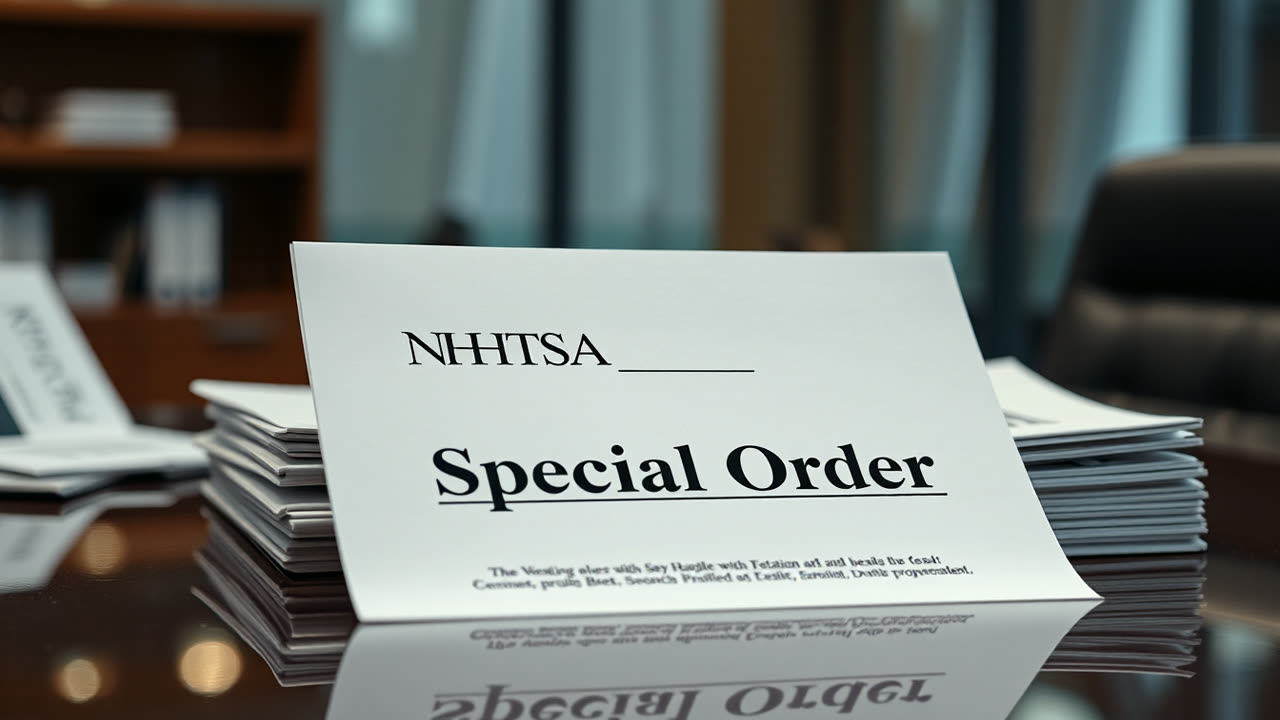
The National Highway Traffic Safety Administration (NHTSA) issued a formal Special Order to Tesla on September 10, 2026, demanding the automaker prove, under oath, that its proposed Cybercab autonomous vehicle complies with federal safety standards for sale in the United States, a critical regulatory challenge for Tesla's ambitious robotaxi service. This unprecedented directive centers on the Cybercab's radical design, which reportedly eliminates traditional driver controls such as a steering wheel, pedals, and mirrors, directly clashing with long-established Federal Motor Vehicle Safety Standards (FMVSS). The agency's move underscores a growing regulatory scrutiny of Level 4 and Level 5 autonomous vehicles that aim to operate without any human intervention or provision for manual override.
This Special Order is not merely a procedural step; it represents a significant roadblock for Tesla’s highly anticipated robotaxi network, which CEO Elon Musk has touted as a cornerstone of the company’s future valuation and a revolutionary shift in urban mobility. The requirement to certify legality under oath places a direct and immediate burden on Tesla to demonstrate how a vehicle devoid of conventional controls can meet existing safety mandates or justify an exemption. Such an exemption, if granted, would be a landmark decision, potentially setting a precedent for other autonomous vehicle developers but also requiring extensive data and safety assurances from Tesla that go beyond typical certification processes.
The implications for users are profound. A successful Cybercab deployment promises unprecedented convenience and potentially lower transportation costs by removing the human driver, offering an on-demand, fully autonomous ride-hailing experience. However, the regulatory challenge highlights fundamental questions about passenger safety, liability in the absence of a driver, and the public's trust in truly driverless technology. If Tesla fails to satisfy NHTSA, the launch of Cybercab could be significantly delayed, forcing design compromises or even a fundamental re-evaluation of its fully autonomous vision, potentially impacting consumer access to this futuristic transport model for years.
For the industry, NHTSA's Special Order sends a clear signal that regulatory bodies are taking a firm stance on the deployment of truly driverless vehicles, moving beyond conditional testing permits to scrutinize commercial viability and adherence to safety standards. Unlike competitors such as Waymo and Cruise, which have largely focused on Level 4 autonomous vehicles that still retain some emergency manual override capabilities or operate within geo-fenced areas with remote human supervision, Tesla's Cybercab aims for a completely driverless design intended for widespread public use. Waymo's vehicles, for instance, operate with traditional controls, albeit with the human driver often disengaged, allowing them to fit more readily into existing FMVSS categories. Cruise and Zoox have also sought exemptions for vehicles without traditional controls, but their operational scale and design specifics may differ from Cybercab's ambitious scope. Tesla's prior Full Self-Driving (FSD) beta, while advanced, still requires active human supervision and has been subject to its own regulatory and safety investigations, indicating NHTSA's increasing vigilance over Tesla's autonomous claims. This new order elevates the regulatory hurdle significantly, demanding proof of compliance for a vehicle designed from the ground up to operate without any human intervention points.
Historically, NHTSA has granted limited exemptions for novel vehicle designs, but these are typically temporary and come with stringent conditions and data reporting requirements. For a vehicle intended for mass production and widespread public use, a comprehensive exemption or a reinterpretation of existing FMVSS would be necessary, a process that is often lengthy and politically charged. The agency’s demand for proof "under oath" signifies the seriousness of its concerns, suggesting that Tesla's previous assertions or data may not have fully addressed the regulatory ambiguities surrounding a truly driverless platform.
Looking ahead, the outcome of this Special Order will be a bellwether for the entire autonomous vehicle industry. If Tesla can successfully navigate this regulatory labyrinth, it could pave the way for other companies to pursue similar designs, accelerating the transition to fully autonomous mobility. However, failure could lead to substantial delays, increased development costs, and potentially force Tesla to redesign the Cybercab to include at least minimal human interface controls, diluting its revolutionary appeal. This situation also highlights the urgent need for updated federal regulations specifically tailored to Level 4 and Level 5 autonomous vehicles, as current standards were largely drafted with human-driven vehicles in mind. The coming months will likely see Tesla engaging in intense dialogue with NHTSA, providing detailed technical specifications, safety analyses, and potentially advocating for new regulatory frameworks. The future of driverless transportation, particularly one without any human controls, hinges significantly on this crucial regulatory showdown.