Northrop Grumman's Robotic Vehicle to Attempt First In-Orbit Thruster Replacement
The Mission Robotic Vehicle (MRV) will attach a new thruster to an aging satellite, marking an unprecedented step in extending orbital asset life and transforming space economics.
✨ This content was summarized and interpreted by AI; it may contain errors — please verify accuracy with the original sources. Learn more
Listen to this story
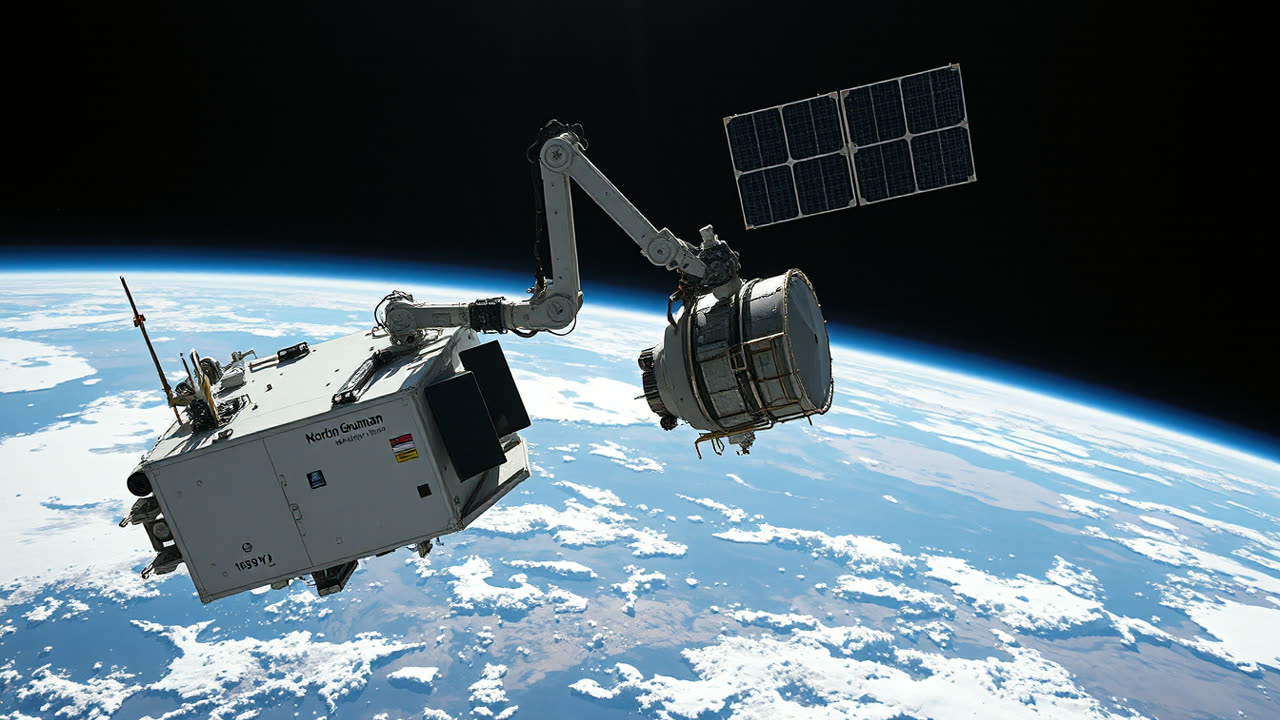
The Northrop Grumman Mission Robotic Vehicle (MRV) is poised to fundamentally alter the economics and sustainability of in-orbit operations, commencing its inaugural mission to attach a new thruster to an aging satellite, a critical maneuver that could extend the operational life of orbiting assets by years. This unprecedented undertaking, initiated in late 2025 following its launch aboard a SpaceX Falcon 9, represents a significant leap from previous satellite servicing efforts, moving beyond simple repositioning or life-extension through propulsion top-offs to actual component replacement and upgrades in the harsh vacuum of space. The target satellite, whose identity remains undisclosed for proprietary reasons, will receive a Mission Extension Pod (MEP), essentially a bolt-on propulsion system, demonstrating a modular approach to satellite maintenance that promises to unlock new efficiencies for both commercial and government operators.
This mission's success carries profound implications for the satellite industry, which faces mounting pressures from escalating launch costs, the increasing volume of space debris, and the imperative for sustained, reliable satellite services. Historically, a satellite's end-of-life was dictated by the depletion of its propellant or the failure of critical components, leading to costly replacements and the addition of more inactive objects to Earth's orbital environment. The MRV, equipped with advanced robotic arms and sophisticated AI-driven navigation, offers a paradigm shift: instead of decommissioning a still-functional satellite due to a single point of failure or fuel exhaustion, operators can now consider in-orbit repair or refueling. This capability translates directly into higher return on investment for satellite owners, as assets can remain operational for longer periods, deferring the multi-million dollar expense of designing, building, launching, and commissioning a replacement. For users, this means enhanced continuity of critical services, from global communications and navigation to Earth observation and scientific research, minimizing disruptive service gaps caused by satellite retirement.
The MRV builds upon the pioneering work of Northrop Grumman's Mission Extension Vehicles (MEV-1 and MEV-2), which successfully docked with and provided propulsion services to Intelsat's IS-901 and IS-10-02 satellites, respectively, effectively extending their operational lives by several years. While the MEVs acted as "tugboats" or external propulsion modules, the MRV represents a more versatile "mechanic". Its robotic arms, developed in collaboration with DARPA's Robotic Servicing of Geosynchronous Satellites (RSGS) program, are designed for intricate manipulation, enabling tasks like inspection, repair, and component installation. This advanced functionality positions Northrop Grumman at the forefront of a nascent but rapidly expanding in-orbit servicing market, distinguishing it from competitors primarily focused on refueling or orbital transfer services. Rivals like Astroscale, for instance, are heavily invested in debris removal and satellite life extension through refueling, while others like Orbit Fab aim to establish a "gas station in space". The MRV, however, introduces a level of mechanical intervention that few others currently offer, setting a new benchmark for complexity and capability in orbital maintenance.
Looking ahead, the successful demonstration of thruster attachment will likely catalyze a broader adoption of in-orbit servicing strategies across the space industry. The immediate next steps will involve validating the long-term performance of the attached MEP and monitoring the thruster's operational efficiency. Beyond this initial mission, the MRV's modular design and robotic dexterity suggest a future where satellites are no longer disposable but upgradeable. This could lead to the development of standardized, interchangeable components for future satellites, making them inherently more serviceable. We may see a shift towards "on-demand" upgrades, where new sensor packages or communication modules are installed in orbit to adapt to evolving technological landscapes or mission requirements. Furthermore, the data gathered from the MRV's operations will be invaluable for refining robotic capabilities for even more complex repairs, potentially including the replacement of delicate electronics or structural components. This technological progression is not merely about extending satellite life; it's about fostering a more sustainable, resilient, and economically viable space ecosystem, paving the way for a future where orbital infrastructure is maintained and evolved rather than simply replaced.