Northwestern University's 'Phantom Twist' Drone Achieves Near-Invisibility Through Extreme Rotation
Researchers at Northwestern University have engineered a drone, dubbed 'Phantom Twist,' that achieves near-invisibility by spinning its entire body at extreme velocities, blurring itself into its surroundings.
✨ This content was summarized and interpreted by AI; it may contain errors — please verify accuracy with the original sources. Learn more
Listen to this story
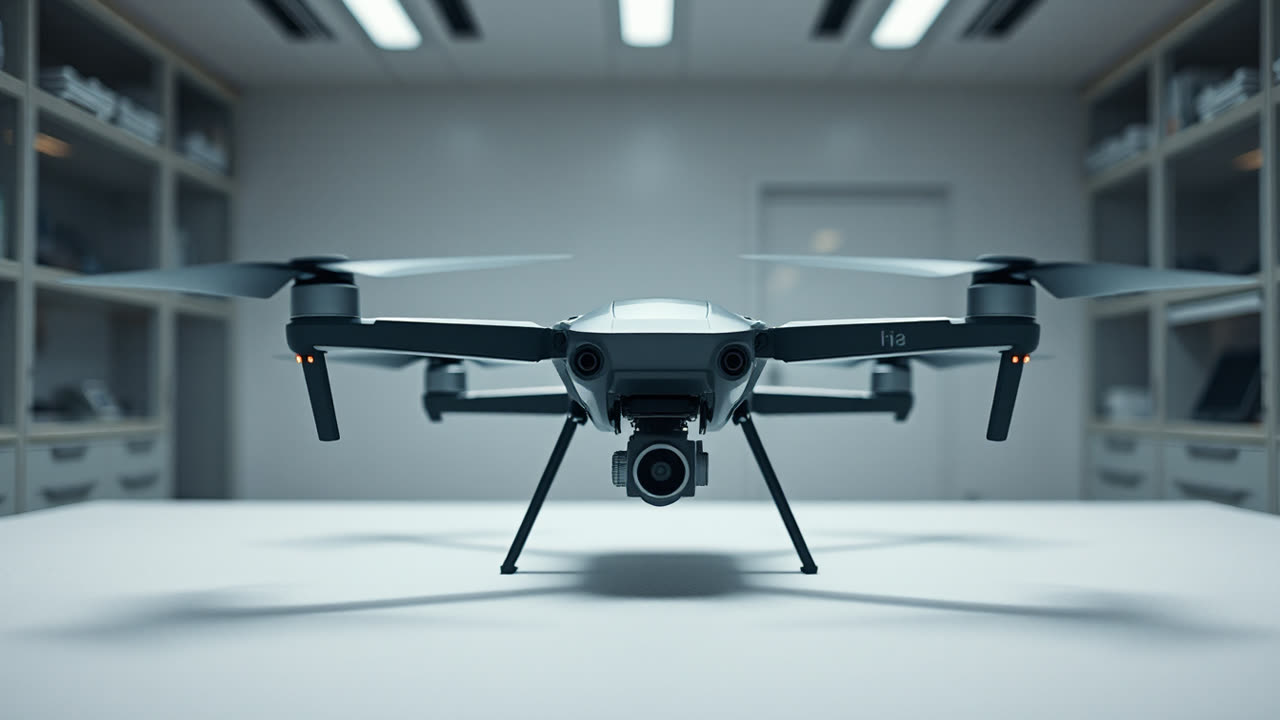
Northwestern University researchers have engineered a drone, dubbed "Phantom Twist," that achieves near-invisibility through extreme rotational velocity, blurring itself into its surroundings via a phenomenon akin to a rapidly spinning propeller disappearing to the naked eye. This novel approach, detailed by the team, fundamentally redefines drone stealth, moving beyond traditional radar-evading designs or acoustic dampening to exploit the limits of human visual perception and camera frame rates. Unlike conventional drones that rely on static or slowly moving airframes, the Phantom Twist's core innovation lies in its ability to spin its entire body at speeds so high that its physical form is optically obscured, presenting a diffuse, ghost-like image rather than a solid object. This effect is achieved by a unique aerodynamic design that allows the entire drone chassis to rotate rapidly while maintaining stable flight, a significant engineering feat given the inherent challenges of gyroscopic forces and control.
The implications of this visual cloaking mechanism are profound, offering a paradigm shift for applications demanding discreet operation, from advanced surveillance and reconnaissance to potentially minimizing visual distraction in urban delivery scenarios. For military and intelligence agencies, the ability to deploy a visually undetectable aerial platform represents a considerable advantage, making it significantly harder for adversaries to track, identify, or even confirm the presence of an airborne threat. Current stealth drones, such as the RQ-170 Sentinel or the more recently developed Kratos XQ-58A Valkyrie, focus on reducing radar cross-section and infrared signatures, but remain visually discernible, especially in close proximity or with optical aids. The Phantom Twist, conversely, tackles the visual spectrum directly, creating a "motion blur cloak" that could render it practically invisible against complex backgrounds or during rapid maneuvers. This could drastically reduce detection probabilities in contested airspace or sensitive zones, forcing a re-evaluation of current counter-drone strategies which often rely on electro-optical/infrared (EO/IR) systems for positive identification.
Beyond military applications, the technology holds significant promise for civilian and commercial sectors where visual intrusion is a concern. Imagine drones performing infrastructure inspections, delivering packages, or monitoring environmental conditions without drawing undue attention or causing alarm. This could foster greater public acceptance of drone operations, particularly in densely populated areas where the sight and sound of conventional drones are often met with apprehension. The visual unobtrusiveness could also be a game-changer for wildlife monitoring, allowing researchers to observe animals in their natural habitats with minimal disturbance. Furthermore, the inherent rotational stability required for such high-speed spinning could lead to advancements in drone aerodynamics and control systems, potentially influencing future drone designs across the industry.
This innovation stands in stark contrast to prior generations of drone stealth, which primarily focused on material science (radar-absorbent coatings), airframe shaping (faceted designs to scatter radar waves), and acoustic signature reduction (quieter propellers, electric propulsion). While these methods reduce detectability by specific sensors, they do not address the fundamental visual presence of the drone. The Phantom Twist’s approach is analogous to a helicopter rotor, which, despite being a solid object, appears as a shimmering disc when in motion. The challenge for the Northwestern team was to extend this principle to the entire drone body while maintaining directional control and payload capacity. Early reports suggest the drone utilizes a unique propulsion system that allows for this full-body rotation without compromising flight stability, possibly involving counter-rotating components or advanced gyroscopic stabilization algorithms. Details regarding its power source and potential flight duration remain under wraps, but achieving sustained high-speed rotation would necessitate efficient power management.
Looking ahead, the development of the Phantom Twist signals a new frontier in drone design, where visual perception becomes as critical a stealth vector as radar or infrared. The immediate next steps for the Northwestern team will likely involve refining control algorithms for various flight conditions, optimizing the rotational speed for maximum blur effect versus power consumption, and exploring methods to integrate useful payloads without disrupting the aerodynamic balance. Commercialization pathways could involve licensing the core technology to defense contractors or specialized industrial drone manufacturers. However, significant challenges remain, including the potential for increased acoustic signatures at extreme rotational speeds, the impact of high G-forces on internal components, and the development of robust vision systems that can operate effectively from a rapidly spinning platform. The regulatory landscape will also need to adapt to visually "invisible" drones, raising new questions about identification, tracking, and air traffic management. Nevertheless, the Phantom Twist marks a compelling leap forward, demonstrating that the future of drone technology is not just about flying higher or faster, but also about disappearing into plain sight.