NVIDIA AI Unveils ASPIRE: A Self-Improving Robotics Framework with Groundbreaking Zero-Shot Performance
NVIDIA AI's new ASPIRE framework dramatically boosts robot learning, achieving a 31% zero-shot success rate on complex unseen tasks, a significant leap from previous methods.
✨ This content was summarized and interpreted by AI; it may contain errors — please verify accuracy with the original sources. Learn more
Listen to this story
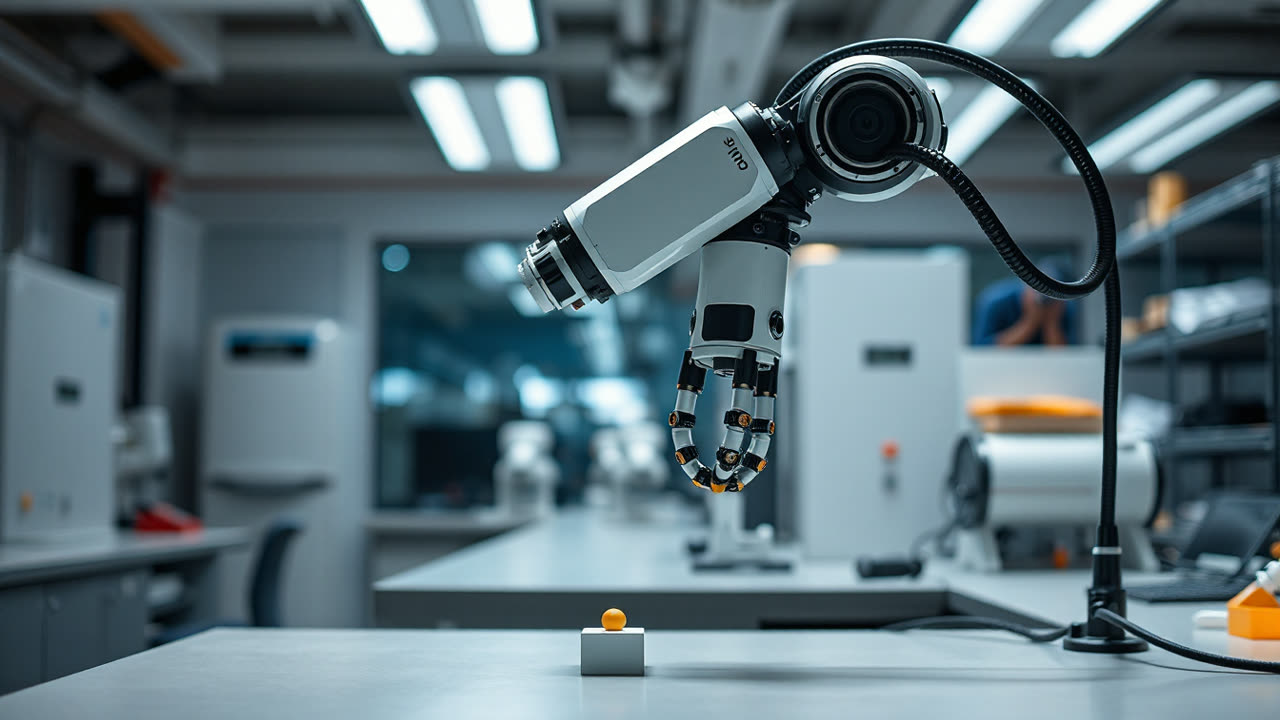
NVIDIA AI has unveiled ASPIRE, a groundbreaking self-improving robotics framework that achieves a remarkable 31% zero-shot success rate on previously unseen long-horizon tasks in the LIBERO-Pro benchmark, a substantial leap over prior methods that typically plateaued at 4%. This innovative system, developed in collaboration with universities including the University of Michigan, UIUC, and UC Berkeley, fundamentally redefines how robots learn and adapt, marking a pivotal moment in the evolution of autonomous systems.
ASPIRE, short for Agentic Skill Programming through Iterative Robot Exploration, empowers robots to autonomously write and refine their own control programs using a "code-as-policy" paradigm. Unlike traditional approaches that offer only coarse feedback, ASPIRE employs a closed-loop execution engine that provides fine-grained, multimodal traces for every perception, planning, and control call. This detailed information allows the agent to precisely diagnose failures, synthesize effective repairs, and validate these fixes through re-execution. Crucially, validated solutions are then distilled into a continually expanding, reusable skill library, ensuring that robots accumulate experience and become progressively more effective over time, rather than starting from scratch for each new challenge. An evolutionary search procedure further enhances this learning by generating diverse task sequences for iterative debugging and refinement.
The framework's performance gains are not limited to zero-shot generalization. ASPIRE has also demonstrated significant improvements on established benchmarks, boosting success rates by up to 77 points on LIBERO-Pro manipulation tasks and elevating the Robosuite bimanual handover task from a 20% to a 92% success rate. Furthermore, it improved long-horizon household tasks like radio pickup on BEHAVIOR-1K from 56% to 88%. This paradigm shift, where training evolves from gradient descent to continuous skill refinement, promises to dramatically accelerate the development of truly autonomous and adaptable robotic systems. The ability for skills to transfer from simulation to real-world scenarios, reducing real-robot programming effort, suggests a future where robots can master complex, novel tasks with unprecedented efficiency and less human intervention, paving the way for a new era of robotic capabilities.