NVIDIA DeepStream 9.1: Agentic AI Transforms Vision Analytics with 13 Skills and Automated 3D Tracking
NVIDIA's DeepStream 9.1, launched in July 2026, fundamentally redefines vision AI development by introducing 13 agentic skills, allowing AI coding assistants to build complex multi-camera solutions from natural language, a move that significantly democratizes advanced AI and solidifies NVIDIA's strategic hold on the evolving AI ecosystem.
✨ This content was summarized and interpreted by AI; it may contain errors — please verify accuracy with the original sources. Learn more
Listen to this story
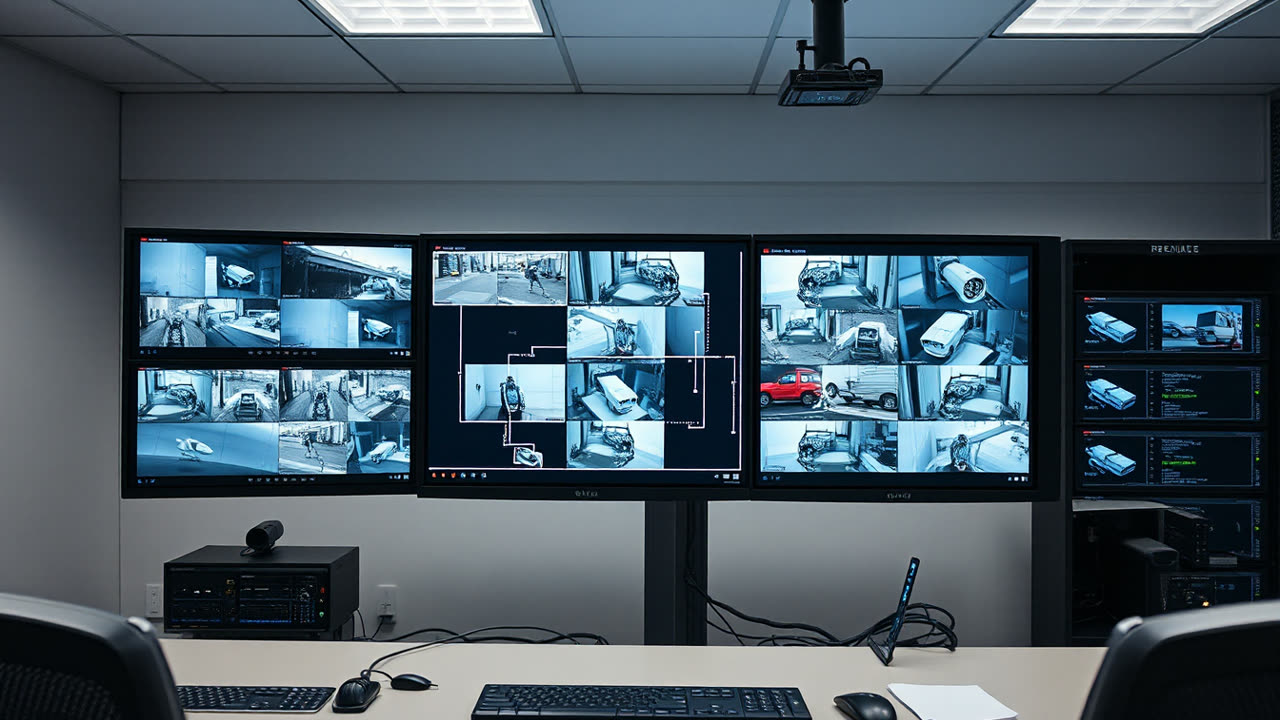
NVIDIA's DeepStream 9.1, released between July 13th and 16th, 2026, marks a significant evolution in vision AI, fundamentally reshaping how developers interact with complex video analytics pipelines. The update's most striking innovation is the introduction of 13 agentic skills, enabling AI coding assistants like Claude Code, Codex, and Cursor to construct multi-camera video analytics solutions from natural-language prompts. This paradigm shift, coupled with the advanced Multi-View 3D Tracking (MV3DT) and AutoMagicCalib (AMC) features, dramatically simplifies and accelerates the deployment of sophisticated AI-powered applications across diverse industries.
The core of DeepStream 9.1's appeal lies in its "agentic skills," a curated set of structured knowledge packages designed to guide AI coding assistants. Instead of requiring developers to manually write scripts or configure intricate GStreamer pipelines, these skills allow for the description of desired application behavior using plain English. The AI agent then handles the underlying setup, dependency resolution, configuration, and execution, generating architecturally sound Python `pyservicemaker` code. This capability democratizes access to advanced vision AI, moving it beyond the realm of specialized GStreamer and GPU programming experts. The impact on development cycles is immediate and profound, allowing engineers to focus on application logic and innovation rather than boilerplate code and complex SDK plumbing.
Central to the practical application of these agentic capabilities is the enhanced Multi-View 3D Tracking (MV3DT) system. Previous generations of video analytics often struggled with tracking objects reliably across multiple camera views, frequently losing track when an object exited a single camera's frame. MV3DT addresses this by fusing detections from several auto-calibrated cameras into a shared 3D coordinate system, ensuring a consistent object ID is maintained throughout an environment. This distributed architecture uses advanced multi-view association algorithms to project independently detected objects into a unified world-coordinate system, supporting detector models such as PeopleNetTransformer, PeopleNet v2.6.3, and RT-DETR 2D. Complementing MV3DT is AutoMagicCalib (AMC), a critical innovation that automates the traditionally labor-intensive and error-prone process of camera calibration. AMC automatically derives intrinsic parameters like focal length and lens distortion, along with extrinsic parameters such as spatial orientation, by analyzing object trajectories from synchronized video streams. This eliminates the need for manual checkerboard patterns and complex calculations, making large-scale multi-camera deployments significantly more feasible.
This release also brings substantial platform support, including NVIDIA Turing, Ampere, Hopper, Ada Lovelace, Blackwell, RTX Pro 4500 GPUs, and Jetson Orin (Nano, NX, AGX) and Jetson Thor embedded platforms. DeepStream 9.1 is also optimized for Ubuntu 24.04 LTS and supports TensorRT 10.16.0.72 for x86 systems and TensorRT 10.16.1.7 for Jetson. A notable change in distribution is the transition to a unified GitHub mono-repo (github.com/NVIDIA/DeepStream) for all SDK sources, packages, samples, and tools, with SDK packages now available as GitHub Release assets, rather than through NGC.
NVIDIA's strategy with DeepStream 9.1 extends beyond mere feature upgrades; it represents a calculated move within its broader Metropolis platform to drive hardware adoption through software innovation. By open-sourcing these modular skills, NVIDIA is cultivating a developer ecosystem deeply integrated with its GPU infrastructure, mirroring the successful CUDA strategy that has historically created a significant software lock-in, challenging competitors like AMD and Intel. This approach positions DeepStream as a cornerstone for building end-to-end services that transform real-time sensor data into actionable insights, crucial for applications in retail analytics, warehouse safety, smart city infrastructure, and patient monitoring.
The industry is currently experiencing an "agentic AI inflection point," as noted by NVIDIA CEO Jensen Huang, where AI systems are becoming capable of autonomous, multi-step task execution. DeepStream 9.1's agentic skills are a direct manifestation of this trend, enabling AI agents to plan, reason, and take actions in software environments, adapting to new information without constant human intervention. This shift is expected to fuel a new wave of demand for specialized AI accelerators beyond traditional GPUs, such as Language Processing Units (LPUs), designed for high-value agentic inference. NVIDIA's commitment to continuously pushing "additional skills" suggests an ongoing expansion of these capabilities, further entrenching its position in the evolving AI landscape. The integration of agentic AI into vision systems is not merely an incremental improvement but a foundational change, promising to unlock unprecedented levels of automation and intelligence in physical AI and edge computing.